
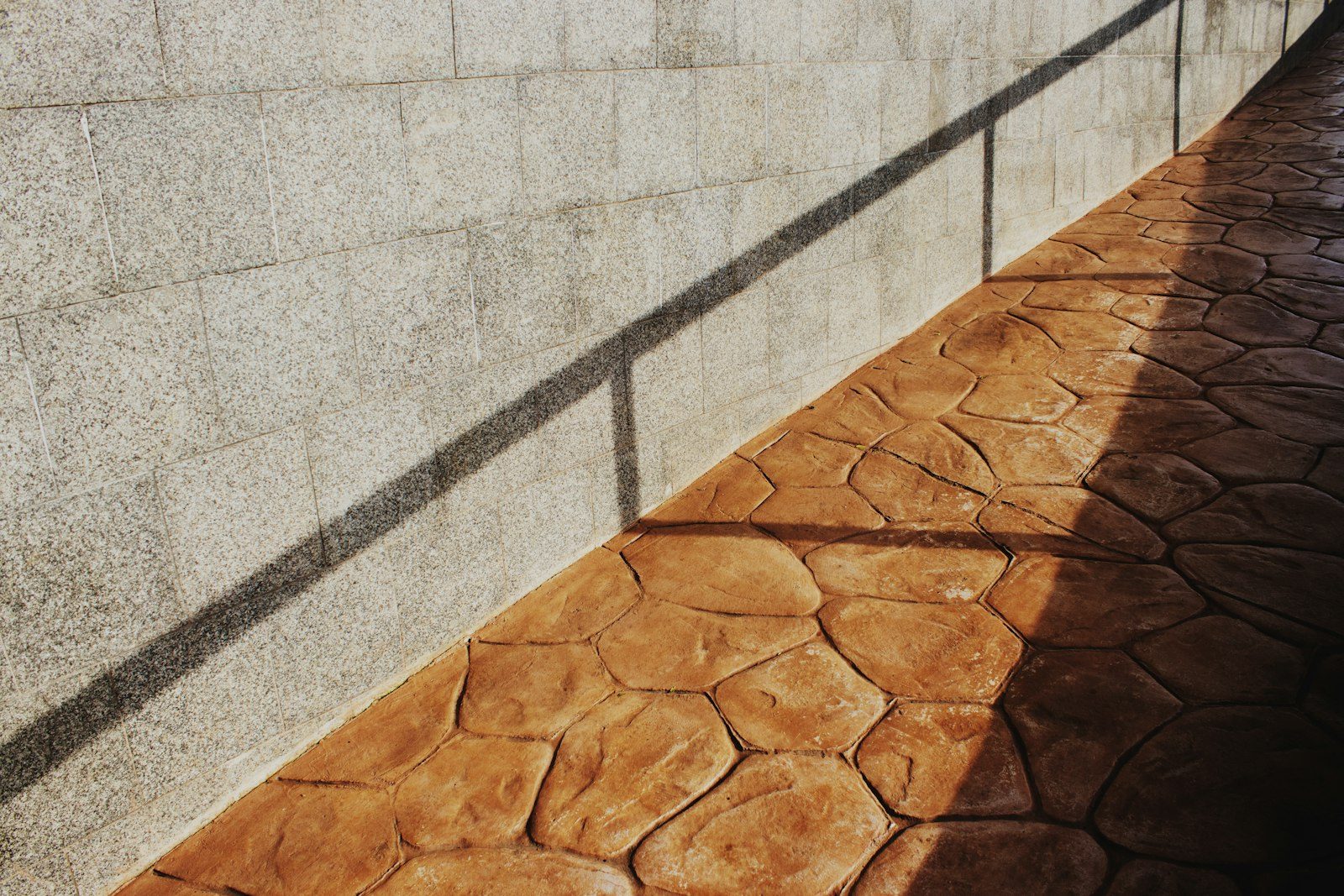
The cheapest design decision in concrete, and the one most often bought in the wrong size.
Scoring is the least expensive way to make a slab look like somebody designed it, and that isn't a sales line, it's arithmetic. You're already paying for concrete, forms, base, steel, and a crew standing in your yard. Score lines add layout and saw time to a job that's happening anyway, and they change how the surface reads from the porch.
What that adds up to depends almost entirely on decisions you make before a blade spins. Straight lines are quick. Curves are not. A simple grid across a rectangular patio is an hour of cutting. A radial pattern with a border, a field, and a feature in the middle is a day. Both are legitimate. You just want to know which one you're buying and why.
Cutting is the fast part. Layout is not. Snapping accurate lines, squaring a pattern to a house that isn't square, and adjusting so the border comes out even on all four sides takes real time, and it's the whole difference between a pattern that looks drawn and one that looks approximated. That happens with chalk and a tape before anybody puts on ear protection.
After layout, the drivers are linear feet, blade wear, and cleanup. Green cutting on pour day is fastest and cleanest. Cutting cured concrete means a wet saw, slurry that has to be contained and hauled, and blades that wear at a different rate. Neither is wrong. They're different days and they price differently.
Here's the distinction that decides whether a scored slab ages well. A control joint is structural. Roughly a quarter of the section deep, placed where the concrete is going to crack anyway, so that it cracks along a line somebody chose. A decorative score is shallow, often an eighth of an inch, and it does nothing whatsoever about cracking. It's a drawing.
Mix those up and here's the outcome: a slab full of pretty lines that cracks somewhere else entirely. So we lay out the real joints first, from slab dimensions and where the panels want to break, then build the pattern around them until the structural cuts vanish into the design. Done right, you can't tell which lines are working. Done backward, you can, and you will for thirty years.
One simple, one ambitious, so you can see what the difference buys. (303) 569-4046.
| The choice | What it adds on site | Our read on the value |
|---|---|---|
| Curves and radius work | Freehand cutting, slower passes, more blade changes, a cleanup pass | Worth it at a front entry you see daily. Rarely worth it on a side walk. |
| A border with a field inside | Extra layout, two cut depths, careful corners | Best value on this list. It makes a plain slab read as finished. |
| Small-scale patterns | Linear feet climbs fast. Halving the grid roughly doubles the cutting. | Looks sharp up close, invisible from twenty feet. Go bigger than you think. |
| Cutting a cured slab instead of a fresh pour | Wet sawing, slurry containment, and matching a weathered surface | Still far cheaper than replacing. Just don't expect it to look new. |
| Color or stain worked into the grooves | A separate day, masking, and a sealer schedule after | Worth doing once. Budget the reseal, because grooves show wear first. |
| Sealing the finished pattern | Another trip out if it wasn't planned into the job | Do it with the scoring. Coming back later always costs more. |
Most people ask for a tighter pattern than they actually want. We chalk it full size, stand back on the porch with them, and nine times out of ten they go a size bigger. Costs less, looks better. Rare combination in this trade.Straight from the crew
The work splits along the age of the housing. Around Perry Park and Sage Port we're usually cutting slabs that have been down for years: an entry landing that needs scale, a long walk that reads like a runway, a patio poured plain. Those are wet-saw jobs, and the pattern has to work with a surface that already carries its own color and wear. Bear Dance is mostly newer flatwork, cut fresh on pour day with no slurry to chase.
Timing is simple. Green cutting happens whenever we're pouring, which outdoors means late May into early October. Cutting an existing slab wants dry weather, temperatures above freezing, and concrete that isn't holding moisture, so roughly the same window with a little stretch on either end. Interior floors run year round. If you want the pattern colored and sealed, plan two visits and leave season enough for the sealer to cure.
Still unsure about something?
Call the crew at (303) 569-4046 and we will talk it through.
Get a free, no-obligation estimate from a crew that knows Colorado soil, Colorado weather, and how to finish concrete that lasts.
Accessibility
Adjust the site to fit how you read and browse. Your choices are saved on this device.