
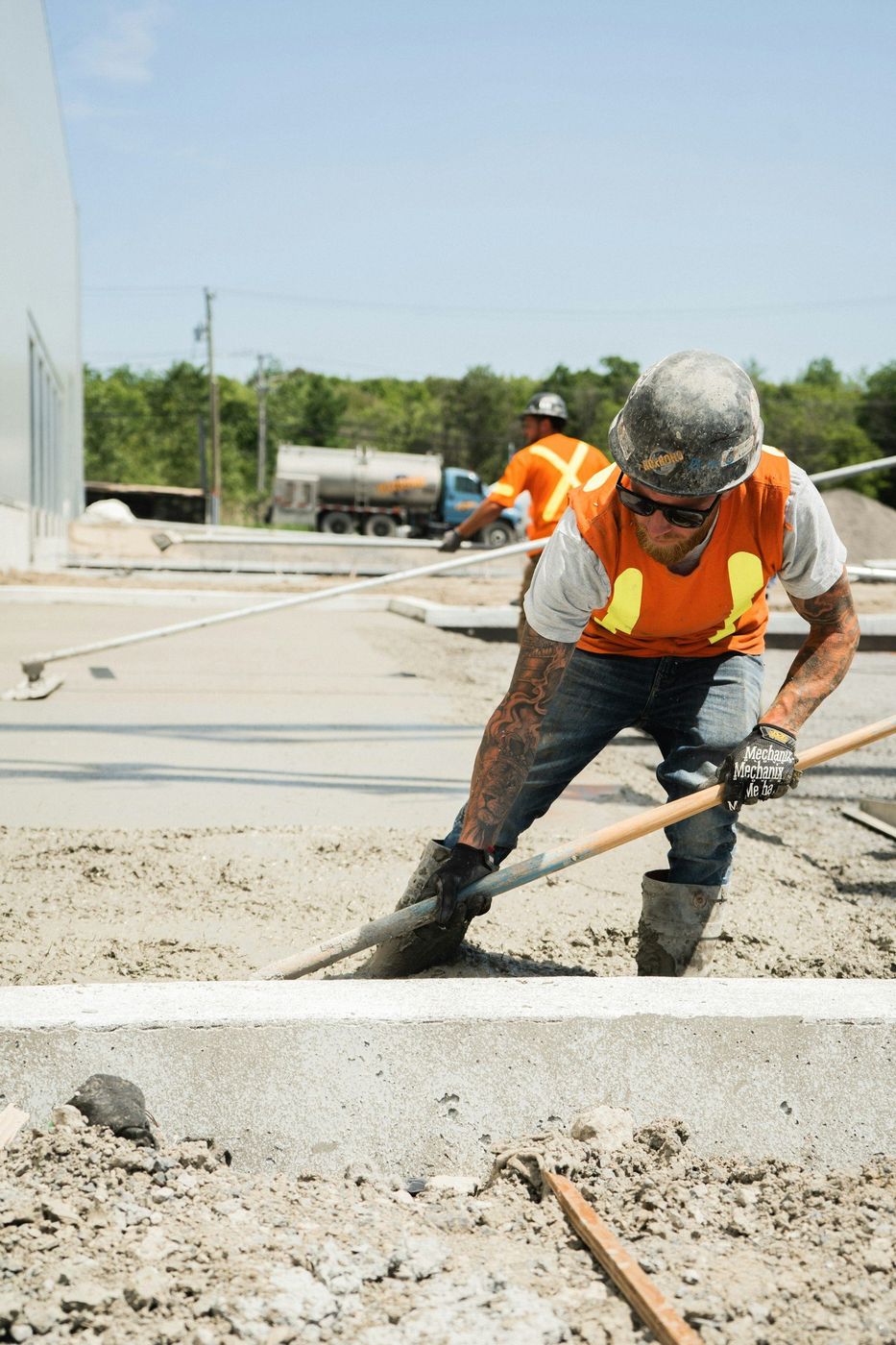
A quarter inch of topping has no mass to hide behind. The weather gets a vote on every one of them.
Picture a Thursday in late June. Eighty-four degrees, humidity somewhere in the teens, a steady breeze working through the pines. Gorgeous day. Terrible day to place a quarter inch of cement topping, because in that air a thin overlay can skin over before the crew reaches the far edge, and a topping that skins early bonds badly and cracks early.
Overlays are weather work more than any other decorative job we do. A four-inch slab has mass and time on its side. A bonded topping has neither. It's thin, it's exposed across every square inch, and the water it needs to cure properly is trying to leave the entire time. That's why the forecast is part of our spec, not an afterthought.
Three things pull water out of a fresh surface: heat, wind, and dry air. At 6,720 feet we routinely get all three at once, and the combination does more damage than any of them alone. Wind is the sneaky one. A breeze you'd call pleasant can double the evaporation rate off a slab, and the topping loses the moisture it needed to hydrate before it ever finishes setting.
The substrate matters just as much. A dark slab that's been in full sun since ten in the morning is a hot plate, and a thin topping placed on it flashes off from underneath. So we read the concrete temperature, not the air temperature, and if the slab is too warm we either shade it, cool it, or come back at dawn. There isn't a product on the market that fixes a substrate you placed on at the wrong hour.
Every overlay failure we get called to comes down to one of two things: the topping dried too fast, or it never really stuck. The second one is preventable with a machine. We shot blast or grind the old surface to open the pores, then vacuum it clean, then bring it to saturated surface dry so the slab isn't pulling water out of the fresh material. On some systems a bonding slurry goes down first and the topping follows it wet on wet.
What we don't do is acid etch a driveway and call it prep. Etching leaves residue, it doesn't create real profile, and every bit of it ends up between your new surface and your old one. Skip the blast and you've bought a topping that will sound hollow under a knuckle within two seasons and start letting go at the edges the winter after.
A few photos and a description usually tell us whether a topping is honest advice. (303) 569-4046.
| When | What we're fighting | How we work around it |
|---|---|---|
| April into mid-May | Cold nights, damp substrate, one more snow | Watch overnight lows, work sunny exposures first, blankets on the trailer |
| Late May and June | Dry air, wind, fast evaporation | Dawn starts, damp substrate, retarder, small batches |
| July and August | Surface heat and afternoon storms | Off the slab before the cells build, shade the work, cool water |
| September to early October | Nothing much. Best window of the year. | Warm days, cool nights, real cure time before the first hard freeze |
| Mid-October onward | Freezing before the topping is cured and sealed | Interior overlays only. Exterior work waits for spring. |
An overlay is a wearing surface, not a structural repair, and that line decides most of these calls. Worn, dusting, lightly scaled concrete that sits flat and drains correctly is a good candidate. So is a builder-grade patio somebody wants textured and colored. Cracked and moving concrete is not, and neither is a slab that has settled, because the new surface inherits every problem underneath it within a year.
Around Perry Park and Sage Port the usual job is an older patio or porch landing whose top half inch has given up while the slab beneath it is still sound. Those are satisfying. Bear Dance calls are typically newer flatwork that was poured plain and now needs to match a finished landscape. Either way we knock around on it, look at the joints, check the fall, and give you a straight answer: real fix, or delay tactic.
Still unsure about something?
Call the crew at (303) 569-4046 and we will talk it through.

Get a free, no-obligation estimate from a crew that knows Colorado soil, Colorado weather, and how to finish concrete that lasts.
Accessibility
Adjust the site to fit how you read and browse. Your choices are saved on this device.