
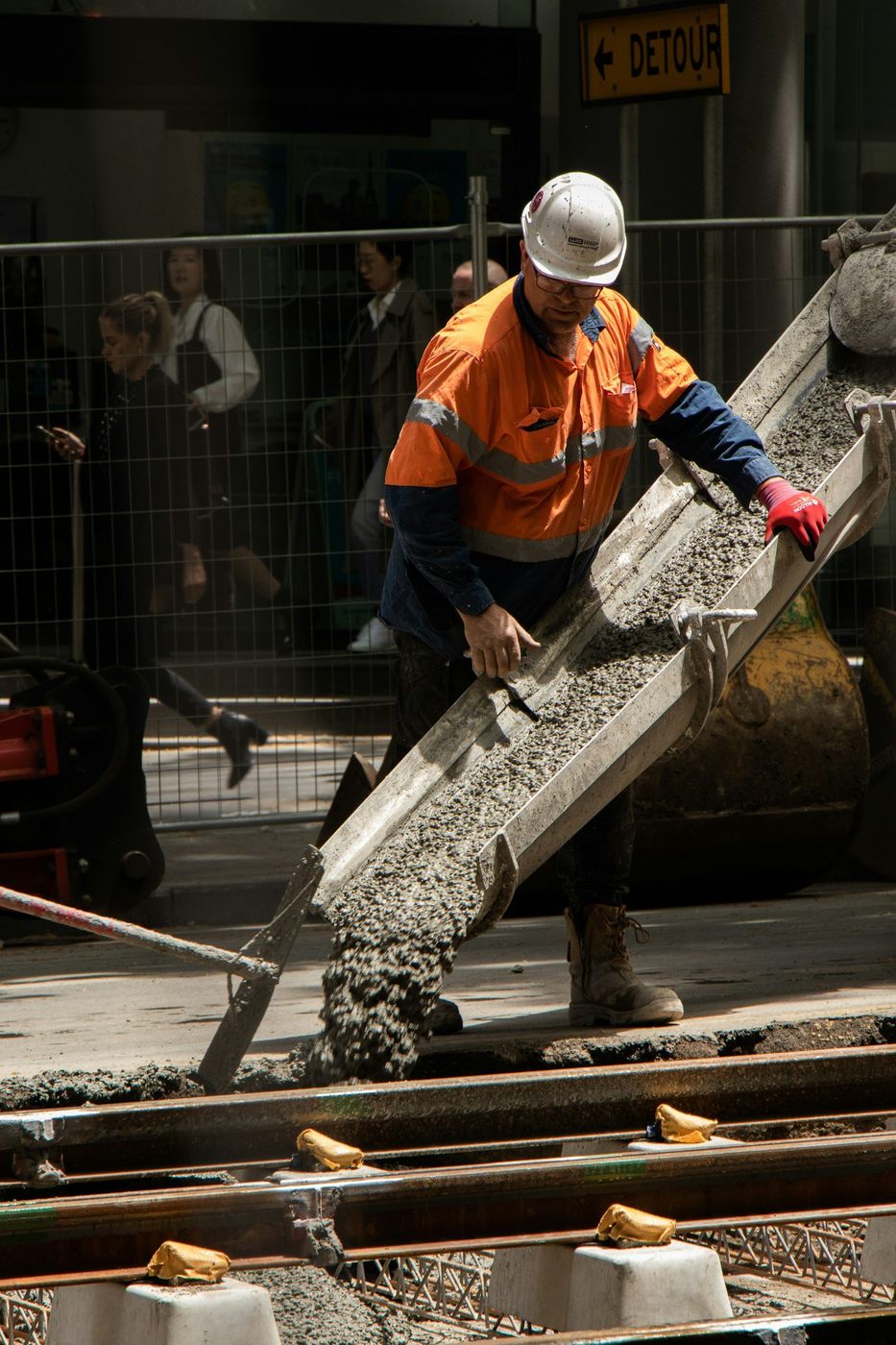
Show us where a property put its trash enclosure and we can usually tell you what decade the property was built.
Lakewood grew in layers, and trash enclosures are one of the easiest places to read those layers. Mid-century commercial property mostly didn't plan for containers at all, so the enclosure got added later, wherever there was leftover asphalt. Properties built through the eighties and nineties got a designated spot and often a slab, just a thin one poured to the size of the container and no further. Newer communities like Solterra were designed around service access from the start, which helps, though a pad still has to be thick enough for what lands on it.
We rebuild enclosure pads across all three of those generations: retail and mixed-use near Belmar, light industrial toward Applewood, older multifamily around Bear Creek, and association-owned enclosures up on Green Mountain. Different eras, same handful of failures, and the fix depends more on where the thing sits than on how old it is.
On the oldest properties, the container sits straight on asphalt with a block screen wall added later. Asphalt was never going to hold a loaded container, so the wheels have pressed four permanent dents into it and the area sags. Easy call. Nothing to repair, and the enclosure usually gets reshaped as well as resurfaced, since the footprint was picked by whatever fit.
The middle generation is trickier. There's a real slab, so people assume the slab is fine. Four inches, poured flat, mesh in it if anything, cracked through the middle because a truck is not a car. It looks legitimate until you notice the pieces move under your foot.
Newer property has a decent pad and a bad apron. Somebody sized the slab to the enclosure and stopped at the gate line, so the truck stands on asphalt while it lifts. That edge breaks down first, then the pad edge follows it, and within a few years you've got a trench at the mouth of the enclosure that everybody drives through and nobody wants to own.
Here's service day. The truck pulls square, drops its forks, and hoists a full container up over the cab. For those few seconds the truck's weight and the container's weight ride on a small footprint at the front of the vehicle, in the same spot every week. Not a parking load. Not a driving load. A repeated, concentrated, always-identical hit.
Which is why we build these heavy and skip mesh entirely. Mesh only earns its keep at mid-depth, and on a small slab with a crew and hoses crossing it, mesh ends up flat on the base. Bar on chairs, tied, through the pad and out through the apron, which has to reach far enough that the truck stands on concrete during the lift.
Water is the other half. Enclosures hold more moisture than anything else on a commercial property: rain, wash-down, container leakage, snow shoveled in there because the enclosure was handy. Wet concrete under a heavy repeated load, cycling through freeze and thaw all winter. That's why a pad ages faster than the lot around it.
| Where it sits | The daily friction | What we change when we rebuild |
|---|---|---|
| Behind a retail strip, in a narrow service lane | Truck can't square up, so it drags the container across the edge | Widen the pad and reshape the approach so the lift happens straight on |
| In the middle of an apartment parking court | Residents park across the approach and the hauler skips the pickup | Extend the apron, add curb or bollards, and make the required clearance obvious |
| At the low corner of a sloped lot | Every bit of site runoff collects under the pad | Cut the water off uphill and rebuild the base before any concrete is ordered |
| At the edge of an industrial yard with roll-offs | Container rails gouge the surface every drop and drag | Thicker slab, tighter finish, and a designated drop zone built to take it |
| Right off the main entrance drive | It's the first thing anyone sees, and it looks it | Rebuild with clean edges and gate posts on their own footings so they stay square |
Send a photo from where the truck stops. We'll tell you whether you need a new slab, a longer apron, or both.
People ask why we make the pad bigger than the enclosure. Because the concrete isn't for the dumpster. It's for the truck that comes to get it.
From the crew lead on these jobs
Still unsure about something?
Call the crew at (303) 569-4046 and we will talk it through.
Get a free, no-obligation estimate from a crew that knows Colorado soil, Colorado weather, and how to finish concrete that lasts.
Accessibility
Adjust the site to fit how you read and browse. Your choices are saved on this device.