
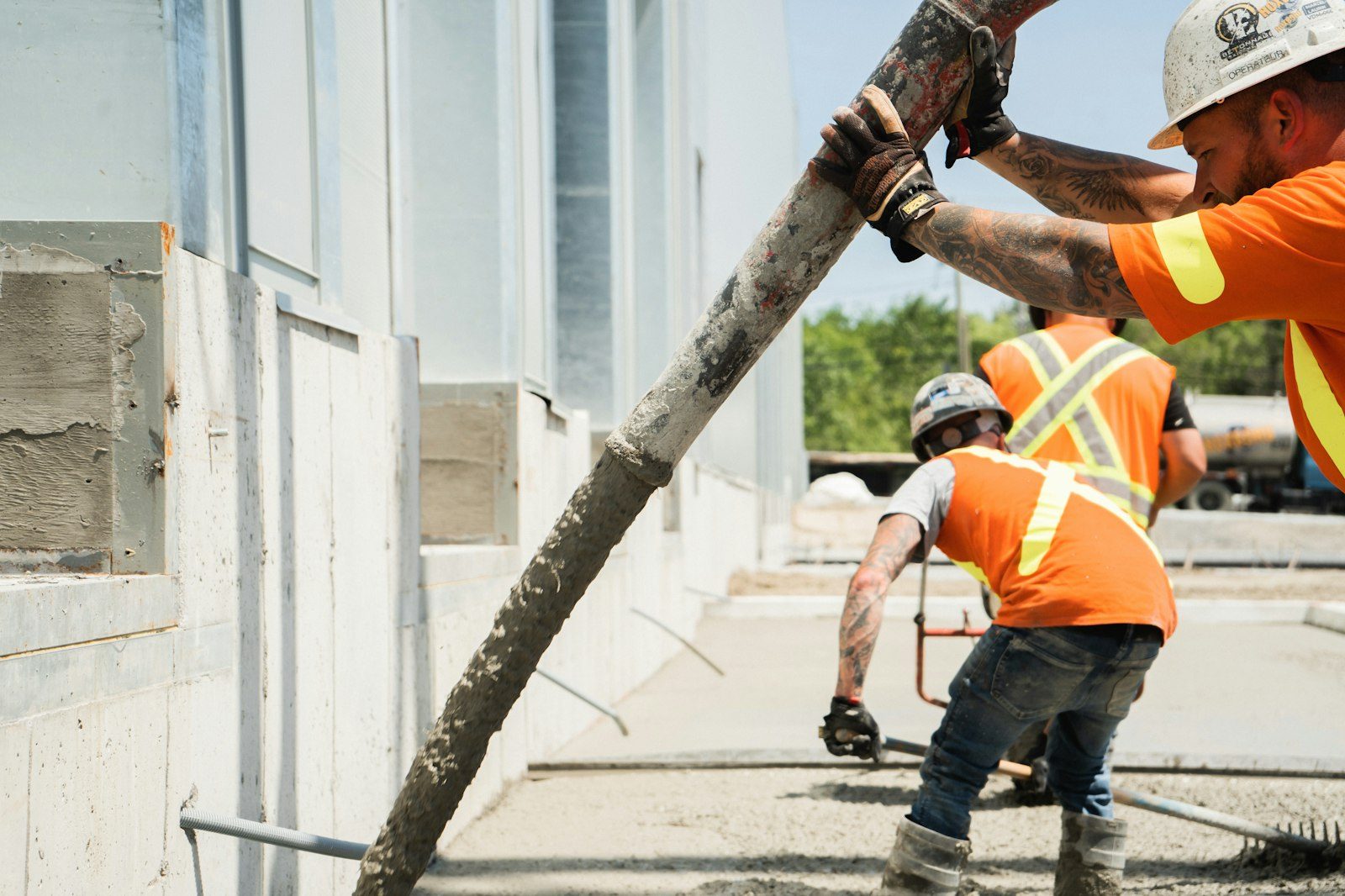
The smallest slab on the property, and the one people most often get quoted wrong.
A shed pad is a small pour with a wide spread in price, and the spread almost never comes from the concrete itself. Two identical eight-by-twelve slabs can land a long way apart on an estimate because one sits ten feet off the driveway on flat ground and the other is behind a gate, down a slope, forty yards from anywhere a truck can park. Yardage costs what yardage costs. Everything wrapped around it is the variable.
We pour plenty of these in Westridge and Southridge, usually under a storage building that's replacing a rotted wood floor or a bed of gravel that has quietly sunk two inches on one end. Owners are almost always surprised by which parts of the job move the number. So here is the honest breakdown, without figures attached, because footprint, access, and what we find under the sod change every single one.
Two schools of thought, and we'll build either one. The first sets the slab to match the building's footprint exactly, so the siding hangs an inch past the edge and rain drips onto the ground rather than running back under the wall. Clean, tidy, and the right answer for most storage buildings. The second runs the pad out past the walls to create a small apron, which is what you want on the door side if a mower or a wheelbarrow has to come in and out, because otherwise the threshold digs a rut in the lawn by the second summer.
Anchoring is the part people forget until the first big wind. If your building is a kit, we set anchor bolts in the wet concrete on the layout the manufacturer gives us. If the building already exists or the layout is unknown, we pour a clean slab and mechanically anchor the sill later. Either works. Bolts set in the pour hold better, so tell us which building you bought before we form.
Thickness follows the contents. Four inches handles a mower, shelves, bikes, and boxes. Five inches with heavier steel is what we run when a garden tractor or an ATV is going in there, and it's a small upcharge next to redoing the slab in six years.
| Cost driver | Why it matters | When it swings hardest |
|---|---|---|
| Truck access | Concrete either runs down a chute or gets pushed by hand in wheelbarrows | Anything past about fifty feet, or a gate under four feet wide |
| Slope of the yard | A level pad on a hill means cut, fill, or a formed step on the low side | Backyards falling more than a foot across the footprint |
| What's sitting there now | Gravel scrapes off easily; a rotted deck or an old slab means demo and haul-off | Any removal at all, especially concrete |
| What we find under the sod | Soft or organic material has to come out and get replaced with structural fill | Old garden beds, filled low spots, buried stumps or trash |
| Thickness and steel | A slab for boxes and a slab for a tractor are different builds | Anything with wheels and an engine going inside |
| Edges and finish | A broom finish is standard; a turned-down thickened edge adds forming time | Pads needing a step, an apron, or a short stem wall downhill |
That's enough for a real number most of the time. Call (303) 569-4046 or text the pictures over and we'll come back to you.
An unheated building sits on ground that freezes as deep as the open yard does, which makes people nervous about frost. For a small accessory structure, a floating slab on good base is standard practice and it behaves fine, because the whole assembly is light and moves as one piece if it moves at all. What causes trouble is a slab poured on soft, wet, or organic ground, where one corner sinks and the door stops latching. Base and drainage settle that question, not depth.
Wind is the load people underrate out here. A twelve-foot storage building is a sail, and the only thing holding it down is the connection between the sill and the concrete. Bolts placed in wet concrete, on the layout the kit calls for, are worth more than any extra inch of slab thickness you could buy.
For scheduling, a shed pad is a one-truck job that drops into a calendar easily, so you're not fighting for a slot the way a driveway replacement does in June. Any month from April through October is comfortable. Late fall works if we can get in ahead of the first sustained freeze. Winter is possible on a small pad, since heated water, a non-chloride accelerator, and blankets over that little surface is manageable. The ground still has to be thawed first. We won't lay concrete over frost for a shed any sooner than for a house.
Still unsure about something?
Call the crew at (303) 569-4046 and we will talk it through.

Get a free, no-obligation estimate from a crew that knows Colorado soil, Colorado weather, and how to finish concrete that lasts.
Accessibility
Adjust the site to fit how you read and browse. Your choices are saved on this device.