
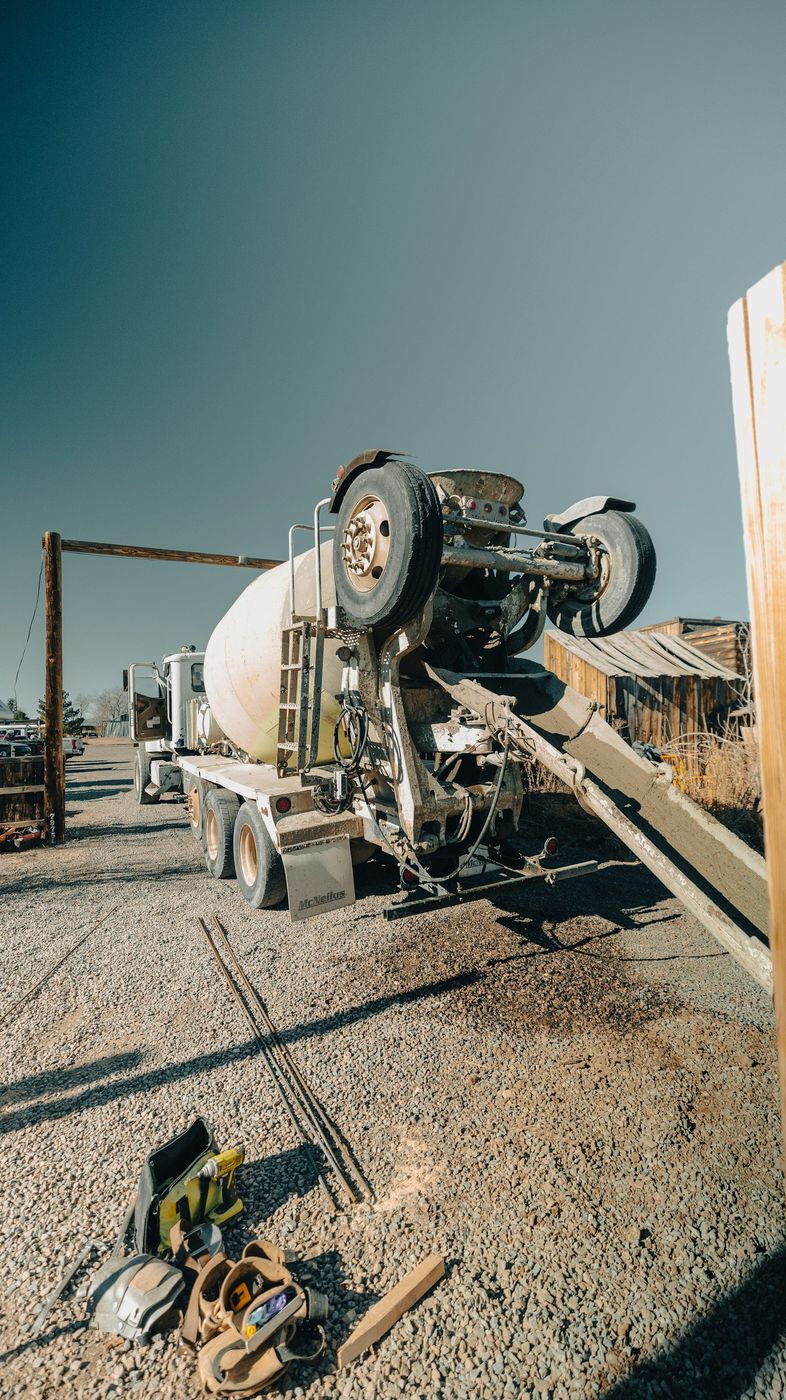
Approach slabs, dolly pads, and leveler pits built for the February morning when everything is glazed over.
Six in the morning, third week of February. The apron is glazed from meltwater that ran off a trailer roof at four the previous afternoon and froze overnight. A driver backs in a few degrees off, landing gear drops onto a slab already spalled along the edge, and a pallet jack catches the lip at the door. That is how a dock turns expensive.
Everything difficult about a loading dock happens in winter, and everything that makes winter survivable gets decided the day the approach slab goes in. Thickness for trailer loads. Fall that carries water away from the door rather than pooling at it. Edges built to take steel plates and jack stands. We rebuild approaches, dolly pads, and leveler pits for warehouses, retail backs, and service buildings across the south metro.
A dock approach carries weight nothing else on your property sees. Start with the trailer. Landing gear sets the front of a loaded box on two small pads, sometimes for hours, sometimes overnight, and every driver stops within a foot of the same spot. Add the tractor working in and out, the forklift crossing the leveler plate with a full pallet, and the jack stands drivers drop when they drop a trailer.
Then the geometry fights you. The approach is restrained by the building on one side and free on the other, it slopes, and it has a pit cut through the middle. Restraint plus point loads plus a joint in the wrong place equals a crack, every time. So we thicken the slab, run heavier steel at closer spacing than anywhere else on a site, keep saw cuts out of the wheel paths, and dowel the approach into the truck court so the two move together instead of arguing.
Base work is the quiet half of it. Eight inches of concrete sitting on a sub-base nobody compacted is just a thicker thing to crack.
| Spot | What winter does to it | How we build against it |
|---|---|---|
| Dock face and bumper line | Melt runs off trailers, freezes against the wall, and works the edge apart | Air-entrained mix, thickened edge, and the joint held back off the face |
| Leveler pit rim | Salt tracked in on tires collects in the pit and eats the corner | Steel angle set flush, a no-chloride policy, and pit drains kept clear |
| Apron surface | Sheet ice forms anywhere water has no way to leave | One to two percent fall away from the building. Flat aprons never happen. |
| Landing gear footprint | Frozen ground heaves, thaws soft, and the gear punches in | Extra thickness and heavy steel wherever trailers routinely sit |
| Trench drain at the toe | Freezes over, backs up, and floods the pit at the worst hour | Correct fall into it, cleaned before the season, and a grate a plow won't catch |
| Truck court joints | Water enters, freezes, and pops the joint edges apart | Sealed joints and a saw schedule that leaves clean arrises, not ragged ones |
We'll look at it with your receiving schedule in hand and lay out a bay-by-bay plan that keeps trucks coming while the work happens.
Nobody can give up their receiving door for three weeks. So we work position by position. One bay comes out, gets rebuilt, and returns to service before we touch the next, with plates and a temporary ramp keeping its neighbors usable. Placements land at night or on a Saturday when carriers can't flex, and demolition happens the evening before so the noise lands while the building is empty.
Coordination is the other half of the job. Leveler suppliers, bumper hardware, electricians pulling conduit to a powered unit, sometimes a steel crew on the frame, all of them touch the same three feet of concrete. We ask for submittals early and set the embeds ourselves instead of letting somebody chip them in afterward. Anything an inspector has to see before it disappears gets scheduled with the same attention as the mix.
Most dock work here sits on service and retail buildings at the commercial edges of the community, behind the parcels serving Eastridge, Southridge, and The Hearth. Those buildings can differ in age by twenty years and still share one failure: an apron poured at parking-lot thickness that was never going to survive trailers.
Look at where the trailers park and you can see two dark half circles in the concrete. That's the landing gear print. On a thin apron those turn into cracks that curve back toward the building, and once they start curving, the only question left is when you're replacing it.Straight from the crew
Still unsure about something?
Call the crew at (303) 569-4046 and we will talk it through.

Get a free, no-obligation estimate from a crew that knows Colorado soil, Colorado weather, and how to finish concrete that lasts.
Accessibility
Adjust the site to fit how you read and browse. Your choices are saved on this device.