
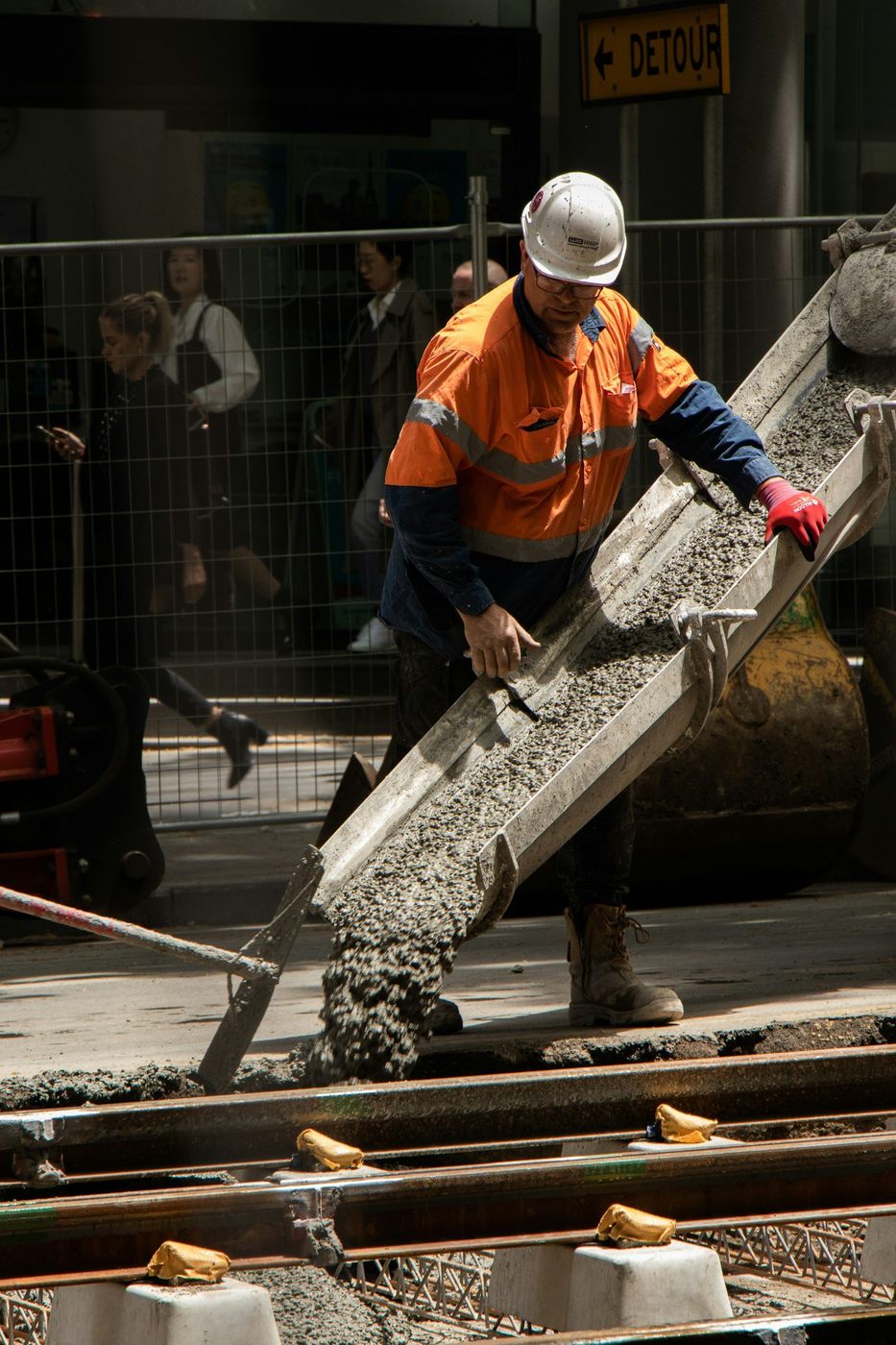
The smallest slab on the property, taking more abuse per square foot than everything else combined.
Highlands Ranch isn't one kind of property. There are townhome and condo courts with a shared enclosure serving twenty households, retail strips where a restaurant and a salon split one container, office buildings with a single pickup a week, and association facilities that fill a roll-off during spring cleanup. Every one of them punishes its pad differently, and every one needs a different slab.
What they share is that the enclosure pad takes more abuse than any concrete they own, and it's almost always the thinnest thing on site. Somebody poured four inches because it looked like a patio. Then a front-load truck started dropping forks on it twice a week. Two years on, the corner is broken out and the gate won't swing because the slab dropped under the post.
Townhome and condo courts run the hardest schedule. One shared enclosure serves a lot of households, so the container fills fast and the truck returns often, which means more fork drops per year on that square of concrete than an office building sees in a decade. Those courts sit all through the older sections, and the pads we replace around Northridge and Westridge are usually still the originals.
Retail is a different animal. Grease, organic waste, and liquid that never quite reaches the container, all of it soaking into a slab someone finished smooth and never sealed. We build those thicker, slope them deliberately, and talk with the owner about a penetrating sealer once the concrete has cured out.
Office parcels are the simple ones: a single container, one pickup weekly, and a pad that mainly needs to be built right the first time. Association facilities toward Southridge, Eastridge, and The Hearth bring the roll-off problem, where a steel box gets dragged on and dragged off and gouges anything that wasn't built for it. Sites near BackCountry are newer, and those calls are almost always about a pad sized to the enclosure instead of to the truck.
| Property type | What the pad takes | How we build it |
|---|---|---|
| Townhome or condo court | One or two front-load containers plus daily resident traffic | Full enclosure floor plus an apron the truck's front axle can rest on |
| Retail with a restaurant | Container, grease barrel, heavy organics, constant liquid | Thicker slab, sealed surface, sloped so runoff never reaches the parking |
| Office building | One container, one pickup a week, light foot traffic | Standard heavy pad, and the apron still gets poured |
| Association facility | Roll-off boxes dropped and dragged during cleanup weekends | Reinforced slab with a wear zone where the box rails ride |
| Center with a compactor | Static heavy equipment, power feed, and drainage | Engineered pad with conduit, bollards, and a drain tied into the system |
Send a photo and tell us your pickup days. We'll size the slab and the apron to the truck that actually services you.
An enclosure gathers water that nothing else on the property gathers. Snow blows into a fenced square and sits in the shade long after the lot has dried. Melt off the container runs onto the slab and refreezes overnight. Add whatever leaked out of the bags and you've got concrete sitting wet, chemically loaded, and cycling through freeze and thaw all winter. Nothing scales a surface faster.
Which is why the mix is air entrained, the finish is a light broom instead of a hard trowel, and the slab gets fall in a direction we picked on purpose. Not a lot of fall. Just enough that liquid leaves on its own.
Scheduling is the easy part, because pads are small. April through October is comfortable and we can usually slot one into a week without much notice. Winter placements work too, since a small volume is simple to blanket and keep warm, though frozen ground still stops us. If a pad fails in January we can pull the container, plate the opening, and pour it properly a few weeks later.
Every broken pad shows the same footprint of damage. Two crushed spots along the front edge with a crack running back between them. That's forks and front wheels, week after week, landing on a slab nobody built for a truck.What our crew lead tells homeowners
Still unsure about something?
Call the crew at (303) 569-4046 and we will talk it through.
Get a free, no-obligation estimate from a crew that knows Colorado soil, Colorado weather, and how to finish concrete that lasts.
Accessibility
Adjust the site to fit how you read and browse. Your choices are saved on this device.