
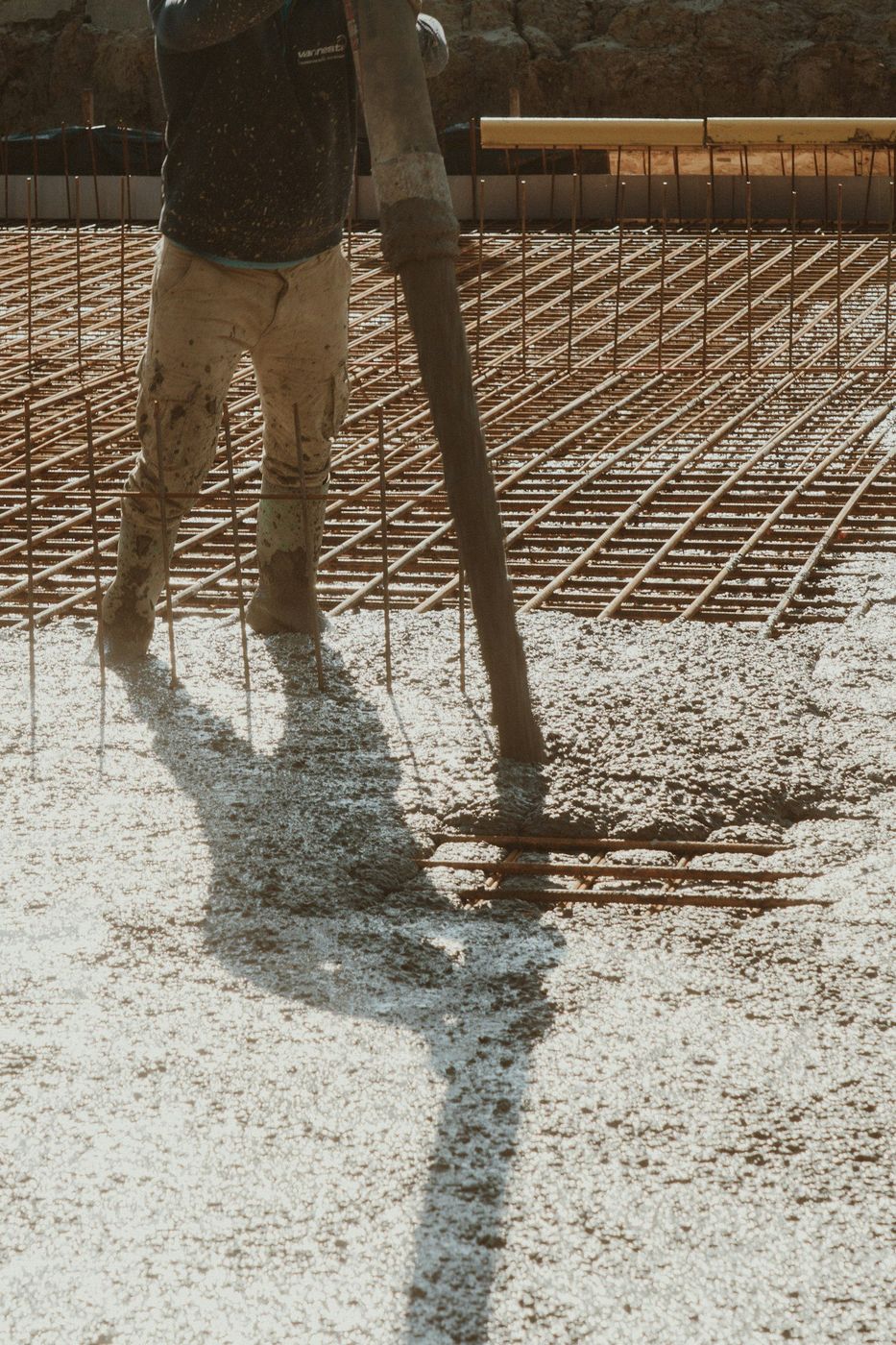
Everything that decides how your slab looks happens in about four hours.
The finish is not a product we apply later. It's a series of decisions the crew makes while the concrete is still soft, inside a window that opens exactly once and shuts when it feels like it. Get the timing right and you have a surface that sheds water, grips a boot, and looks the same in fifteen years. Get it wrong by twenty minutes and you have dusting, a sealed-in bleed layer, or broom lines going three directions.
So this page is a walk through pour day. What the crew is doing at each step, why we wait when it looks like nothing is happening, and how the texture you picked at the kitchen table actually gets put into the slab. It's the same sequence whether we're pouring a front walk in Eastridge or a shop floor out past The Hearth. Only the timing moves, and up here it moves a lot.
Concrete goes in, gets raked to rough grade, and then gets struck off with a screed so the top plane matches the forms. That's fast work and it's loud. Right behind it comes the bull float, which knocks down the ridges the screed left and pushes the big aggregate a little below the surface so there's paste to work with later. Edging follows around the perimeter, giving the slab a rounded lip that won't chip the first time somebody drops a tailgate on it.
Then everybody stops. That pause confuses homeowners more than any other part of the day. Bleed water is rising, and until it comes up and evaporates, nothing else can happen. Troweling that water back down is exactly how you build a weak, dusty top layer that fails in a few winters. So the crew waits, watches the sheen, and tests with a boot.
Front Range air is thin and dry, and that changes the whole rhythm of finishing. Bleed water evaporates fast, sometimes faster than it can rise, which fools an inexperienced crew into working the surface too early. A hot afternoon with a breeze can take a workable slab to unworkable in fifteen minutes. That's why we start summer pours at first light, run a water truck or fogging on the big ones, and keep the crew sized for the yardage instead of stretching three people across a driveway.
Cool weather flips the problem. In late fall a slab can sit there refusing to set until well after dark, and we'll finish under work lights rather than leave a surface half done. Spring and early fall are friendliest, which is why May, June, and September fill first. Winter finishing works: warm the mix water, add a chloride-free accelerator, and lay blankets the moment the last pass is made. Thawed ground first, always.
Joints get sawed the same day, a few hours after finishing, cut deep enough to genuinely control where the slab cracks. Shallow scratches don't count. That step matters as much as the texture, because a nicely broomed drive with a random crack across it is still a cracked drive.
| Finish | How it goes on | Best use | Watch out for |
|---|---|---|---|
| Broom | Bristle drag across a floated surface | Driveways, walks, patios, anything outdoors | Direction matters. Broom across the slope, not down it |
| Hard trowel | Steel blades, several passes, tight and smooth | Garages, basements, shops, covered floors | Dangerously slick outdoors once it is wet or iced |
| Float finish | Magnesium or wood float, left slightly open | Steps, ramps, and shaded walks needing quiet grip | Reads coarser up close than most people expect |
| Swirl or fan | Overlapping arcs worked in by hand | Porches, entries, pool surrounds | Slow, and it shows every inconsistent hand |
| Rock salt | Broadcast, pressed in, washed out later | Patios wanting texture without a stamp | Pits hold water, so we skip it on north-facing work |
Slope, sun, shade, and what you do on it all point at an answer. Free estimate. Call (303) 569-4046.
You can tell a rushed finish from the sidewalk. Broom lines that wander, a shiny patch where somebody troweled the bleed water back in, edges that were never run. None of that is a material problem. It's a crew that got ahead of the concrete instead of letting the concrete tell them when.What the crew sees on site
Still unsure about something?
Call the crew at (303) 569-4046 and we will talk it through.
Get a free, no-obligation estimate from a crew that knows Colorado soil, Colorado weather, and how to finish concrete that lasts.
Accessibility
Adjust the site to fit how you read and browse. Your choices are saved on this device.