
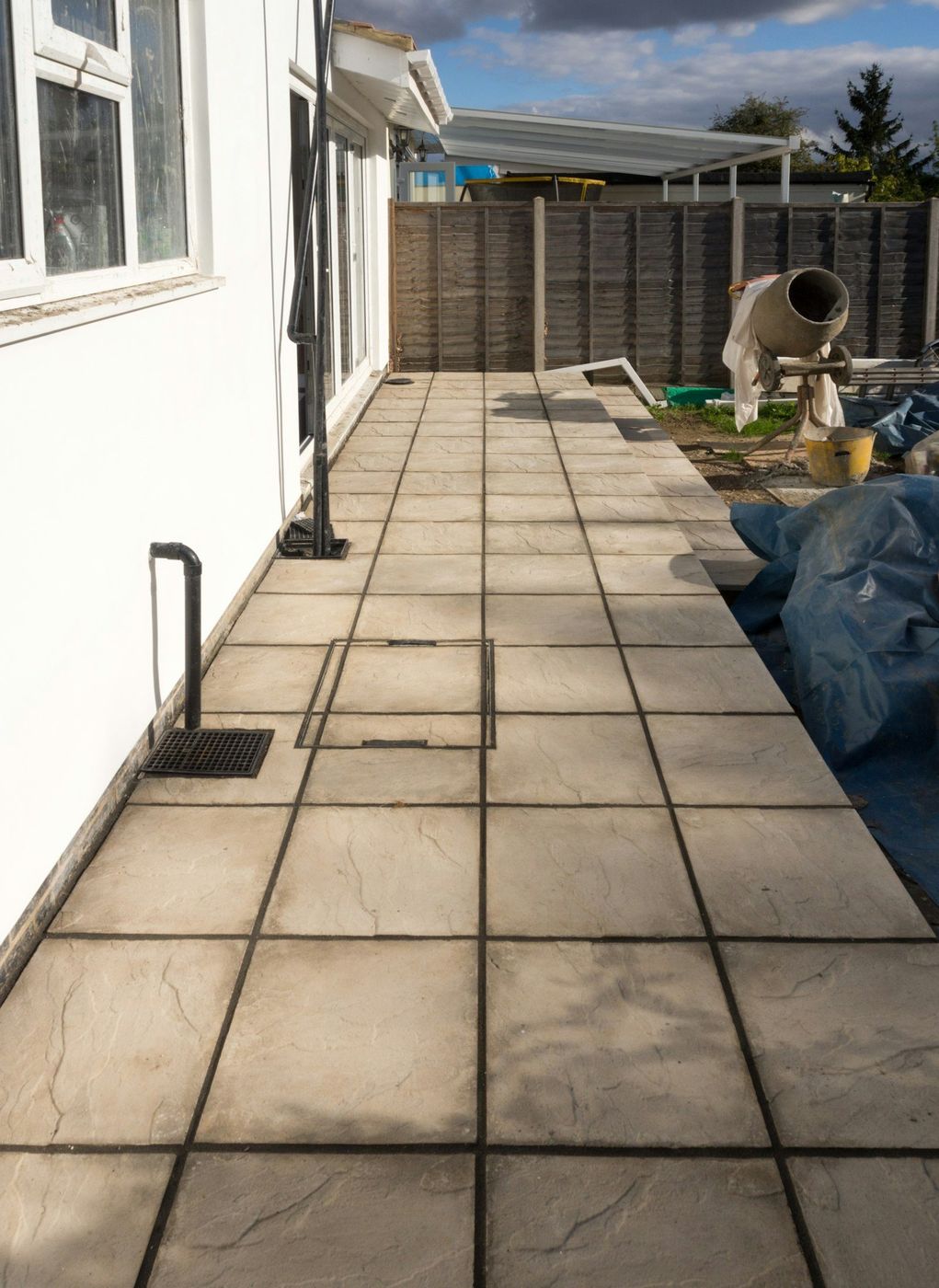
Washed stone underfoot, grip in every direction, and dirt that never shows.
Exposed aggregate is the finish people choose once they've thought about maintenance. The stone in the mix gets uncovered while the concrete is young, so what you walk on is rock rather than cement paste. That surface grips wet, grips icy, and camouflages leaf stain, mud, and pollen better than any smooth finish will. Around a pool or on a sloped front walk, it's frequently the correct answer before anybody talks about looks.
It also runs above a broom finish on the estimate, and homeowners deserve to know exactly where that extra money goes. Not into markup. Into a narrower pour-day window, extra bodies on site, stone that sometimes has to be ordered instead of scooped from the standard load, and a wash step that has to be handled cleanly so slurry doesn't end up in your beds. Here's how each of those pieces moves the number.
Start with the rock itself. The cheapest version uses whatever round river stone is already riding in the local mix, and honestly it looks good: warm browns, tans, a little gray, familiar to anyone who has walked a Colorado sidewalk. Step up and you're into select stone, ordered by size and color, sometimes broadcast by hand across the fresh surface and worked in by a crew member on knee boards. That's a different job with a different labor line, and it's why two exposed aggregate quotes can sit a long way apart.
Depth of exposure is the second lever. A light open of the surface is quick and forgiving. A deep exposure, where the stone stands proud and reads almost like a creek bed, wants a chemical retarder brushed on, a controlled dwell, and considerably more washing and brushing before anyone goes home. More product, more hours, more water to manage. Neither is better. They're different surfaces, and we bring samples of both.
| Driver | Keeps it lean | Pushes it up |
|---|---|---|
| Stone | Round rock already in the standard load | Select or seeded stone, hand broadcast and hand worked |
| Exposure depth | A light open that just breaks the paste | Deep relief needing retarder, dwell, and heavy washing |
| Shape of the pour | One honest rectangle in the back yard | Radius edges, curved beds, and stepped elevations |
| Borders | A single continuous field of stone | Troweled or broomed bands framing every edge |
| Access | Chute reaches the forms from the street | Pump or wheelbarrow because the gate is three feet wide |
| Slurry handling | Open lawn that swallows the rinse water | Containment next to new landscaping or a shared lot line |
Everything about this finish comes down to one window on pour day. Wash too early and the stone rolls out of the paste and leaves pockmarks. Wash too late and the paste has locked, and now you're grinding or blasting to recover a surface that should have taken twenty minutes. Our crew leads read that window by fingernail and thumb, not by clock, because it moves with air temperature, wind, sun angle, and how thirsty the base was.
Which is why this finish is fussier about weather than plain gray. Dry Front Range wind pulls surface moisture fast and slams the window shut early. A cloud bank stretches the afternoon into evening. May, June, and mid-September hand us the steadiest conditions. July and August work, but we start at first light and watch the cells over the foothills, because hard rain landing before the wash is done cuts its own channels through the paste. In deep winter we reschedule. Cold slows the set, rinse water freezes where it lands, and the stone comes out uneven.
Around town we pour this finish in two situations. In Eastridge and Southridge it replaces a slick original walk that got dangerous once it iced. Out in BackCountry and The Hearth it goes in as part of the first landscape plan, matched to stone already on the house.
We bring exposure samples to the site and measure while we are there. No charge either way. Call (303) 569-4046.
The question we hear on every bid is whether it's worth the difference over a broom finish. Our answer depends on the slope. Flat back patio, either one serves you fine. Anything pitched, anything wet, anything people walk barefoot on, and the stone pays for itself the first winter nobody falls.Our crew lead, after the walkthrough
Still unsure about something?
Call the crew at (303) 569-4046 and we will talk it through.
Get a free, no-obligation estimate from a crew that knows Colorado soil, Colorado weather, and how to finish concrete that lasts.
Accessibility
Adjust the site to fit how you read and browse. Your choices are saved on this device.