
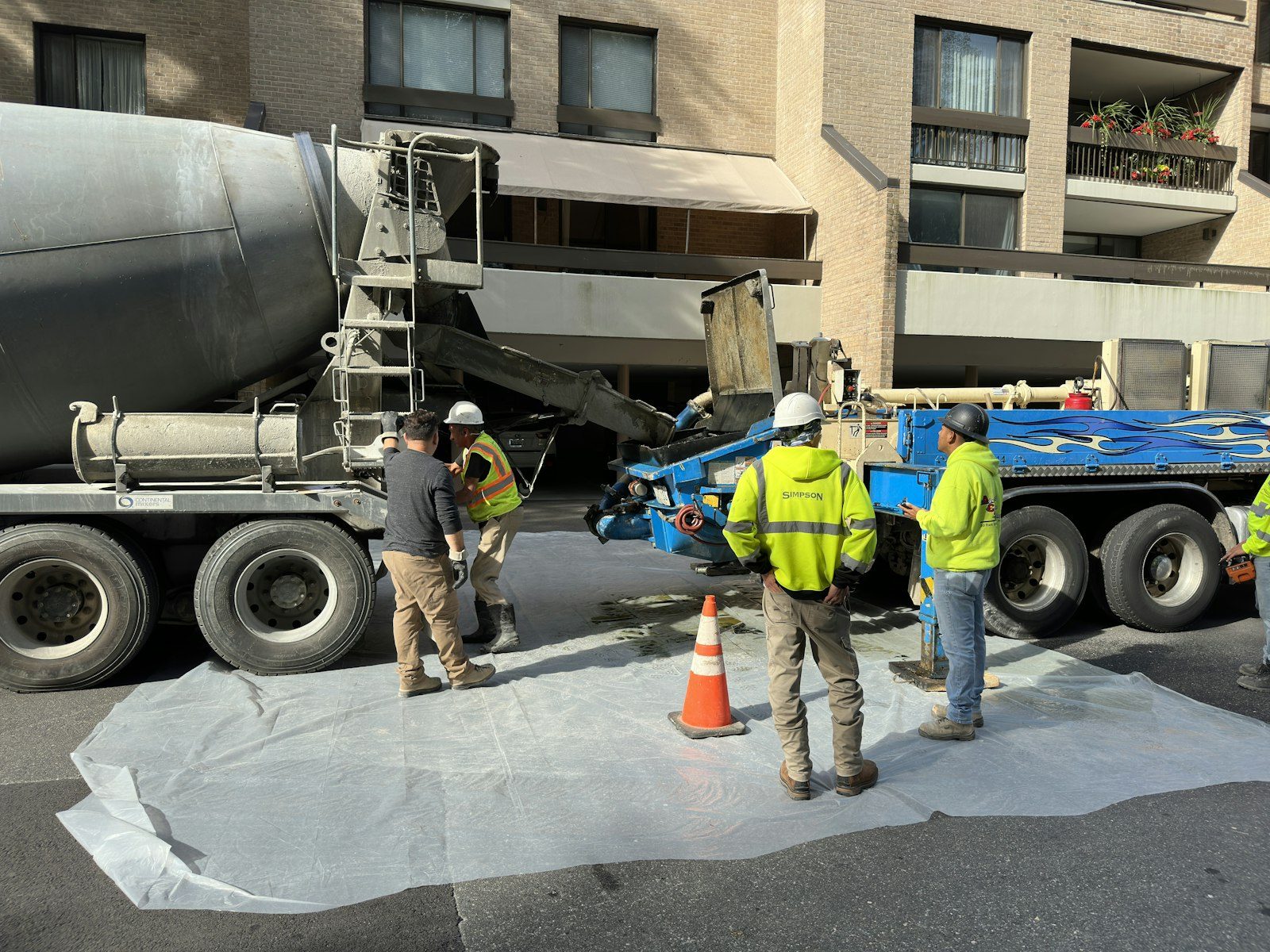
Service drives and equipment routes sized to the trucks that will really use them.
Pour day on an access road starts well before the first truck arrives. We're on site at first light checking that the sub-grade sits where we left it, that overnight rain didn't pond in a low spot, and that nobody parked a delivery van across our route. Forms get pulled tight to string. Steel gets walked, every chair checked. Then somebody calls the plant and the rest of the day belongs to the trucks.
A service road is a long, narrow, continuous placement, which makes it unlike anything else we pour on a property. There's nowhere to stop. Once that first yard hits the grade we're locked into a rhythm, and every choice made during the two weeks prior shows up in the finished surface. Here's how the day really goes.
Half of a good pour gets decided in the week ahead of it. We size the road to the vehicles that will use it rather than to whatever fits between the trees: twelve feet for a single lane, twenty for two-way traffic, and turning radii built around the longest trailer that has to swing through. Then the dirt. Cut, fill, compact, recheck. A soft pocket under a road turns into a cracked panel inside two seasons.
Getting mix trucks to the work is its own puzzle. A loaded ready-mix truck is heavy, long, and awful at reversing through an active site, so we map where each one enters, where it chutes, and where it turns before anybody calls the plant. On tight parcels that means a pump. We'd rather pay for a pump than watch nine yards of truck rut the sub-base we spent two days compacting.
Delivery cadence gets planned too. Trucks stacked too close and concrete sits stiffening in the drum. Trucks spread too far apart and you get a cold joint across the middle of your road. That timing is a phone call that starts the night before.
| When | What the crew is doing | What can go wrong |
|---|---|---|
| Before sunrise | Grade check, forms re-strung, steel walked and tied off | Rainwater sitting in the sub-base. We pump it out or we move the day. |
| First trucks | Placement begins at the far end and works back toward the entrance | Traffic crossing fresh work. The sequence is the entire plan. |
| Mid-morning | Screed, bull float, edge, and the crew leapfrogs down the run | Sun and wind pulling water off faster than the finishers can keep up. |
| Late morning | Broom texture goes on section by section as each firms up | Texturing early leaves a slick spot. Texturing late leaves nothing at all. |
| Afternoon | Saw crew follows behind cutting joints while the slab is green | Cutting too late. The road then cracks where it wants, not where we planned. |
| Next morning | Forms stripped, shoulders backfilled, cure protection checked | Somebody driving on it. Vehicles wait a week and equipment waits a month. |
Give us the heaviest vehicle and the tightest turn. We'll come back with a width, a thickness, and a build sequence that keeps your gates usable.
Altitude makes finishing harder than most people expect. Thin dry air and a stiff breeze pull moisture off a fresh surface quickly, and a long narrow road carries a lot of surface for its volume. Summer placements start at daylight, we run evaporation retarder once the wind comes up, and we track the storms that build most July and August afternoons. A cool overcast morning is the gift we hope for.
Our season opens in late spring and closes in early fall, with September probably the best of it. Heat off, ground still warm, plenty of runway before ice melt season. Winter road work happens when a project genuinely can't wait, using heated water, non-chloride accelerator, and blankets across the entire run. Frozen sub-grade stops us regardless of what the schedule says.
Most routes we build around here serve association property, retail parcels, and the maintenance and utility corridors behind them. Older service drives around Northridge and Westridge usually want a full rebuild. Calls from Eastridge and Southridge lean toward widening and radius corrections. Out near BackCountry and The Hearth we're mostly adding a proper equipment route to a site that never got one.
A road tells you who scheduled the trucks. Panels with a consistent surface the whole way down got a steady cadence. When you see a stripe across the width where the color shifts, that's a driver who showed up twenty minutes behind the one before him.Our crew lead, after the walkthrough
Still unsure about something?
Call the crew at (303) 569-4046 and we will talk it through.
Get a free, no-obligation estimate from a crew that knows Colorado soil, Colorado weather, and how to finish concrete that lasts.
Accessibility
Adjust the site to fit how you read and browse. Your choices are saved on this device.