
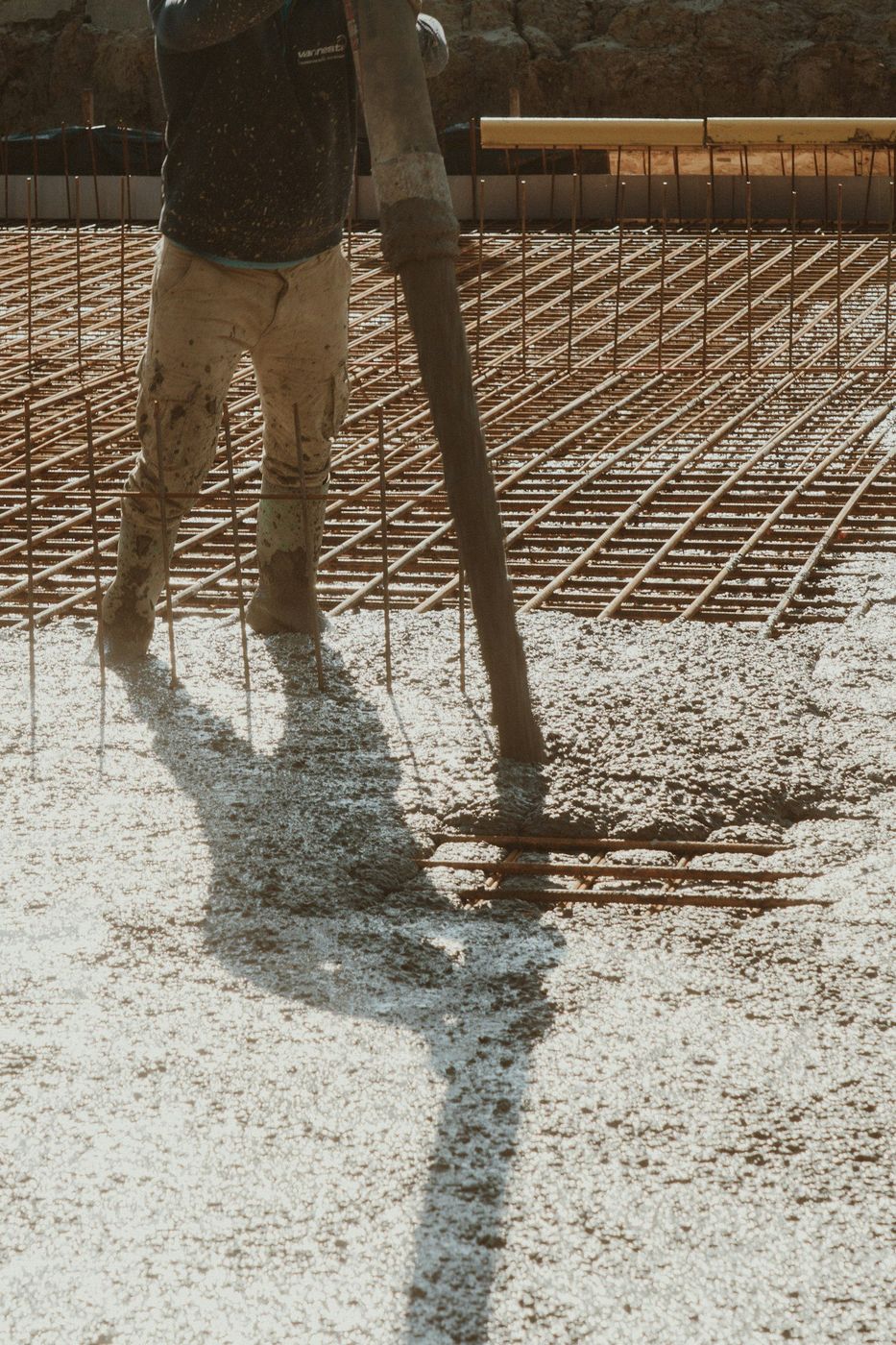
Pour day is mostly waiting. Every serious mistake in this trade is somebody who didn't.
Watch a slab get poured and you'd think the interesting part is the truck. It isn't. The truck is twenty minutes of noise. What decides whether you get a floor that lasts is a series of decisions about timing, made by people standing around looking at a wet surface and arguing about whether it's ready.
Concrete keeps its own clock, and it does not care about yours. After it goes down, water rises through it and leaves. Everything we're allowed to do to the surface depends on where it is in that process, and almost every failed floor we get called out to look at in Englewood was finished ahead of it. So here's what an honest pour day looks like, start to finish, including the hour where nothing appears to be happening.
Fresh concrete is heavy solids suspended in water. Set it down and the solids settle, which pushes water up toward the surface. That's bleed, and it's normal. It arrives as a sheen, sits there a while, and then goes, partly by evaporating and partly by getting drawn back in as the mix stiffens.
Here's the rule the whole trade runs on: you don't close a surface while that water is still coming up. Trowel it early and you seal a layer of water and fine paste at the top, and that layer is weak. It doesn't fail on day one. It fails in February, in sheets, and everybody blames the concrete.
What makes it tricky at this elevation is that the surface can lie to you. Dry air and a bit of wind take the sheen off fast, so the top looks finished while the slab underneath is still pushing water. That's why the crew keeps touching it, watching a boot print, and refusing to be rushed. The floor is telling us when. We're just listening.
| Tool | What it's actually doing | What using it at the wrong moment costs |
|---|---|---|
| Chute or pump line | Delivering concrete where it goes without letting it separate | Long drops and sideways dragging sort the rock away from the paste |
| Vibrator at forms and penetrations | Working trapped air out along edges and around anything cast in | Overworked concrete sends aggregate down and brings a soupy layer up |
| Screed | Cutting the surface to the elevation you're paying for | Nothing, if the base was screeded true. Everything, if it wasn't |
| Bull float | Knocking ridges down and pressing the top aggregate in | Right after screeding it's the correct tool. Late, it tears a stiffening surface |
| Edger and groover | Rounding edges and starting joints where the concrete is still plastic | Too early and the edge slumps back in behind you |
| Trowel or broom | The finish you'll actually live with | Closing the surface while bleed water is still rising is how floors flake |
| Saw | Putting a controlled weak line in before shrinkage picks its own | Wait a week and the slab has already cracked wherever it felt like |
Clients find this part unnerving. The trucks are gone, the slab is flat, and four people are sitting on the tailgate drinking coffee. It looks like we quit. We didn't. That gap is the single most valuable stretch of the day, and shortening it is the cheapest way to ruin a floor.
What we're doing is checking. Press a thumb in near an edge, look at how a footprint reads, watch whether a wet sheen comes back after we drag a float across it. Slabs don't stiffen evenly either. The sunny end goes first, the shaded end lags, and a garage with the door open on a breezy afternoon can be twenty minutes apart end to end. We finish in the order the concrete is ready, not the order it was placed.
Then the finish itself. Outside gets a broom, always, because a hard troweled exterior surface is a skating rink the first time it ices over. Inside, a garage or shop gets worked harder for a tighter, more cleanable surface. Different tools, same rule about when.
We'll walk you through exactly how your pour day will run, including how long we'll be in your driveway. (303) 569-4046.
Fall is the good stuff. Mild days, cool nights, slower bleed, and a long comfortable finishing window. Late spring is nearly as good. Those are the months where pour day is boring, and boring is what you want.
Summer means starting early. A July afternoon shortens every window on this page at once, so trucks are ordered for first light and we're finished before the heat arrives. We also watch the sky rather than the forecast, because a hard cell landing on a slab we're still finishing beats water into the paste and shows up later as a surface that dusts and flakes. Rain after the finish is set and covered is a nuisance. Rain during finishing is damage.
Winter works indoors. A closed garage or a heated shop pours in January about as well as in May, once the space is warm and the ground under it has thawed. Outdoor work in the cold months gets heated mix water, non-chloride accelerator, and blankets, and never goes on frozen ground. Whatever month yours lands in, keep deicers off it the first winter. Shovel, sweep, and use sand if you need grip.
Still unsure about something?
Call the crew at (303) 569-4046 and we will talk it through.

Get a free, no-obligation estimate from a crew that knows Colorado soil, Colorado weather, and how to finish concrete that lasts.
Accessibility
Adjust the site to fit how you read and browse. Your choices are saved on this device.