
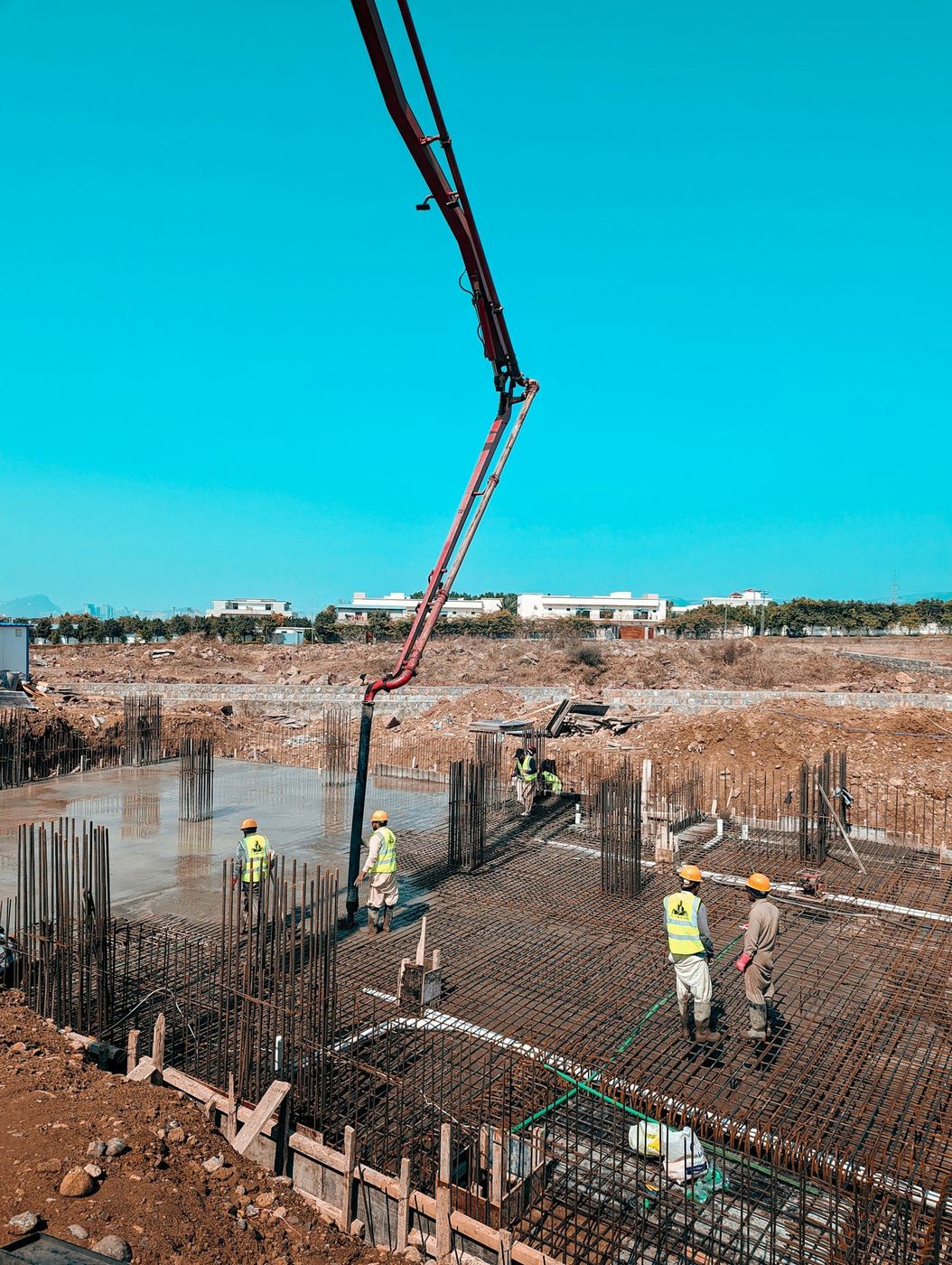
Two identical buildings, two parcels, two very different numbers. The parcel is doing most of the talking.
Owners bring us a footprint and a load takedown and ask what a foundation runs. Fair question, wrong first question. The building tells us how much concrete. The parcel tells us how hard every yard of it is going to be to place, and on this side of the metro the parcel usually wins that argument.
Englewood grew up around small commercial and light industrial parcels that were laid out when trucks were shorter and nobody planned for a pump truck. Buildings sit close to property lines. Neighbors keep operating while you build. There's often no square foot of the site that isn't either the building, the drive, or somebody's parking. All of that is priceable, and all of it is worth understanding before you decide the budget is wrong.
Here's the part that surprises people. Concrete and steel are commodities. Their prices move, but they move for everybody, and two contractors pulling from the same plants aren't going to differ much on material. What differs is how many times a person or a machine has to touch that material to get it where it belongs.
On an open site, dirt comes out and sits in a pile until it goes back. On a constrained parcel, dirt is a series of trucks, each one scheduled, each one waiting for a gate. On an open site, a placement is one long morning. On a tight one, it's three shorter placements because the pump can only reach so far and there's nowhere to queue. Same drawings. Very different jobs.
The other big driver is what you're working next to. Excavating tight to somebody else's building means shoring, monitoring, and digging in shallower lifts than anyone would choose. That's not padding. It's the cost of not damaging a structure that isn't yours, and it's a whole lot cheaper than the alternative.
| Site condition | Where it lands in the number | How much you can design out |
|---|---|---|
| No room to stockpile anything | Every load in and out turns into a scheduled delivery | Some. Staged sequencing and off-hours trucking recovers a fair share |
| Excavation running tight to a neighbor's structure | Shoring, survey monitoring, shallower digging lifts | Very little. It's a physics cost, and cutting it is the expensive version |
| Live utilities crossing the footprint | Hand exposure, relocation, and a third party in your schedule | Most of it, if locates happen during design instead of during excavation |
| Adjacent business that has to keep trading | Restricted hours, dust control, protected access routes | Some, through sequencing rather than through trimming scope |
| One narrow entrance serving concrete and steel both | Pump setups, smaller placements, more days for the same volume | Partly. One big pour beats four small ones whenever the gate allows it |
| A tenant date locked before design finished | Cold weather protection, acceleration, and overtime folded into the pour | Most of it, by moving the foundation earlier in the year |
Value on a commercial foundation is easy to measure if you look at it as a question of timing rather than quality. Almost everything worth having is cheap while the ground is open and expensive once concrete covers it. That's the whole test we apply.
Over-excavation the geotech called for belongs in this category. So do conduit sleeves, floor drains with real slope, thickened sections under bearing lines and racking runs, and the heavier approach at overhead doors where wheel loads land hardest. None of those are exciting. All of them are trivial now and brutal later, because later involves saw cutting a floor that a business is standing on.
The joint layout deserves the same attention. Where the saw goes decides where the floor cracks, how it behaves under wheel traffic, and whether joints spall in three years. It costs nothing extra to lay out properly and it's not fixable afterward.
Send the geotech report and the foundation drawings. We'll walk the site and show you which costs belong to the building and which ones belong to the lot. (303) 569-4046.
We plan commercial foundations from the end. Tell us when steel arrives or when a tenant takes possession, and we count backward through anchor bolt verification, inspections, cure time, and the weather each of those steps has to happen in. That calendar is usually the most useful document on the job.
The favorable window runs from late spring into fall, with fall being genuinely the best of it. Ground behaves, trench faces hold, and there's still time to backfill and get site concrete down before a freeze. Summer trades that for afternoon storms, so summer placements start early and we watch the western sky rather than the clock.
Winter doesn't stop us. It costs. Heated mix water, non-chloride accelerators, insulated blankets, hoarding and heat where the schedule demands it, and no placement on frozen bearing ever. All of that is a real line, and it's often smaller than the cost of a lease starting late. That's the actual comparison, and it's the one we'll run with you rather than just quoting winter as impossible.
Still unsure about something?
Call the crew at (303) 569-4046 and we will talk it through.
Get a free, no-obligation estimate from a crew that knows Colorado soil, Colorado weather, and how to finish concrete that lasts.
Accessibility
Adjust the site to fit how you read and browse. Your choices are saved on this device.