
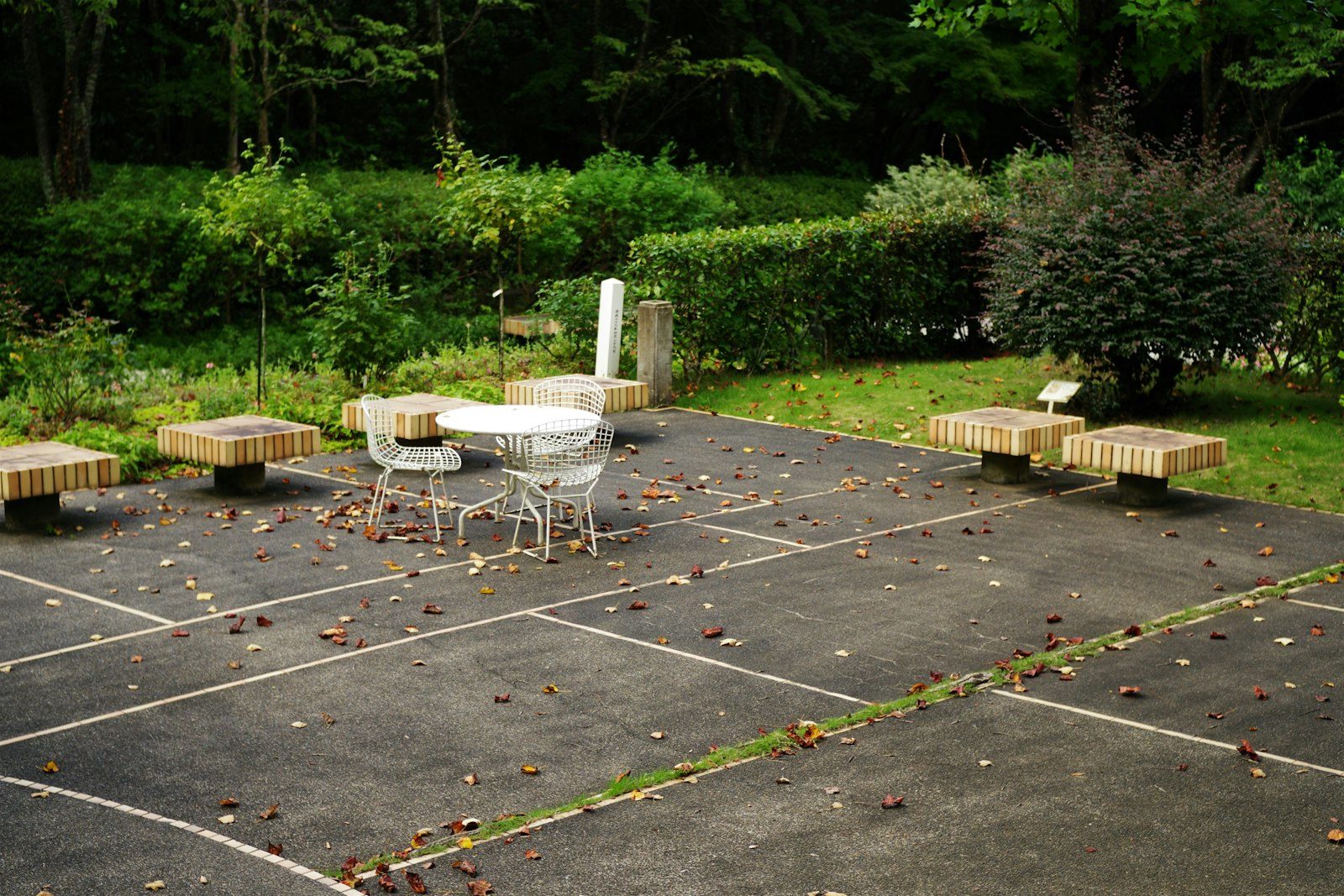
A saw blade doesn't care what's holding the slab up. We do, because every line we cut is a weakness we chose on purpose.
A diamond blade doesn't care what's under a slab. We do, and that's the difference between a scored patio that still looks designed a decade later and one where every line has a crack running away from it.
Most of the scoring we do in Centennial happens on concrete that's already down. Somebody has a wide gray field out back that has held up fine, and they want it to look like something other than a parking pad. Before we chalk a single line, we want to know what's holding that slab up: how the base was built, whether water leaves the surface or sits on it, whether any panel has shifted since the day it was poured. A score line is a weakness we're putting in on purpose, and a slab with trouble underneath will find it.
Concrete gives way where it's thinnest and where it's already under stress. Cut a line and you've made that spot thinner on purpose. Over a compacted base with water running away from the slab, that's completely fine, and it's the same principle control joints have always worked on. Over soil that's been soaking and drying under a downspout for thirty years, that line becomes the exact place the concrete decides to let go.
So the visit starts on our knees rather than with a pattern book. We look for panels no longer sitting flush with their neighbors, hairlines that have opened wider at one end than the other, corners that sound hollow under a tap, and the wet corner where a gutter dumps. Older properties around Willow Creek and Homestead usually give us plenty to read. A slab that fails the inspection isn't automatically off the table, but the layout changes, and sometimes drainage gets corrected before anybody starts a saw.
People use the words interchangeably and then wonder why the patio cracked anyway. A control joint is structural housekeeping. It goes roughly a quarter of the way through the slab, it gets sawed the same day the concrete goes down, and its only job is handing shrinkage a straight, hidden place to happen. A decorative score is shallow, cosmetic, and cut for the look of the thing.
Trouble shows up when somebody cuts decorative lines deep enough to behave like joints, or lays out a pattern that leaves one oversized panel with no real joint anywhere inside it. Now two systems are arguing with each other. Our approach is simple enough to say in a sentence: joints get planned first and honored, decorative lines get drawn to disguise them, and every line in the finished pattern is either a genuine joint or plainly shallow. Nothing lives in between.
The concrete usually tells us which layouts are realistic and which ones are wishful. Free estimates. Call (303) 569-4046.
| The cut | Roughly how deep | What it's doing | What goes wrong at the wrong depth |
|---|---|---|---|
| Decorative line tooled into fresh concrete | An eighth of an inch, give or take | Pure looks, pressed in while the slab is still soft | Too deep and it holds water and grit. Too shallow and it fades away in a couple of years |
| Decorative line dry cut on an older slab | An eighth to three sixteenths | Same job, done years later with a small saw and a straightedge | Reach the steel and you've started a rust problem you can't see until it stains |
| Sawed control joint | A quarter of the slab thickness | Tells shrinkage where to crack, and it gets sawed the day of the pour | A shallow joint controls nothing. The slab cracks wherever it prefers instead |
| Isolation or expansion joint | Full depth | Separates the slab from a foundation, a post, or a step so the two can move apart | Skip it and the slab cracks along whatever it was pinned against |
| Crack chase and fill | Follows the crack, opened enough to hold material | Cleans up an existing crack so it can be filled and folded into the pattern | Rigid filler in a crack that still moves simply breaks apart again |
Still unsure about something?
Call the crew at (303) 569-4046 and we will talk it through.

Get a free, no-obligation estimate from a crew that knows Colorado soil, Colorado weather, and how to finish concrete that lasts.
Accessibility
Adjust the site to fit how you read and browse. Your choices are saved on this device.