
A price per foot hides four different jobs, and only one of them is concrete.
Curb arrives on a proposal as a length. So many feet, so much per foot, one line an owner can hold up against another line on another page. That unit is the most misleading number in site work, because two crews quoting the same footage can be planning very different amounts of labor, and the cheaper one is usually planning less of the part you cannot see.
We replace curb, gutter pan, and ramp transitions on commercial property and association-owned drives across Centennial. Retail frontage, office park loops, church and school lots, and private drives in the older residential communities. Here is where the effort goes on a curb job and what each piece protects, because once you know that, comparing proposals stops being a guessing game.
First there is demolition. Old curb has to be saw cut at clean ends, broken out without wrecking the pavement beside it, loaded, and hauled. On a run tight against parked cars or landscape irrigation, that alone can eat a day.
Second is the trench. What sits under a gutter pan decides whether the new run holds its shape, and the material under a curb built decades ago is usually a mix of whatever was handy and whatever has washed in since. It comes out, gets replaced with clean compacted base, and gets checked rather than assumed.
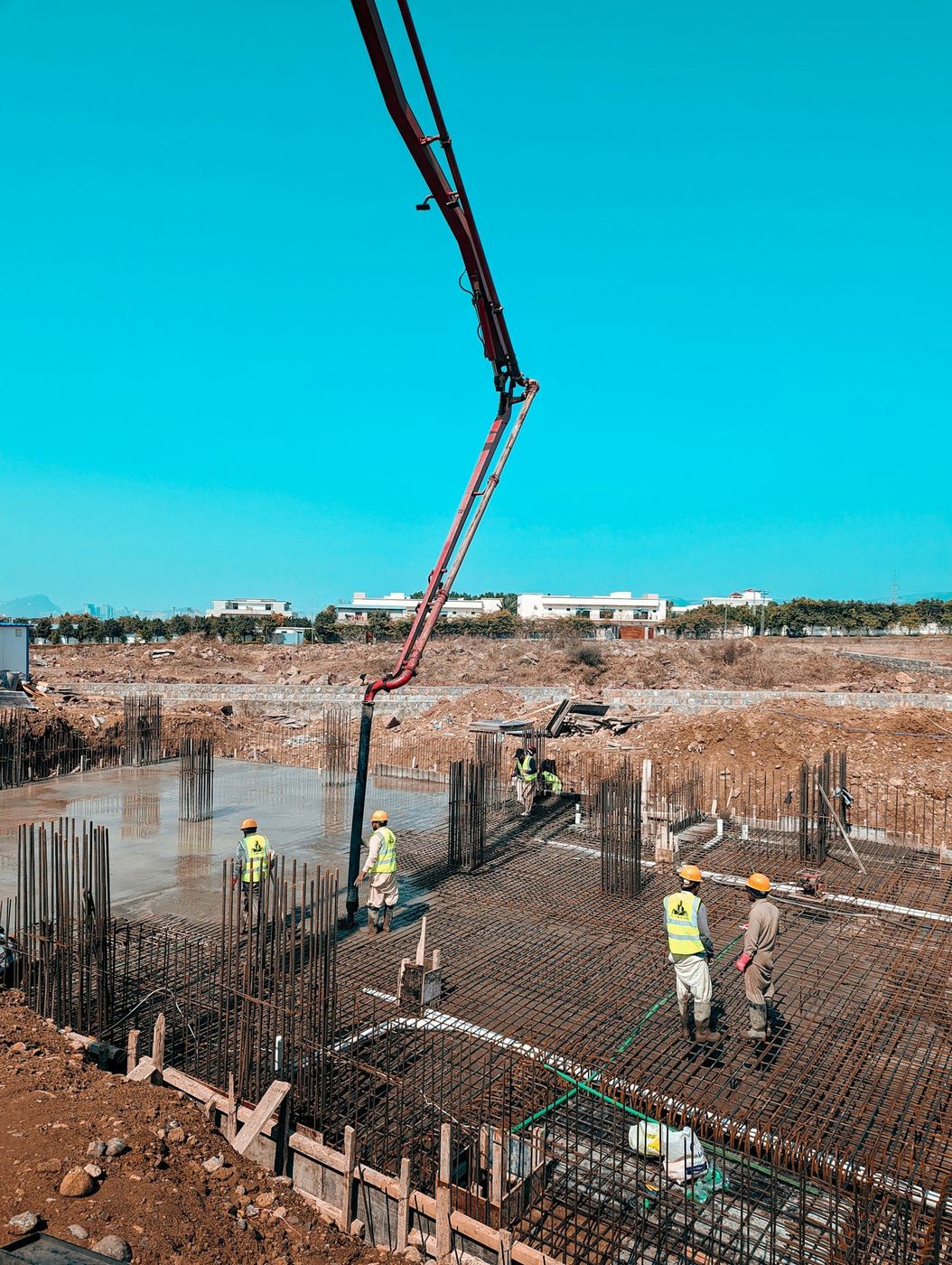
Third is grade, and this is the part with no shortcut. Setting a stringline that carries fall all the way to an inlet, across driveway crossings and ramp corners without a single flat spot, is slow work with an instrument, and it happens before any concrete is ordered. Fourth is the pour, the fastest and least interesting part of the day. Anyone can place curb. Placing it on a line that drains is the job.
| Piece of the work | How much of the crew's time it takes | What trimming it costs you later |
|---|---|---|
| Saw cutting and removal | A large share on tight or congested runs | Ragged tie-ins, cracked pavement edges, and a patch that looks patched |
| Digging out and rebuilding the base | Steady, and the first thing a low bid shortens | The new curb settles and tilts within a few freeze seasons |
| Setting the flowline grade | Slow, precise, done before concrete is ordered | Standing water in the pan, ice in winter, algae stains all summer |
| Placing and finishing | The shortest part of the day | Poor consolidation and a face that spalls off in sheets |
| Backfill behind the curb | Small, and skipped more often than anything else | A soft shoulder that lets the curb rotate under a plow |
| Ramp corners and transitions | Large per foot, small in total footage | Slopes that miss, and a compliance problem inside a drainage fix |
Curb looks like trim. It works as the edge restraint for everything behind it and the channel for everything on top of it. Take it away and the pavement beside it loses lateral support and unravels at the edge, which is why a frayed lot edge and a broken curb almost always show up together.
Then there is the water. Every gallon that falls on your property has to reach an inlet, and the gutter line is the road it takes. A pan holding a puddle two days after a storm is telling you runoff is going somewhere it was never meant to go, usually into the base under your lot or the soil against a building. That is a much larger repair than the curb.
On older commercial frontage near Foxridge and Homestead, we see plenty of original curb still doing fine on the straight runs while every driveway crossing and ramp corner has broken up. That pattern is not random. It is where trucks track, where plows catch, and where grade changes direction. Replacing those pieces and leaving the sound runs alone is the highest-value curb work a property can buy.
Send the scopes and a photo down the gutter line. We will tell you what each one included, what it left out, and which sections truly need to come out.
Extruded curb goes down fast and it belongs on long, open runs where a machine has room to work. Hand-formed curb costs more per foot and it belongs on short sections, tight radii, pan tie-ins, and anywhere a run has to match existing work at both ends. Most Centennial jobs end up mixed, and any bidder quoting one method for a whole property has not walked it.
Winter is what actually kills a curb line here. Snowmelt runs the gutter all afternoon, freezes in the pan overnight, and repeats from November into March. Water that cannot leave works into every joint and hairline crack, and by the fourth season the pan face is coming apart in flakes. Add a plow blade riding the curb face and deicer sitting in the low spots and you have the failure pattern visible on most older properties in town.
Schedule this work between late April and early October. Spring is heavy with these calls because the thaw exposes everything, so booking early gets you a better slot. We pour in the cold with heated water and blankets when a run is genuinely broken, though frozen ground stops us no matter whose calendar it wrecks.
Still unsure about something?
Call the crew at (303) 569-4046 and we will talk it through.

Get a free, no-obligation estimate from a crew that knows Colorado soil, Colorado weather, and how to finish concrete that lasts.
Accessibility
Adjust the site to fit how you read and browse. Your choices are saved on this device.