
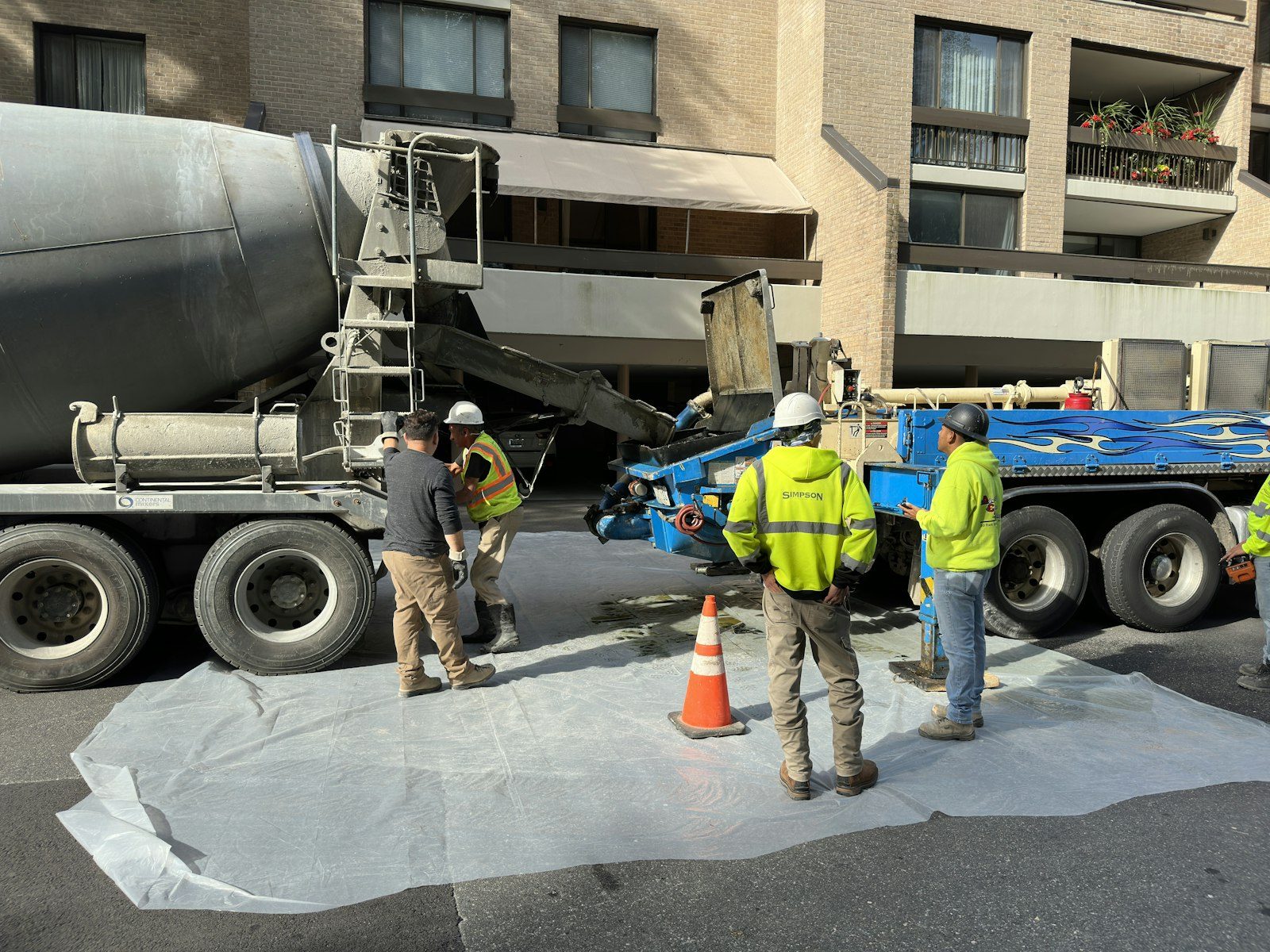
You can diagnose a service drive from the public sidewalk, in about the time it takes to glance down the side of the building.
Stand out front and look down the side of your building. Not at the frontage, which somebody maintains because customers see it. At the drive that wraps around to receiving, the trash enclosure, and the maintenance gate. Most of what is wrong back there is visible from where you are standing, and it shows up in a predictable order that has little to do with the age of the surface.
Centennial has no industrial belt, so the access roads we build here are not haul roads. They are working drives behind retail centers and office parks, fire and service lanes looping association property, the routes maintenance crews take to detention areas, and the back drives at schools and churches that see a bus and a delivery truck daily. Light duty by the name on the plan, heavy duty by what drives on them.
Edges go before anything else. A drive built without lateral support ravels along its outer foot, and that ravel turns into a gravel shoulder that keeps getting wider as tires clip it. Once the edge is gone, water gets under the surface from the side, which is a much faster route in than anything through the middle.
Next you see the wheel paths. Two darker bands where the trucks track, slightly lower than the surface next to them, holding water after a storm long enough that you can spot them from the street. Those bands are the surface telling you the base under them is compressing. On asphalt drives they turn into ruts. On thin concrete they turn into a line of cracks running with traffic instead of across it.
The last stage is the honest one. Fines pumping up through a crack after rain, a fan of gray silt spreading out around it, and a section that rocks when a loaded truck crosses. At that point the surface is not what failed. It has been riding on nothing for a while and finally broke. Drives serving property near Foxridge and Piney Creek that were built for a lighter era usually get to this stage at the turn into the trash enclosure first, because that is where weight and steering happen in the same square yard.
A drive is a structure with three parts, and the concrete is the thinnest one. Under it goes compacted road base, and under that goes subgrade that somebody either proofed or did not. When a truck rolls across, the load spreads down through those layers like a cone. Build the cone right and the pressure reaching the soil is small. Skip the base and that same load lands on dirt in a narrow footprint, over and over, in the same tire prints.
Water is what turns a small weakness into a failure. It arrives from the roof, from the lot draining toward the back of the property, from an irrigation line that has been leaking for two years, and it collects along the exact edge that already lost its support. Saturated subgrade has almost no bearing capacity. Add freeze cycles and the whole thing lifts and drops through the winter, which is why so many drives look worst in early spring and then partly close back up by June. Nobody fixed it. The ground dried out.
So the first thing we do on a road walkthrough is figure out where water arrives and where we can send it. If that question does not get answered, the new concrete inherits the same problem the old surface had.
| Stage | What you can see | What it takes to correct now |
|---|---|---|
| Edge ravel | The outer foot breaking down into a loose shoulder | Edge restraint and a shoulder rebuild. The cheapest stop point there is. |
| Wheel path depression | Two shallow bands holding water after a storm | Localized removal and base repair before the surface breaks through |
| Cracking along the tracks | Lines running with traffic, widening each season | Partial removal, base rebuild, and new concrete in those lanes |
| Pumping and silt fans | Gray fines spreading out of cracks after rain | Full removal of that section. The base has already washed out. |
| Rocking sections | Movement you can feel when a loaded truck crosses | Reconstruction, and by now the surrounding pavement is going too |
We will walk it with you, dig a test hole where it matters, and tell you honestly which segments need concrete and which ones can wait a cycle.
Still unsure about something?
Call the crew at (303) 569-4046 and we will talk it through.

Get a free, no-obligation estimate from a crew that knows Colorado soil, Colorado weather, and how to finish concrete that lasts.
Accessibility
Adjust the site to fit how you read and browse. Your choices are saved on this device.