
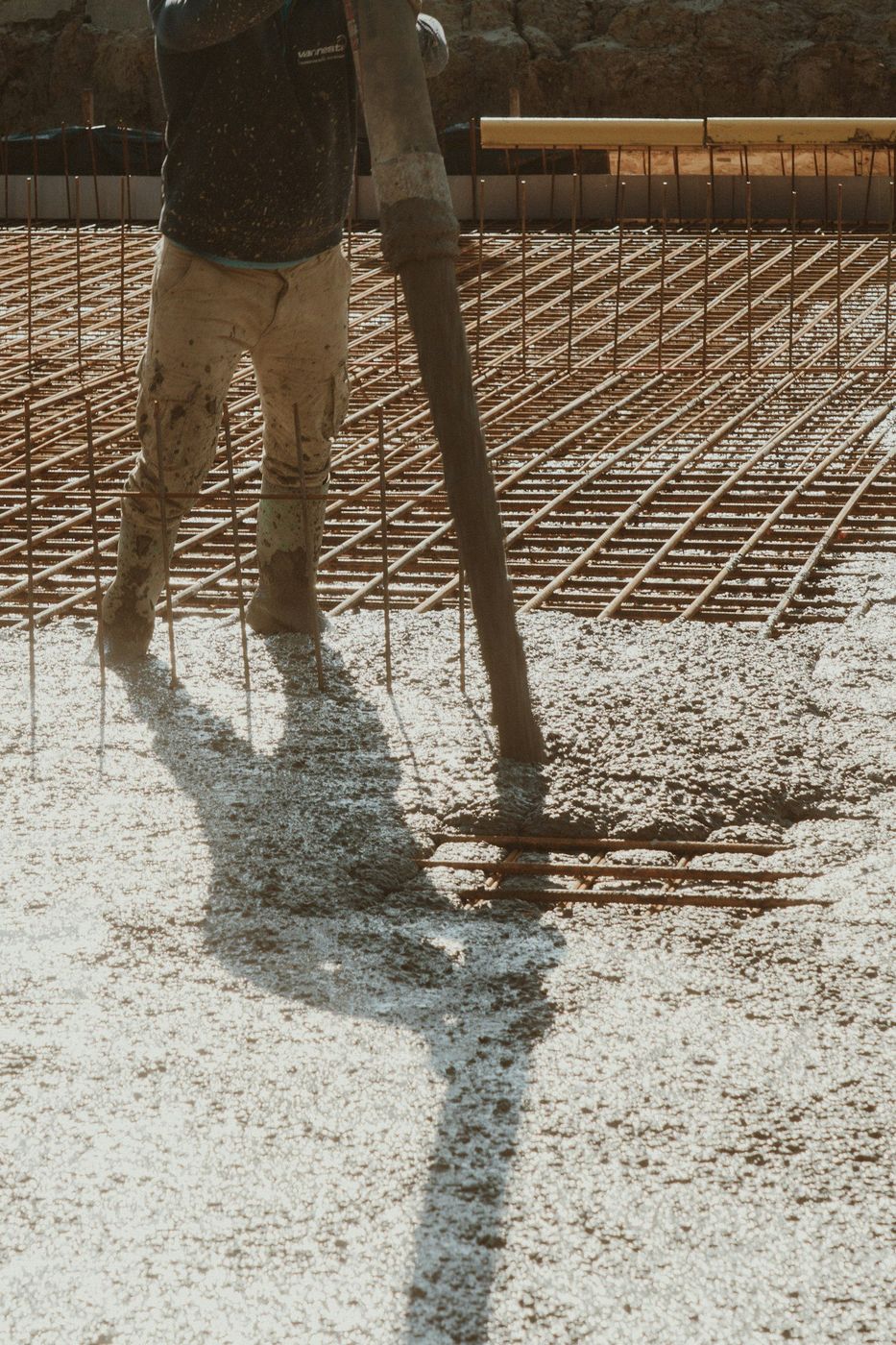
One layer, no place to hide a mistake. Here's how our pour day actually runs.
First truck is booked for seven. We're on site at six, because the hour before any concrete shows up decides how the rest of the day goes. Forms get a final check for line and elevation. Someone walks the vapor retarder hunting for punctures left by yesterday's boots. Steel comes up onto chairs and gets retied where it sagged overnight. Screed pins go in. Then the crew stands around for ten minutes with nothing to do, which is a good sign, because the alternative is finding a problem while a loaded truck idles at the curb.
This is the simplest structure we build and the least forgiving one. There's no second layer to bury an error under. Whatever happens between seven in the morning and the middle of the afternoon becomes the floor you park on, work on, or live above for the next several decades.
Concrete comes off the chute in a planned sequence, starting at the far corner and working back toward the access point so nobody walks through fresh material. Place, rake to rough grade, screed to the pins. Vibration goes in around edges and embeds. On big pours a laser screed earns its keep; on a garage floor, a straightedge and two people who have done it a thousand times get there fine.
Then comes bull floating, and then the hardest part of the trade, which is waiting. Finishing too early traps bleed water at the surface and gives you a floor that dusts and scales within a couple winters. So we watch the sheen leave, test with a boot print, and start troweling when the slab is ready rather than when the schedule wants us to. At 6,224 feet with dry air and sun, that window can arrive fast. A cool cloudy afternoon stretches it out and keeps the crew here until evening.
| Space | Under-slab assembly | The reason |
|---|---|---|
| Attached garage | Compacted base, vapor retarder, steel, slope to the door | Melting snow has to leave the building, and a car brings a lot of it in |
| Finished basement or living space | Base rock, sealed and lapped vapor retarder, no punctures left open | Moisture vapor ruins flooring adhesives and finishes from underneath |
| Detached shop or heated outbuilding | Deeper base, retarder, thickened lines under posted loads and equipment | Point loads and vehicle traffic concentrate where the plan says they will |
| Unheated storage building | Compacted base, steel, retarder optional depending on contents | No conditioned air above means vapor drive matters less than frost detailing |
| Warehouse or service floor | Engineered base, thickened aisles, doweled joints, filled after shrinkage | Wheel loads repeat in the same tracks thousands of times a year |
Call before you finalize the building plan. Under-slab decisions are cheap now and expensive after the concrete sets.
Concrete shrinks as it cures. That's not a defect, it's chemistry, and it means the slab is going to crack somewhere. Control joints are simply us choosing where. We cut them the same day, usually within hours of finishing, deep enough to actually create a weakened plane rather than a decorative scratch. Spacing follows slab thickness, and we keep joints out of doorways and out of the path wheels take every day.
Isolation joints matter just as much and get forgotten more often. Anywhere the slab meets a foundation wall, a column, or a stoop, it has to move separately. Bond the two together and the slab separates on its own schedule, in a line nobody chose.
Late April through October is the working season for exterior and unenclosed slabs. Inside a finished shell we pour all year. If you get to choose, choose September. Warm days, cool nights, low wind, and a full stretch of curing weather before the first hard freeze. July pours are routine but we start at dawn, keep evaporation retarder on the truck, and keep an eye on the storms that stack up over the foothills most summer afternoons.
Winter slabs need heated mix water, non-chloride accelerators, blankets, and sometimes a tented and heated work area. Costs more, takes longer, and works fine when it's done seriously. What we won't do is place concrete on a frozen sub-base. Frozen ground lifts, then it thaws and drops, and your brand new floor has a void under it before you ever park on it.
Still unsure about something?
Call the crew at (303) 569-4046 and we will talk it through.
Get a free, no-obligation estimate from a crew that knows Colorado soil, Colorado weather, and how to finish concrete that lasts.
Accessibility
Adjust the site to fit how you read and browse. Your choices are saved on this device.