
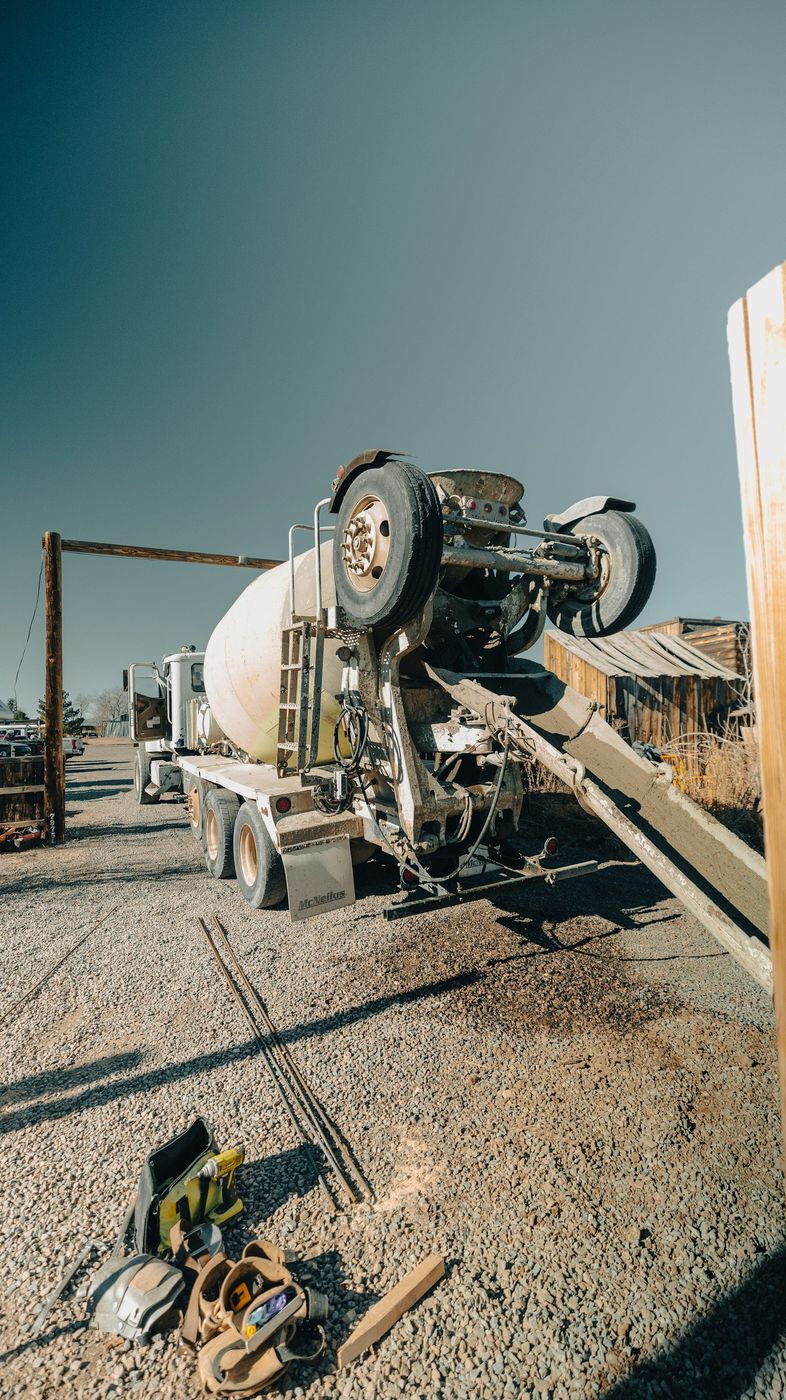
Sand and cement slurry pumped into the empty space under a slab, once we know what put that space there.
A settled walkway is a symptom whose cause is buried four inches down. Concrete doesn't sag into a dip on its own. It follows the dirt, and the dirt went somewhere. So before anybody talks about lifting a panel, we want to know what's under it: how much base there is, whether there was ever any, and where the water that moved it comes from.
Mudjacking answers the void with a wet mix of sand, portland cement, and water, pumped through drilled ports until pressure carries the panel back up to its neighbor. Old method, still a good one. But it fits only when the ground can carry what we're adding, and that call gets made standing on your driveway.
The first is nothing. No gravel, no road base, just concrete laid on whatever the grader left behind. Plenty of older flatwork around Sterling Hills and Murphy Creek went in that way, and it holds up until the first stretch of wet years.
The second is base that used to be there. Roof water hitting one spot season after season carries the fines out from under the edge, and once they go the gravel loses its lock. You end up with a slab bridging a gap it never signed up for.
Third is a trench. Water, sewer, gas, and low-voltage lines all get dug in and backfilled, and backfill compacted with a shovel instead of a compactor keeps settling for a decade. Panels that dip along a straight line across the drive are almost always sitting on one of those.
Fourth is fill. Graded lots in Southshore, Saddle Rock, and Tallyn's Reach can have several feet of engineered fill on one side of a house and undisturbed ground on the other. When a slab spans that seam, one half stays and the other travels.
Every void we fill was excavated by moving water. A downspout with no extension. A sprinkler zone throwing half its pattern onto concrete and soaking the edge every other morning. Or the yard itself, graded so the storms that build over the plains here drain toward the slab. Lifting without dealing with that is renting a level walkway.
Season matters for a reason that has nothing to do with comfort. Slurry is cement based, so it wants above-freezing ground to set properly, and frozen subgrade holds a slab artificially high while we work. Lift to that false grade in January and you inherit the old dip in April. March through November is our honest range. Late spring is busiest because winter's damage shows itself all at once, and fall is quietly the better booking: soil moisture has evened out, and a September lift gets months to settle in before anything freezes. One caution tied to summer here: a hard cloudburst saturates a subgrade in half an hour, and we give it a couple of dry days rather than pump into mud.
Lay a straight board across the low spot, photograph the gap, and send it over. We can usually size the job from that.
| Condition under the concrete | How it got that way | What it means for slurry |
|---|---|---|
| Native dirt, no gravel anywhere | Base prep skipped when the slab went in | Lifts cleanly. Expect more material than the dip suggests. |
| Base washed thin along one edge | Roof water discharging beside the concrete for years | Strong candidate, but the downspout moves before we drill. |
| Soft line crossing the slab | A utility trench backfilled loose and never compacted | We lift and then watch it. Trench soil keeps consolidating. |
| Deep uncompacted fill on a graded pad | Cut and fill work during construction | The place where slurry weight fights you. We point to foam instead. |
| Clay that stays wet all season | Irrigation overspray, a low spot, or a broken line | Drainage first. Pumping into saturated ground buys nothing. |
| Firm ground, shallow void, one low corner | Ordinary settlement of a well-built slab | Easiest work we do. Half a day and you're walking on it. |
The drill tells us more than the estimate did. You feel it drop through four inches of concrete and then keep going through nothing for another six, and right there you know the story. Sometimes it hits packed gravel an inch down and we stop and rethink the whole job.The crew lead's read on it
Still unsure about something?
Call the crew at (303) 569-4046 and we will talk it through.

Get a free, no-obligation estimate from a crew that knows Colorado soil, Colorado weather, and how to finish concrete that lasts.
Accessibility
Adjust the site to fit how you read and browse. Your choices are saved on this device.