
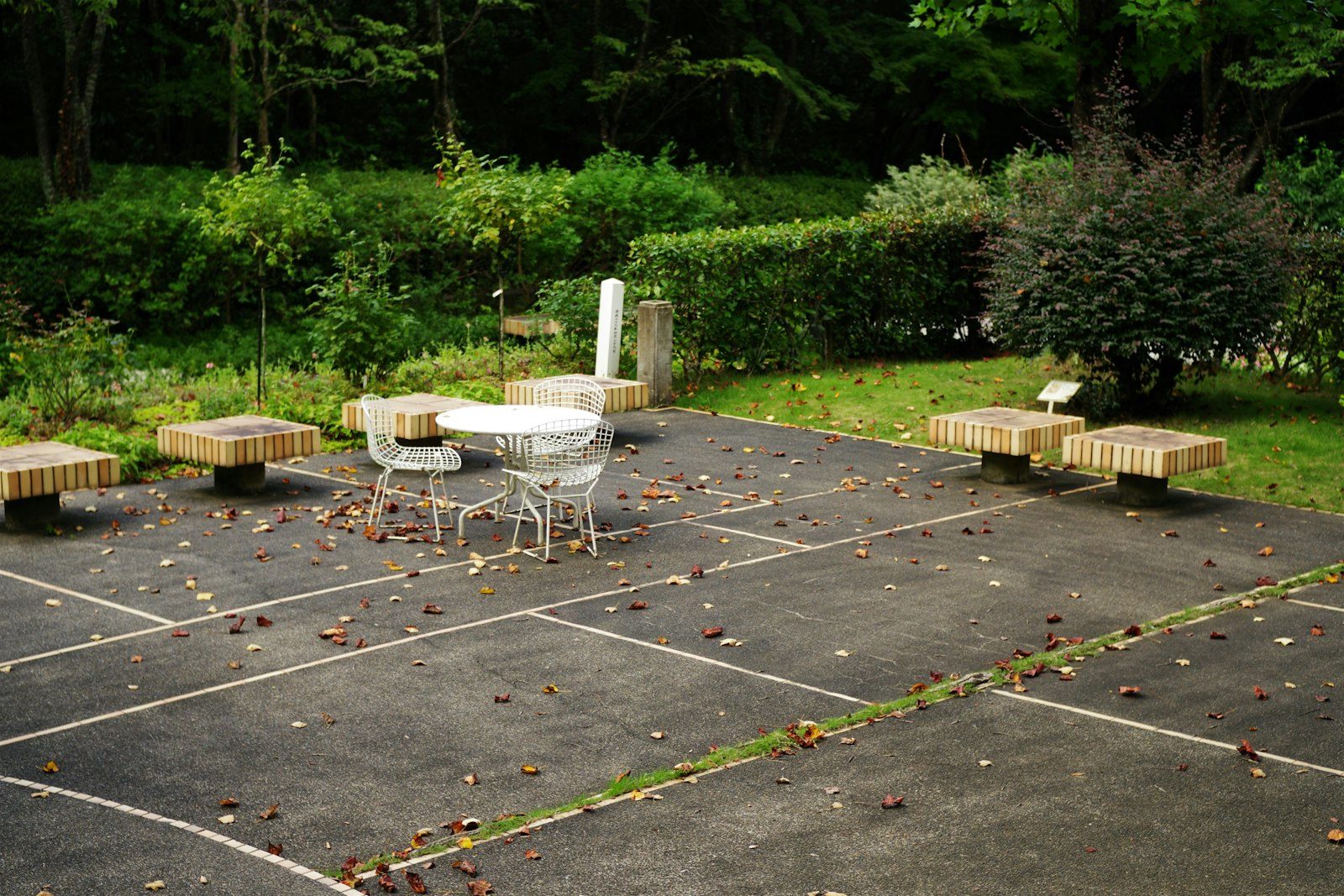
The thing that decides whether a new surface lasts is six inches below the one you're standing on.
The best predictor of how a resurfacing job turns out is something you can't photograph. Not the cracking, not the scaling, not the faded color. It's whatever is packed under that slab holding it up, and whether water has been quietly rearranging it since the concrete went down. Aurora covers a lot of ground and a lot of different soil, so we check every site instead of assuming the last one predicts the next.
Resurfacing replaces the wearing course of concrete you keep. A bonded cementitious layer, in your color and texture, over a slab we've verified will hold still beneath it. Good base, and it's one of the best values in the trade. Gone base, and it's money you spend twice. Everything below is about telling those two apart before anybody signs.
We sound the slab first. A length of chain dragged across concrete gives back a bright ring where the slab is fully supported and a flat, hollow thud over a void. Ten minutes, and it tells us more than an hour of studying the surface. Corners and edges get the most attention, since that's where water enters.
Then we test the panels. A foot on each side of every joint and crack, weight shifted back and forth. Any rocking, any click, any lip that has developed between two sides means the pieces are moving independently and the ground has given way somewhere below.
Then the water story, which is usually the actual cause. Where do the downspouts land? Does the grade beside the slab fall away from the house or back toward it? Is there a low spot holding a puddle two days after a storm? Water that gets under an edge takes fines with it every time it moves, and after enough seasons there's a cavity where compacted base used to be. The concrete didn't fail. It lost the thing it was resting on.
Still uncertain, we core a small hole in an out-of-the-way spot and look at the base directly. Cheap hour, compared to topping a slab that's about to drop.
It restores a worn, chalky, scaled, or faded top layer completely, and changes texture and color while it's at it. It adds grip to a slick pool surround. It makes a driveway that lost its paste look like new concrete for a fraction of a replacement. It fills and disguises stable cracks so they read as joints. Real results, all season.
It cannot lift a settled corner. It cannot correct drainage, because a layer measured in fractions of an inch has no room to build slope. It cannot hold together panels that shift against each other, and it cannot bridge a void. Put a topping over any of that and the new surface tracks the old failure line, usually inside two winters, and now you've bought a surface and still need the replacement.
The in-between case is common. One bad section on an otherwise sound slab. We cut that panel out, rebuild the base under it with compacted road base in lifts, repour, let it cure, then resurface the whole area so it reads as one continuous piece. That combination saves most of the concrete and hides the repair, and it's how plenty of Murphy Creek and Sterling Hills driveways get a second life.
| What's under the slab | How it got that way | What the concrete needs |
|---|---|---|
| Solid compacted base, full contact | Built right, drained right, and it stayed put | Resurfacing. This is the ideal case and it's more common than you'd guess |
| Void along one edge | Roof or grade water running in at the perimeter for years | Fix the water, fill the void or replace that section, then resurface |
| Thin base over soft ground | Corners cut on the original build | Depends how much has moved. Often replacement of that area |
| Base soaked and holding moisture | Irrigation, a downspout, or grade pushing water at it | Correct the source first. Nothing bonded over a wet slab performs |
| Ground that lifts and drops with the seasons | Soil that reacts to moisture, and Aurora has plenty of variety | Engineered repair or replacement, not a topping |
| Sound base, ruined surface | Deicers, a rained-on finish, or decades of sun and shovels | Resurfacing. It will look like a new slab when we're done |
Chain, a foot on every panel, a look at where your water goes. Free, and you get a straight answer.
Homeowners always point at the ugliest spot. I never look at it. I look at the corner nearest the downspout, because that's where the story starts and the ugly part is just where it ended up.Our crew lead, after the walkthrough
Still unsure about something?
Call the crew at (303) 569-4046 and we will talk it through.
Get a free, no-obligation estimate from a crew that knows Colorado soil, Colorado weather, and how to finish concrete that lasts.
Accessibility
Adjust the site to fit how you read and browse. Your choices are saved on this device.