
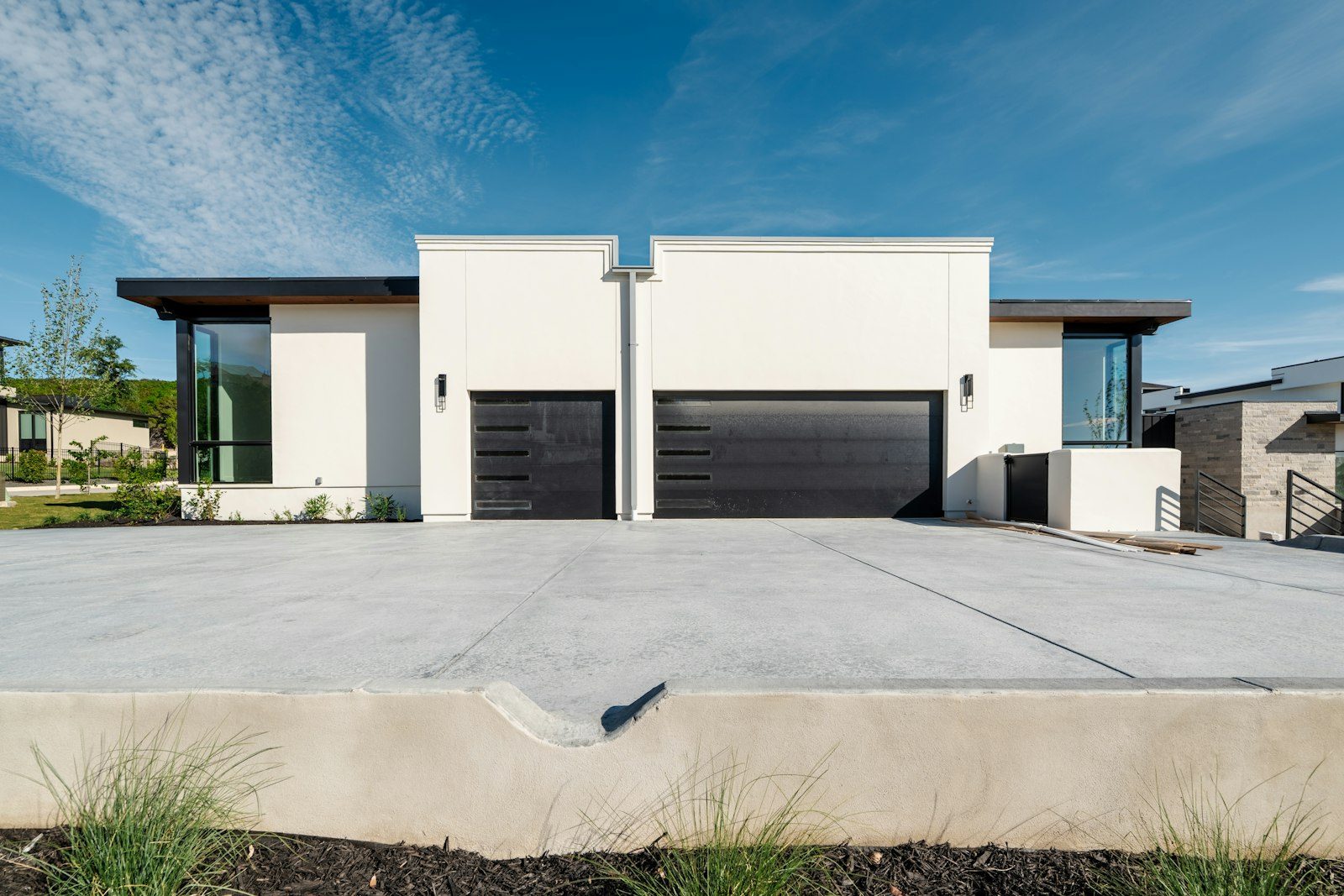
Sealing starts as a decision on pour day and turns into a product about a month later.
Almost every homeowner asks the same thing while our crew is still tooling the edges: when do you seal it? The answer, standing on a slab a few hours old, is that we made the first sealing decision that morning and the actual product is four weeks out. That confuses people, because sealing gets talked about like a coat of paint you slap on at the end.
It isn't. Sealing runs from the curing method we picked before the truck arrived, through a month of the slab gaining strength and pushing moisture out, to a product chosen for how that surface will be treated. Get the order wrong and you trap water under a film, which is how most of the cloudy, peeling driveways in Aurora got that way.
Fresh concrete needs its water to stay put. Hydration is a chemical reaction and it keeps going for weeks, but the top layer is what dries first and the top layer is what you walk on, so protecting it is the priority in the first few days. Around here, with dry air and wind that comes out of nowhere, a slab left uncovered can lose surface moisture fast enough to leave a weak, dusty skin that no sealer will ever rescue.
So we cure it, with plastic and wet coverings or a membrane-forming curing compound sprayed right after finishing. That compound looks like sealer, feels like sealer, and sits beside sealer on the shelf. It is not sealer. It's a temporary film holding water in during the first critical week, and most of it breaks down on its own. What's left comes off before a real sealer goes down, because layering a permanent product over a sacrificial one is a bond failure with a delay built in.
Meanwhile the joints get sawed the same day, vehicles stay off for a week, and the slab does its work. Design strength lands around twenty-eight days. That's the earliest sealing date on any pour we do, and if it's turned cold by then we push to spring and hand you a winter care sheet.
| When | What the slab is doing | What goes on it |
|---|---|---|
| Pour day | Setting, then hydrating in earnest | Curing compound or wet cover, plus same-day saw cuts |
| Days 1 to 7 | Gaining strength fast, still soft near the surface | Nothing. Foot traffic after a day or two, no vehicles |
| Weeks 2 to 4 | Strength climbing, moisture still leaving the pores | Patience. Vehicles fine after the first week |
| Day 28 onward | At design strength and dry enough to bond to | First sealer, weather permitting, in thin crossed coats |
| First winter | Fully cured but young at the surface | Sand for traction. No chloride deicers |
| Years 2 to 3 | Sealer thinning under sun and shovels | Clean, water test, recoat |
We'll test a corner and tell you whether it needs stripping, recoating, or nothing at all. Free estimate.
Penetrating sealers, the silane and siloxane family, soak in and chemically line the pore walls. Nothing sits on top, appearance barely changes, and traction is unaffected. They're what we put on driveways, walks, steps, and anything that meets a snow shovel. Their failure mode is quiet and boring: they wear out. Nothing peels, nothing clouds, water just starts soaking in again and you recoat.
Film-forming sealers, mostly acrylics, cure into a thin layer on top. They darken concrete, add sheen, and make color and aggregate look wet. On stamped and stained work they aren't optional, since the appearance depends on the film being there. Their failure modes are the loud ones. Trapped moisture turns the film milky white. Too heavy a build goes soft in July, tracks on shoes, and gets slick under water. And a film laid over a curing compound or a dirty slab lets go in sheets.
Aurora's calendar gives us two good windows. Late spring, after the last hard freeze and before storms settle into their afternoon habit, when the slab has had weeks to dry. And mid-September into early October, which is the smarter one strategically, since fresh sealer goes on right before the season that attacks concrete. We avoid hot July afternoons, when a baking slab flashes the carrier off before the product can wet the surface, and anything past the third week of October, when overnight lows drop under what the sealer needs to cure.
Exposure sets the cadence. A south-facing drive in Sterling Hills or Murphy Creek with sun on it all day burns through a film faster than a shaded walk, and the shaded walk needs the grip additive more.
Still unsure about something?
Call the crew at (303) 569-4046 and we will talk it through.
Get a free, no-obligation estimate from a crew that knows Colorado soil, Colorado weather, and how to finish concrete that lasts.
Accessibility
Adjust the site to fit how you read and browse. Your choices are saved on this device.