
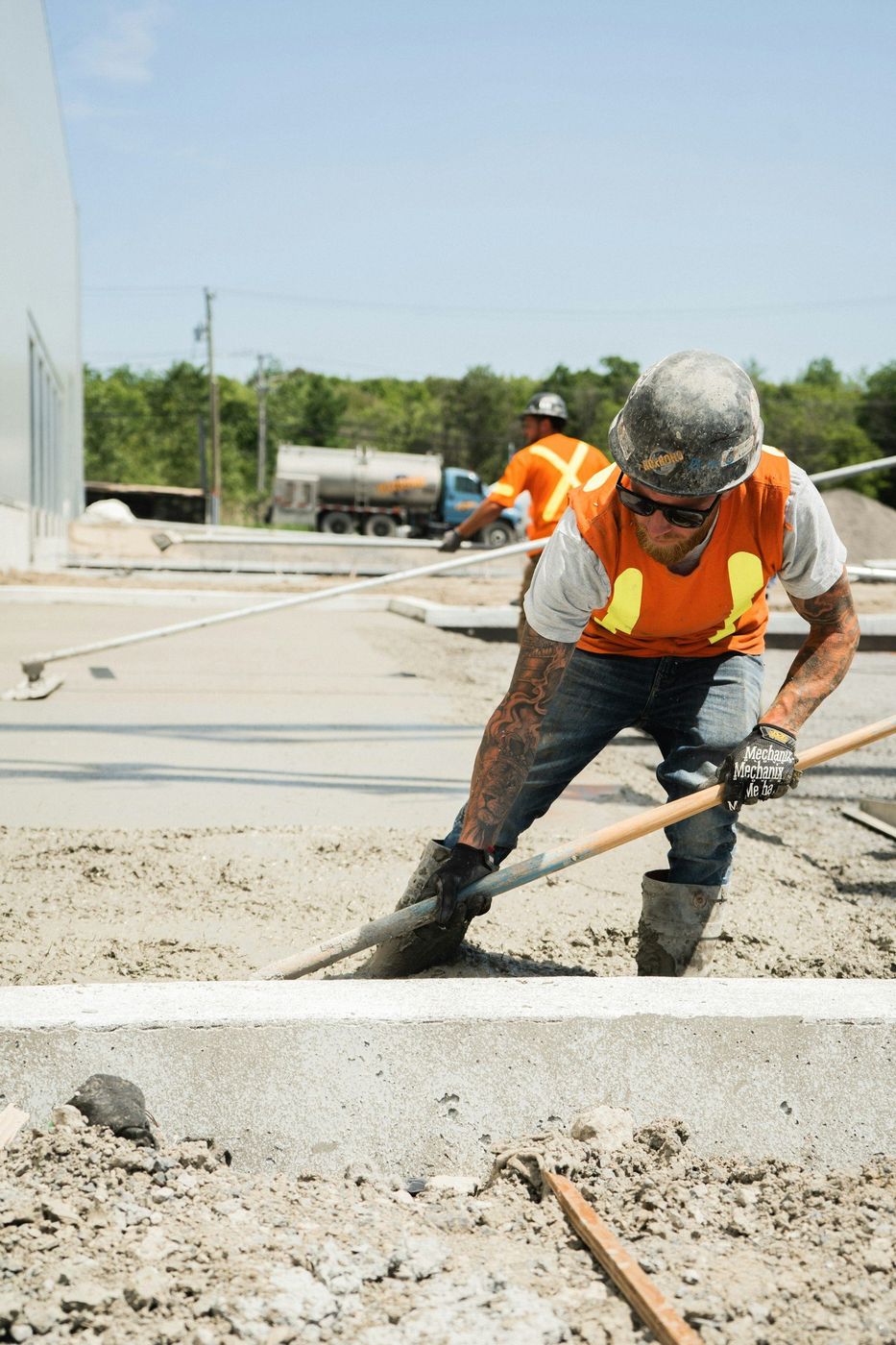
One opening, one truck, and a room nobody can drive into for a week. Here's how the day actually runs.
Seven in the morning and the garage is empty. Everything that lived in there is out on the driveway under a tarp. The old slab came out yesterday, so the hole is open, and the first thing our crew does is walk it with a rake and a level before anybody calls the plant for a delivery time.
A garage is the one pour where the room fights you. Three walls, a low header, drywall nobody wants to patch, a water heater in the corner, and a single opening to move every wheelbarrow through. The concrete work is ordinary. The logistics are the job. So we plan the day backward from wherever the truck can safely park.
We saw the perimeter before breaking anything. A clean cut along the walls and across the door line keeps the demo from telegraphing into the apron outside or cracking the stem wall behind the drywall. Then the slab comes up in manageable pieces and goes straight to the truck.
What's underneath is why this gets its own day. Sometimes it's clean fill and good base and the schedule holds. Sometimes it's bare dirt, a buried downspout line, or a soft trench where a plumber worked decades back. We'd rather have that conversation with the hole open than with a mixer idling at the curb. Wall bottoms get tarped, the water heater boxed, and we sweep before we leave, because demo dust finds every shelf you didn't empty.
| Method | When it works | What it means for your day |
|---|---|---|
| Straight off the chute | Truck reaches the apron and the run is short | Fastest there is, often a two hour placement |
| Power buggy | Detached shops and long drives | Adds crew and time, and we protect the route |
| Line pump | Tight lots and slabs behind a gate | Extra equipment on the bill, keeps weight off your drive |
| Conveyor | Grade changes a buggy would fight | Quick once set, needs clear space beside the garage |
| Wheelbarrow by hand | Small repairs and partial sections | Slow, and not how we run a full slab in July |
Poly under the slab isn't optional on our jobs. Ground moisture climbs through concrete whether you can see it or not, and a garage floor without a vapor barrier is the one that blooms white every spring, sweats under a parked car, and refuses to hold a coating. The sheet goes over compacted base, laps taped, and we keep it intact while the steel goes down.
Base gets what it would get outside. Road base in lifts, compacted, brought to a grade that already carries the slope we want. An isolation strip goes against the stem walls and around any column so the floor can move a hair without dragging on the structure. Then steel on chairs, tied, riding mid-slab instead of lying on the plastic.
We'll walk the slab, tell you which days you lose, and put the sequence in writing. Free.
People are surprised by how quiet the pour is and how long the finishing takes. Concrete is in the room by nine. We're still on our knees at four, waiting on the surface to tell us it's ready.The crew lead's read on it
We start at the back wall and work toward the door, screeding to the grade stakes as we go. Slope gets set here, not later. About an eighth of an inch per foot toward the opening carries snowmelt off your car out the door instead of letting it pool at the back wall all winter, where it eventually finds the drywall.
Then we wait. Bull float, then hands off until the bleed water burns away, because troweling a wet surface is how a floor ends up shedding dust for years. Once it firms we finish, usually to a smooth trowel since this floor lives indoors and gets swept. Joints go in the same day.
Timing is friendlier than outdoor flatwork, since the room shelters the slab from sun, wind, and rain. An unheated garage in January is still an unheated garage, though. Cold weather work means mix batched warm, an accelerator that skips the chloride, and blankets over the whole floor. Frozen subgrade stops us in here the same as it would outside. Folks in Saddle Rock and Tollgate Crossing hear the same advice from us: if the timeline bends at all, spring and fall are calmer and the finishing window is wider.
Still unsure about something?
Call the crew at (303) 569-4046 and we will talk it through.

Get a free, no-obligation estimate from a crew that knows Colorado soil, Colorado weather, and how to finish concrete that lasts.
Accessibility
Adjust the site to fit how you read and browse. Your choices are saved on this device.