
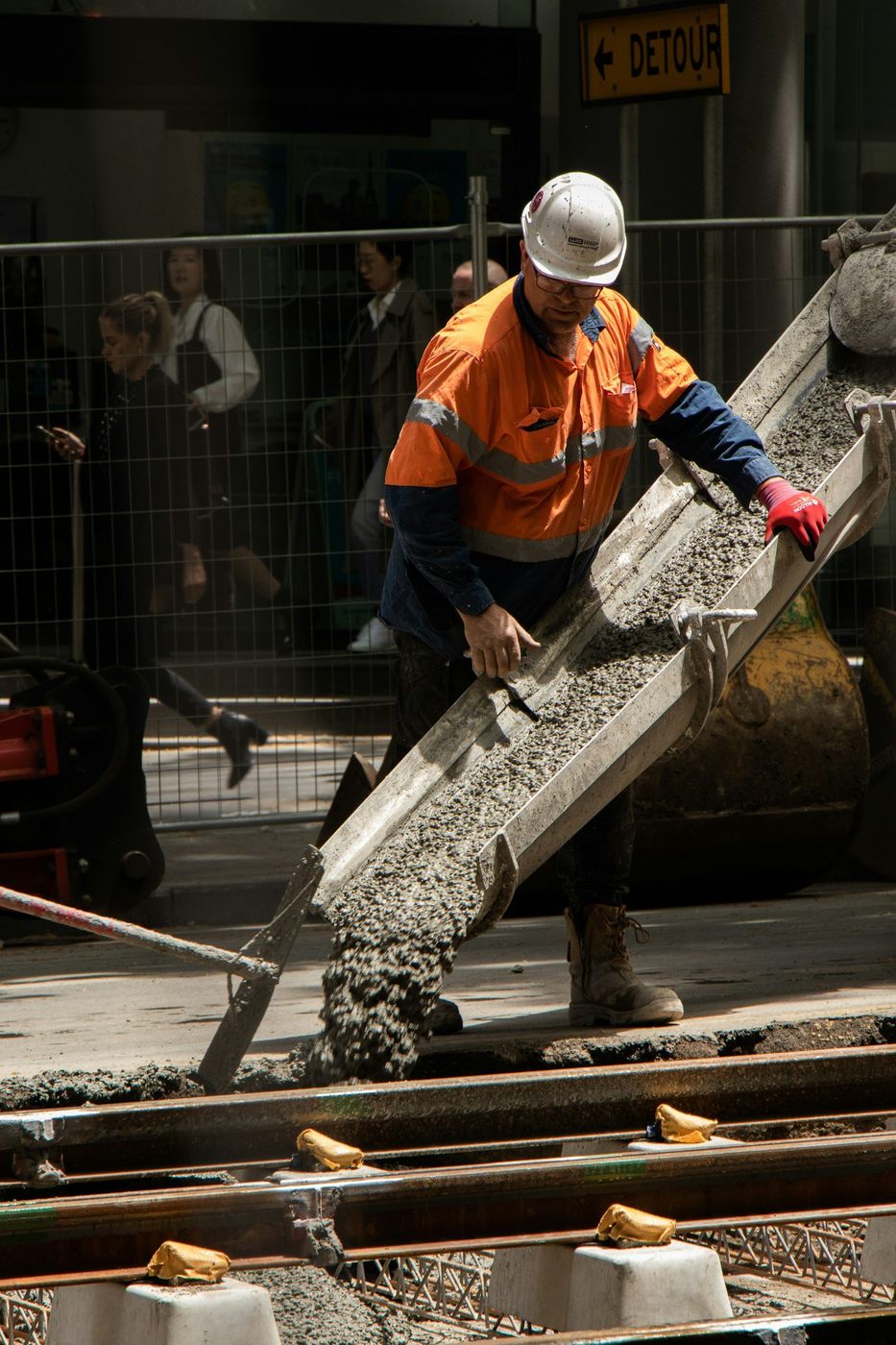
Wind off the open prairie decides when we wash. Everything else on the job bends around that.
A dry Tuesday in the middle of May, clean sky, temperature perfectly reasonable, and a fifteen mile northwest wind running across open ground with nothing to slow it. That's the day an exposed aggregate pour gets hard. Not the hot days. Not the cold ones. The windy ones, because moving air strips water off a fresh slab faster than heat does, and the window between a slab too soft to wash and one too hard to wash slams shut while you're still uncoiling hose.
Aurora hands us a lot of those days. Newer builds out toward Southshore and Murphy Creek sit on open lots with no mature trees breaking anything up. So we plan wash pours around wind the way other trades plan around rain.
First move is the start time. Wash pours get the earliest truck of the day, because dawn air is usually still and the sun hasn't started pulling. Second move is placement size. We only put down as much concrete as we can honestly wash in one continuous sweep, so a big driveway becomes two pours with a joint we planned rather than one pour with a seam we regretted.
Third is chemistry. On a day the wind is going to win, we spray a surface retarder right after finishing. That holds the top layer of paste soft under plastic overnight and moves the wash to the next morning, when we control the timing instead of the weather. It costs a day. It has never once cost us a slab.
Then the small stuff that adds up: evaporation retardant between passes, screens set upwind, wet burlap staged, and one person pressing a thumb into the first corner poured and calling the clock out loud. Wash too soon and stone rolls loose across your yard. Wash too late and you've got a gray slab with rocks buried in it that no pressure washer will rescue.
| Stone | The look | Underfoot | Worth knowing |
|---|---|---|---|
| Rounded pea gravel | Tan and brown pebbles, even and quiet | Smooth domes with good bite, fine for bare feet | Stocked by the plant, so it's the value pick and easiest to match later |
| Crushed granite | Gray and pink chips with sharp faces | Grabs harder than anything else we pour | Too rough for a pool surround. Ideal on a sloped drive or a shaded walk |
| Larger river rock | Bold and chunky, reads closer to landscape stone | Uneven. Patio chairs will rock on it | Catches leaf litter and grit. Best as a border or a feature band |
| Hand-seeded specialty stone | Whatever you choose, broadcast across the fresh surface | Depends entirely on the rock | More labor, longer lead time, and a test panel first, always |
Stone, wash depth, and sealer, done small so you can look at it in your own light. Call (303) 569-4046.
Put it where people slip. Shaded north walks, the run between a side gate and a back door, a driveway with any real pitch to it, and the apron in front of a garage where snowmelt refreezes overnight. A washed surface has genuine texture instead of a pattern imitating one, and boots and tires both find something to hold. Homeowners in Tallyn's Reach and Sterling Hills call us about that grip more often than they call about the look.
Skip it where people are barefoot every evening or where dining chairs get dragged back twenty times a night. That's a real limitation and we'd rather say it than sell you a patio you stop using in July. Pool coping and eating areas want a lighter texture, and we'll border those in exposed so the property still reads as one design.
Winter is the test that matters. A washed surface has more open area than a troweled one, so water settles between stones and freezes. Air entrained mix handles that. Deicing chemicals do not, and magnesium chloride on a washed slab pops rock loose faster than anything nature does. Sand, a plastic blade, a current sealer coat. That's the whole winter program.
Our outdoor window runs from the last hard freeze into early October, and we'd take the back half of September over any week in June. Nights cool off, the wind lays down, and there's runway to get sealer cured before the first storm. November through April we design and schedule. Nobody should be washing concrete with a hose in twenty degree air.
People think the wash is the skill. It isn't. The skill is standing there with your thumb in the concrete while everybody else is holding a hose and wants to start, and telling them no for another forty minutes.What our crew lead tells homeowners
Still unsure about something?
Call the crew at (303) 569-4046 and we will talk it through.

Get a free, no-obligation estimate from a crew that knows Colorado soil, Colorado weather, and how to finish concrete that lasts.
Accessibility
Adjust the site to fit how you read and browse. Your choices are saved on this device.