
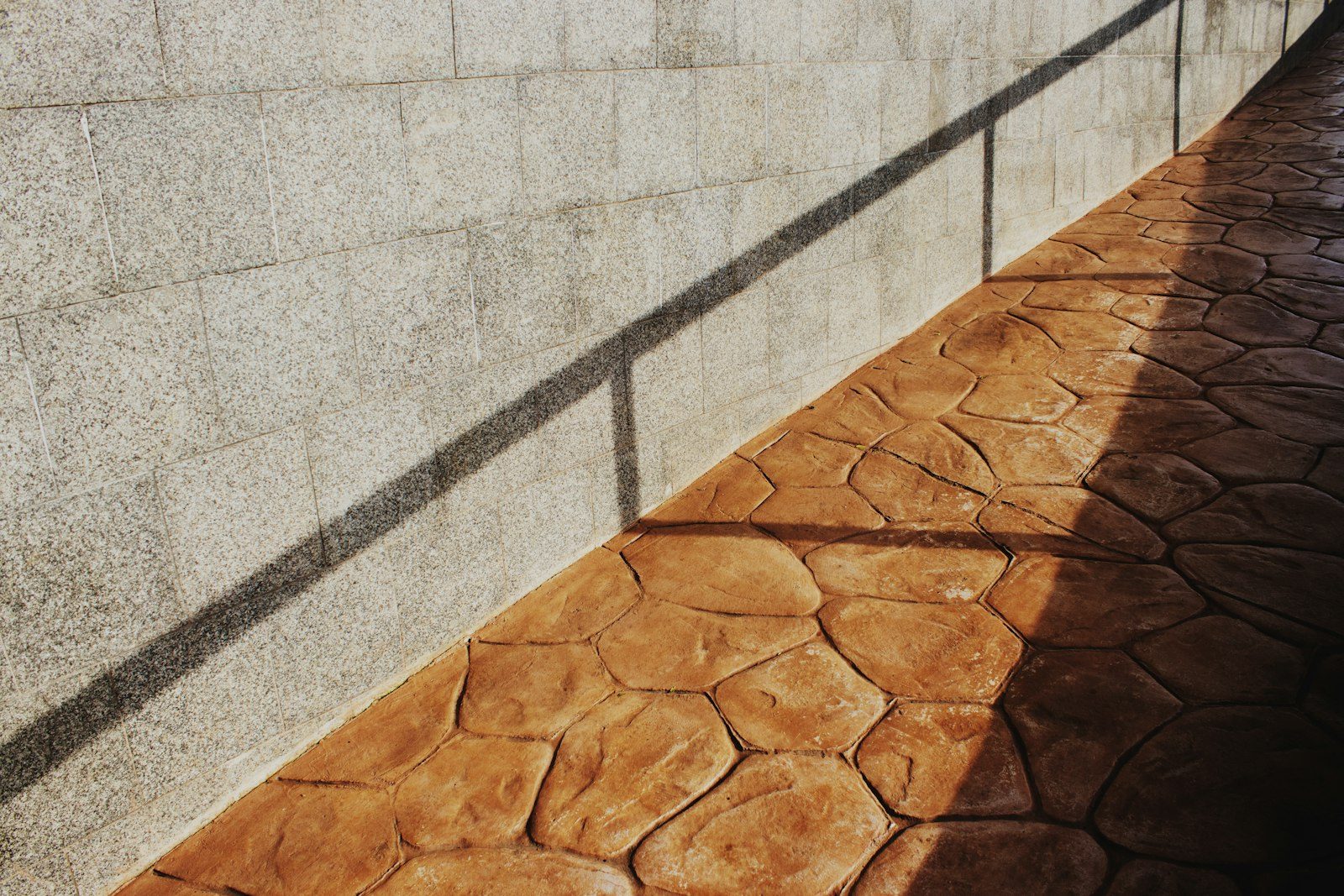
Shallow cut lines that give a plain slab a pattern, and give a wandering crack somewhere to belong.
Stand at your mailbox and count the lines on your driveway. Three of them, all in odd places, one stopping halfway across, and a crack that took its own route from the garage corner out to the apron. That's what most Aurora flatwork looks like from the curb. Functional. Unconsidered. A little sad in low afternoon light, which is when every line on a slab starts throwing a shadow.
Scoring is a saw, a chalk line, and a plan. We cut shallow decorative lines into cured or freshly finished concrete so a slab reads as a field of tiles, a diamond grid, a border with a plain center, or large panels that look deliberate. No topping, no tear-out, no color required. It costs layout time and blade time. It buys a surface that stops looking like an accident.
Most of what bothers people about a slab from the street traces back to jointing. Panels left too large crack somewhere in the middle, because concrete relieves its shrinkage stress wherever it likes when nobody gave it a planned place. Joints cut too late do the same, since the slab already picked its line before the saw showed up. Both look worse than they are.
Then the crooked-line problem. A joint that wanders, one that stops short, a grid that isn't square to the house. Those read as sloppiness even to people who couldn't say why. And the blank slab problem: a broad patio with almost no lines, sitting there like a parking apron.
Scoring addresses all three. A crack gets folded into a pattern until it reads as one line among many. A bad grid gets overwritten by a stronger one squared to the architecture. A blank field just needs geometry. What scoring cannot do is repair anything, and we say so on the first visit.
Two entirely different cuts get confused constantly, so here's the difference. A control joint is structural. It goes about a quarter of the way through the slab, which is roughly an inch on standard four inch flatwork, and it creates a deliberate plane of weakness so the concrete cracks there and nowhere else. Those get sawed the same day the slab goes down, spaced by thickness, panels kept near square.
A decorative score line is cosmetic. It lives in the top eighth to quarter inch, deep enough to hold a shadow, shallow enough that it touches nothing structural and reaches no reinforcement. Cutting decoration to joint depth is how amateurs create cracks that weren't going to happen. Cutting a control joint at decorative depth gets you a slab that ignores the joint and cracks two feet away. We hold both depths.
On a new pour there's a timing choice. Green cutting with a soft blade happens within hours and leaves a slightly rounded line with almost no dust. Waiting a few days and dry cutting gives a crisper edge and better control, which is what we want when line quality is the entire product. Structural joints never wait for the pattern plan.
One local caution. Every line you cut is a place water sits, and Aurora crosses the freezing point often enough all winter that a groove holding water works on the concrete. So we keep lines shallow, slope the layout so grooves drain, and put every scored exterior surface on a reseal schedule. We cut patterns from Sterling Hills out to Tallyn's Reach, and the jobs we turn down are the shaded north walks that never dry.
| What you see from the curb | What it usually means | Does scoring help |
|---|---|---|
| Crack running diagonally across a wide panel | Joints spaced too far apart or cut too late | Yes. It gets absorbed into a grid and stops being the focal point |
| Joints in random places, nothing square to the house | Layout was an afterthought on pour day | Yes. A stronger pattern squared to the wall overwrites it |
| A joint widened and chipped along both edges | Water and freezing working the shoulders | No. Joint repair first, then we cut around it |
| Big driveway with almost no lines at all | Nothing wrong. It just reads as a parking apron | Yes. A border band is the cheapest improvement in this trade |
| Crack with one side sitting higher than the other | The base has moved. This is a settlement problem | No. Cutting decoration into a moving slab hides nothing for long |
| Surface flaking and chalky between joints | Scaling from deicers, weather, or a weak finish | No. Resurface first, then score the new surface |
Stand on it, look from the street, sleep on it. Nothing gets cut until you say go. Call (303) 569-4046.
Still unsure about something?
Call the crew at (303) 569-4046 and we will talk it through.

Get a free, no-obligation estimate from a crew that knows Colorado soil, Colorado weather, and how to finish concrete that lasts.
Accessibility
Adjust the site to fit how you read and browse. Your choices are saved on this device.