
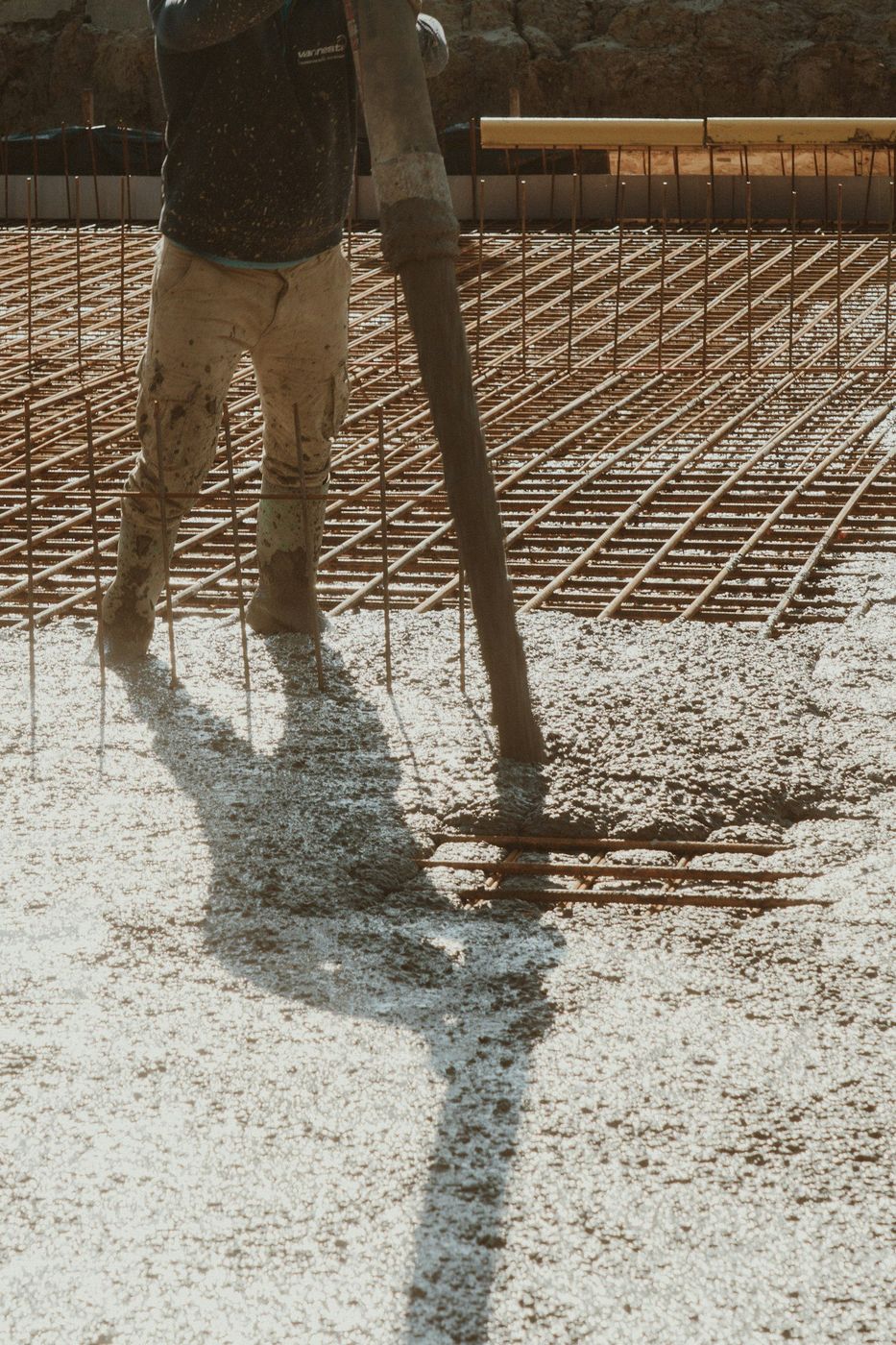
Slow down out front and the walk will tell you which panels are actually in trouble.
Stop at the curb before you turn into the drive. Look down the run when the light is low, early or late, so every lip throws a shadow. Cheapest sidewalk inspection going, and it catches most of what matters: the panel with a hard shadow line along one edge, the one still dark and damp two days after the rest dried, the corner a plow blade took off some February.
The walk out front is a different animal from the path to your door. Strangers use it. Kids ride bikes down it. A stroller has to make the whole block without detouring into the street. So the tolerance for a lip is lower, and whatever we build lives with brine spray, plow blades, and the tree that lifted the panel to begin with.
| Where you see it | What's going on below | What the fix looks like |
|---|---|---|
| The panel beside a street tree | A root grew under the slab and jacked one edge up | Take the panel out, deal with the root, repour with a joint where it travels |
| Where the walk crosses the driveway | Vehicle loads landing on a section poured at walk thickness | Rebuild that crossing thicker, with steel through it |
| Right along the curb line | Plow spray, brine, and street runoff all concentrate here | Often surface only, so a partial-depth repair holds |
| The seam with the neighbor's panel | Two slabs settling at different rates, nothing separating them | Replace the low one, put a real isolation joint between |
| A dip halfway down the run | Base material washed out, usually over an old trench line | Fix what's underneath or the new panel repeats the trick |
| The whole run leaning back toward the houses | Cross slope built the wrong direction | Rebuild it falling toward the street |
A vertical offset between two panels is the most expensive quarter inch on your property, and not because concrete costs much. Accessibility guidance treats a small vertical change as something to bevel or remove, and cities set thresholds on top of that. More to the point, it's what puts somebody's palms on the pavement.
Cross slope is the other measurement nobody thinks about until an inspector pulls out a level. The walk has to shed toward the street, gently, without tipping so hard that a wheelchair pulls sideways the whole way down. We shoot grade before we form and check it again before the truck backs up. Right-of-way requirements get confirmed with the city before we cut. We'd rather ask twice than saw once.
Send one photo down the length of the walk with the sun low. We can usually tell you where to stop.
Public walks take abuse nothing else on your lot takes. Plows throw a slurry of snow, brine, and grit onto the first few feet. Everybody's ice melt gets tracked down the run. And it stays wet longer than the driveway, because it sits low and the snow bank beside it feeds it all afternoon. That's why the curb-side edge goes before the middle does.
So every panel gets air-entrained mix. Those microscopic voids give freezing water somewhere to expand besides into your concrete.
April through October is the working season, and we like the shoulders best. Cool mornings in May and September hand the finishers room to work the surface properly. Winter panel work is possible with blankets, heated water, and a chloride-free accelerator, though the ground has to be thawed and the window between fronts has to be real. If a hazard shows up in December, call anyway. Sometimes the right answer that week is a temporary bevel and a spot on the spring calendar.
People point at the crack. We look at the joints. Nine times out of ten the crack is just the slab breaking where nobody gave it one, and the real problem is the dirt that washed out from under the low corner.The crew lead's read on it
A fresh panel in an older run reads lighter for a while. That's age, and it closes up over a couple of seasons as the new work weathers. Everything else we control: joint spacing, the width of the tooled edge, the direction of the broom, the radius on the corners. Get those right and the eye reads the run as continuous while the color catches up.
Around Murphy Creek and Saddle Rock we spend real time on this, because those walks went in block at a time and a mismatched repair stands out from three houses away. Straightedge and tape to the neighbors first, copy what's there, resist the urge to improve on it. In the right-of-way, matching beats upgrading.
Still unsure about something?
Call the crew at (303) 569-4046 and we will talk it through.
Get a free, no-obligation estimate from a crew that knows Colorado soil, Colorado weather, and how to finish concrete that lasts.
Accessibility
Adjust the site to fit how you read and browse. Your choices are saved on this device.