
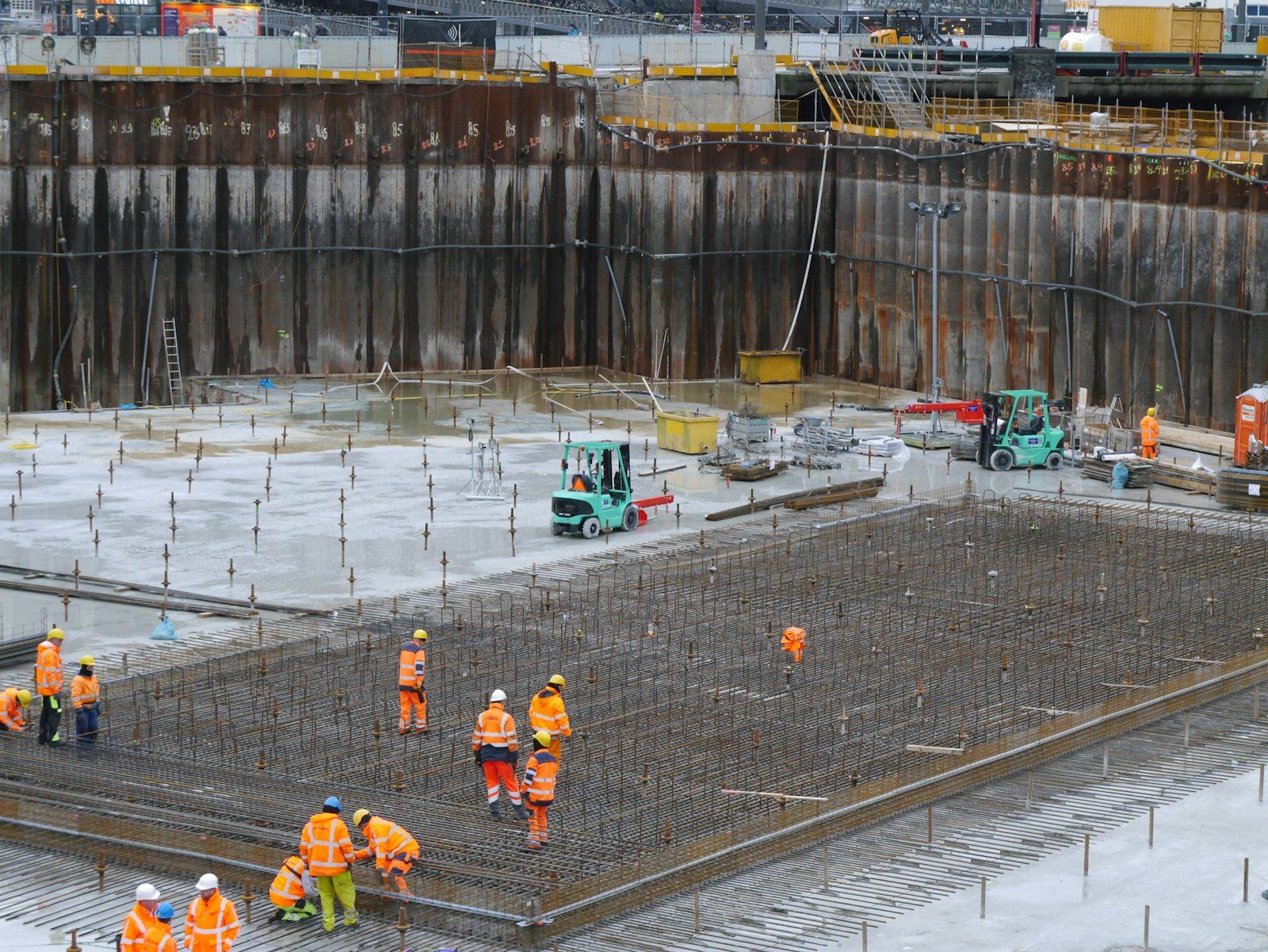
Breaking out old flatwork, hauling it off, and reading the calendar so the ground is ready when you need it.
Late March, forty-eight degrees, and the top three inches of every yard in town has turned to soup while the ground eight inches down is still locked solid. It's the worst week of the year to run a machine across a lawn, and it's exactly the week the phone lights up, because people spend the winter looking at a failing slab and decide in March that the thing has to go.
We'll take the job. We'll also tell you what that particular week costs: ruts a rake won't fix, a subgrade nobody can compact yet, and a pour date that slides anyway. Breaking concrete is close to weatherproof. Everything that happens after the breaking is not, and around here the ground opens up on its own schedule rather than ours.
| When | Working in your favor | Working against you |
|---|---|---|
| Deep winter | Frozen ground carries a machine without tearing up turf | Exposed subgrade refreezes overnight, so nothing gets compacted or poured behind it |
| Late winter thaw | Warm afternoons and an open schedule | Mud sitting on frost. Worst traction of the year. |
| Spring | Ground workable again, grass recovers fast, pour season opening | Our wettest stretch. Rain days push the calendar around. |
| Early summer | Long daylight and dry soil. Best window for demo and repour back to back. | Everybody wants it, so lead times stretch |
| Late summer | Hard dry ground breaks and loads cleanly | Afternoon storms and dust. We start at first light. |
| Fall | Stable soil, mild days, room on the calendar. Our first choice. | Daylight shrinks and the first hard freeze sets a real deadline |
A hydraulic hammer doesn't check the forecast. Give us access and a place to put the debris and we can take out a driveway in December as readily as in June. The complication starts the moment the old slab is gone, because a slab is a blanket. Pull it off and you expose dirt that has been protected from frost for thirty years, and that dirt starts freezing the first cold night.
Frozen subgrade can't be compacted, and base placed on frost settles when the frost leaves. So in cold months we either demo and pour inside one short weather window, or we break the slab, protect the ground with insulated blankets, and hold it until conditions turn. Neither of those is a problem if it's planned. Both are a problem if somebody discovers them on day two.
Wet is the other trap. A subgrade churned by a machine in saturated conditions has to be dried, recut, and recompacted before base goes down, and that's a day of work that produces nothing you can see. We'd rather move you a week than hand you an invoice for it.
Tell us what's coming out and what's going back in. We'll give you the two best windows on this year's calendar.
Aurora hands us a wide range on the same week. In Sterling Hills, Tollgate Crossing, and Murphy Creek it's usually flatwork that has run out its life: driveways with panels going three directions, patios that were never jointed, front walks that heaved and got patched twice. Those slabs are typically thin and lightly reinforced, and they come out quickly once we start.
Over in Tallyn's Reach, Southshore, and Saddle Rock the removals skew toward correction. A walk pitched back at the house. A patio that ponds every storm. A pad in the wrong place for what the family actually does in the yard. The concrete is young and sound, and the interesting conversation is about grade, because putting fresh concrete back on the same grade just restarts the clock.
Then there's the commercial side of a city this size. Loading aprons, worn parking bays, and pads around a building that has changed hands. Those get phased so the business keeps operating, and the weather math is the same, only with a schedule that has customers in it.
In February the ground is doing us a favor and we know it. We can put a machine anywhere without leaving a mark. Then the sun comes out for three days and the same yard turns into something you'd need a tow strap for. We look at the ten-day, not the morning.From the crew lead on these jobs
Still unsure about something?
Call the crew at (303) 569-4046 and we will talk it through.

Get a free, no-obligation estimate from a crew that knows Colorado soil, Colorado weather, and how to finish concrete that lasts.
Accessibility
Adjust the site to fit how you read and browse. Your choices are saved on this device.