
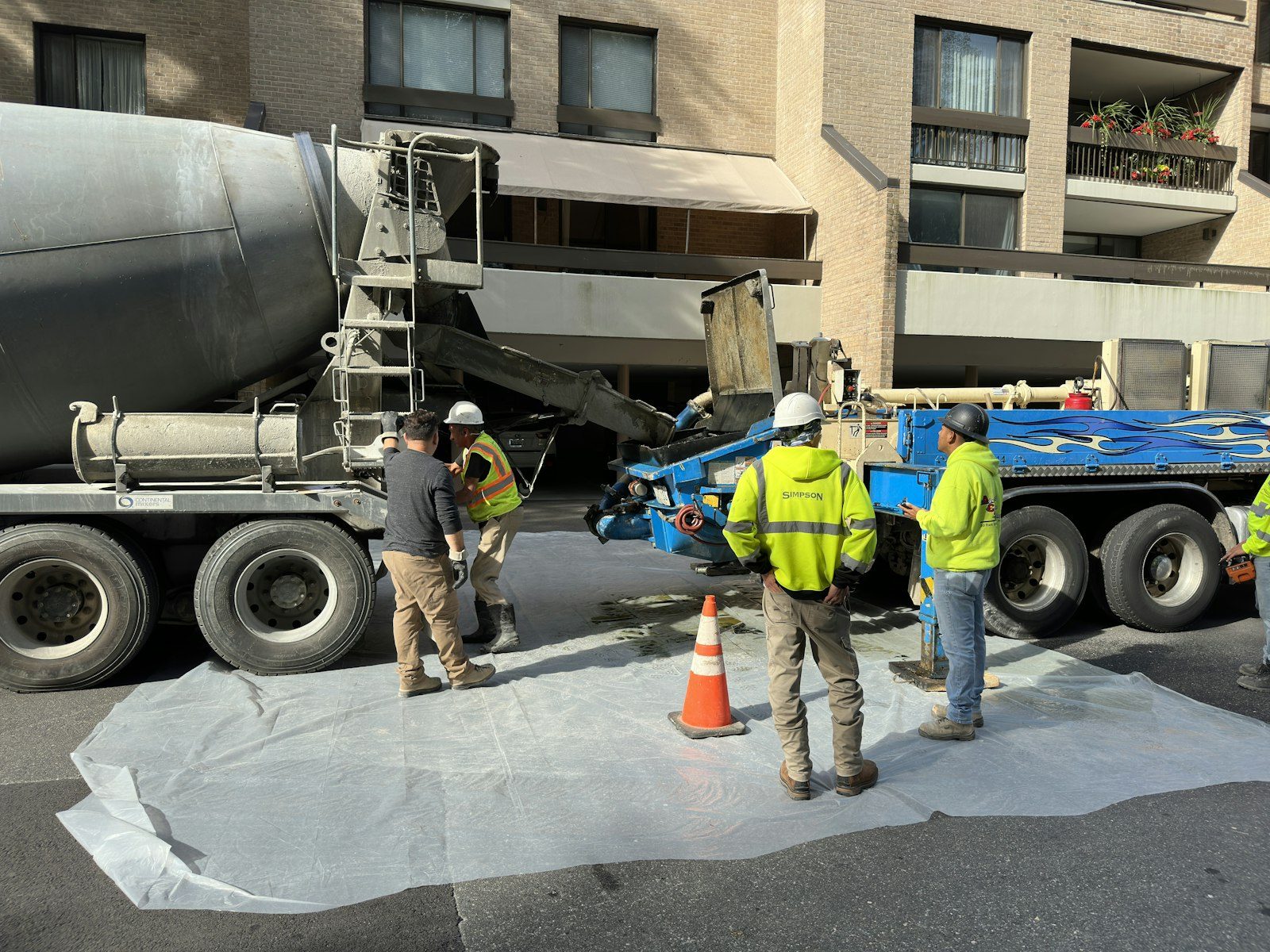
Everybody films the crane. The morning that decides how the building looks happened weeks earlier, lying flat on the floor.
A tilt-up wall gets built lying down. The panels are poured flat on a slab, cured until they can take a pick, then stood upright and braced. That is the whole idea, and it is why the method is quick and why a mistake made on casting morning is permanent by lunchtime.
This page walks through that morning. Not crane day, which gets all the attention, but the pour itself: what has to be finished before the first truck arrives, how the concrete goes into the form, which surfaces get created, and how we know a panel is ready to leave the ground. We do this work for shells, warehouses, service buildings, and flex space across the north metro, with our own engineer involved from the first layout drawing.
A floor gets placed in strips and finished behind the crew. A panel gets filled like a form, so the pour keeps moving and stays level across the whole piece. We work concrete around blockouts and embeds instead of dumping on top of them, and somebody stays with the vibrator the entire time, because consolidation decides whether the finished face has honeycomb in it. Too little and you get voids at edges and under embeds. Too much drives the mix apart.
Then the surface. The face that ends up inside the building is the one being troweled, so it gets screeded flat and finished for whatever happens indoors. Placement stops when the panel is full, not when the truck is empty. A cold joint through the middle of a wall panel is not a repair item. It is a new panel.
| Surface | How it gets treated | What it turns into |
|---|---|---|
| The top face while casting | Screeded, floated, finished for whatever happens indoors | The interior wall of the finished building |
| The bottom face on the casting slab | Takes its texture straight from the slab and the bond breaker | The exterior face people look at for the next thirty years |
| Panel edges against the side forms | Formed square, chamfered, kept free of grout leaks | The caulk joints that keep weather out of the building |
| Blockout perimeters | Braced to exact opening dimensions and released carefully | The reveals where door frames and glazing land |
| The casting slab itself | Protected under bond breaker, then patched and cleaned | Your finished floor, or a temporary bed that comes back out |
After the pour comes the least dramatic part of the job: waiting with data. Cylinders get cast from the same loads and cured beside the panels rather than in a lab, because what matters is the strength of concrete lying in your yard in the weather it actually saw. Those cylinders get broken, and the numbers set the lift date. Not the schedule, not the crane rental.
The inserts get their own attention. A panel is heaviest and weakest at the moment it leaves the slab, loaded in a direction it will never see again once it is standing. The engineer designs the insert pattern for that one event, and we set them to the drawing rather than to habit. Bracing goes in as each panel lands and stays until the roof diaphragm and the connections take over.
Bring the footprint and the schedule. We will tell you honestly where tilt-up wins on your job and where it does not. (303) 569-4046.
Sitting a bit over 5,300 feet with dry air and hard sun, panels lose surface moisture faster than most people expect. A May afternoon with wind behind it can craze a face before anybody finishes troweling, so we cast early, keep evaporation retarder and cover close, and cure hard. Summer storms are the other threat, since a downpour on a panel still being finished drives water into fresh paste and leaves a wall somebody has to grind.
Spring and fall are the best windows. Winter casting works. Water arrives heated, the accelerator carries no chlorides, and insulation goes over the panels. Panels come out right, though cold slows strength gain and pushes the pick date out. Most of this work lands on newer commercial ground toward Bradburn and Legacy Ridge, with the occasional replacement building near the older service properties around The Ranch and Quail Creek. Get the casting slab poured before the weather turns, because everything downstream waits on it.
Still unsure about something?
Call the crew at (303) 569-4046 and we will talk it through.
Get a free, no-obligation estimate from a crew that knows Colorado soil, Colorado weather, and how to finish concrete that lasts.
Accessibility
Adjust the site to fit how you read and browse. Your choices are saved on this device.