
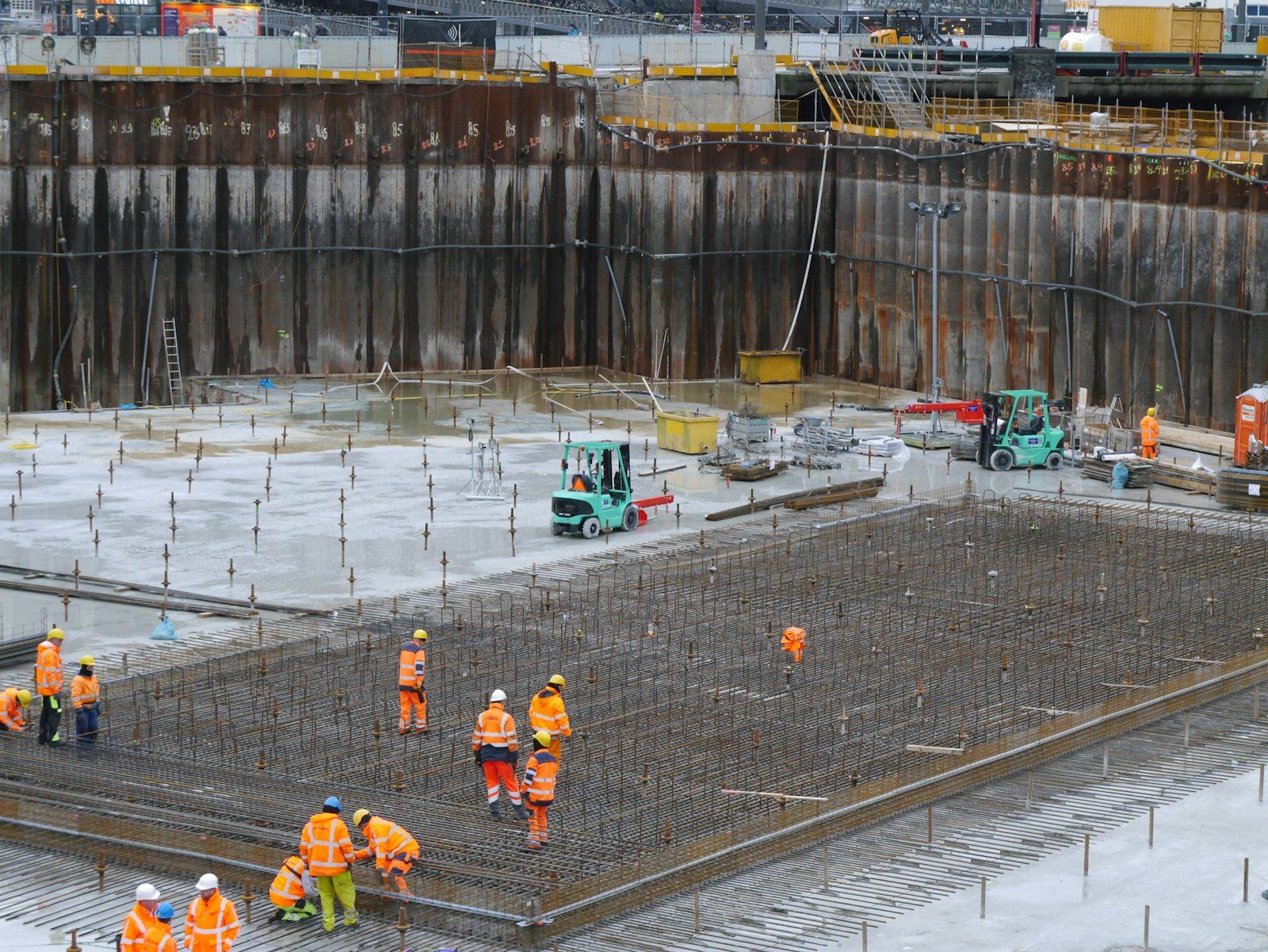
Cut one test square out of a tired commercial slab and the whole failure story is sitting in the first two feet of dirt.
Most commercial slabs we take out around here come out for the same reason, and it is almost never the concrete. We break a panel, load it into the truck, and stand in the hole looking at a couple inches of tired road base on ground that has been drinking irrigation water since the property opened. The slab did what it could. It was carrying a load nothing underneath it was helping with.
So this page is about the part of the job nobody sees again after pour day. Subgrade, base, compaction, drainage. We pour walks, service aprons, courtyard slabs, and delivery pads for retail, office, and flex property across the north metro, from the older commercial edges out by Quail Creek and The Ranch to the newer blocks around Bradburn. Different build eras, same question: what's actually holding this up?
Concrete is strong in compression and not much else. Set it on ground that stays put and it'll carry loaded delivery trucks for thirty years. Set it on ground that moves half an inch in one spot, and it cracks in that spot, no matter how much steel went in. That's the real design problem on flatwork here, and it gets solved with an excavator and a plate compactor, not with a richer mix.
Ground across this part of the metro is moisture sensitive. It carries weight fine when its water content holds steady and turns unreliable when that water content swings. Which is exactly what happens along a commercial building, where downspouts dump in one corner, spray heads run on a timer nobody has checked in years, and the plow contractor stacks snow in the same island every January. We aren't trying to change what the soil is. We're keeping its moisture boring.
So we dig until we reach material that doesn't pump under a loaded wheel, haul off whatever fails, and rebuild with aggregate placed in lifts thin enough to actually compact. Six inches dumped in one pass isn't six inches of base. It's three inches of base with three inches of loose rock riding on top, and it'll find you in year four.
| What's in the hole | What it means | What changes in the scope |
|---|---|---|
| Thin base straight onto native ground | The slab has been serving as its own base this whole time | Full excavation and a rebuilt aggregate section, no shortcuts |
| Dark, damp soil well below the surface | Something is feeding water under there year round | We chase the source before we put anything back |
| Old asphalt, brick, or busted concrete used as fill | Uncontrolled fill that keeps consolidating on its own schedule | Dig it out. We won't pour over debris |
| A soft ribbon running across the panel | An old utility trench that never got compacted properly | Overexcavate along the trench and rebuild it in narrow lifts |
| Clean gravel at a sensible depth | Somebody built it right the first time | Reuse what we can and put the savings into slab thickness |
We'll cut a test square and price the work off what's really down there.
Compaction and drainage are one conversation, not two. A well built aggregate section gives up most of its strength sitting saturated, so grading has to carry water off the slab and away from the material underneath it. We set fall to a real low point and keep the subgrade pitched the same direction so nothing ponds inside the base.
Downspouts cause more of this than anything else on commercial property. A roof drops an enormous volume of water into a very small footprint, and when that footprint is the corner of your service apron, the base under that corner is wet three seasons out of four. Irrigation is a close second. Spray heads along a building throw onto the walk and into the joints, timers keep running into October when nobody's watching, and the ground under the panel nearest the landscape is reliably the softest thing in the hole. Winter takes it from there: meltwater works into the joint, freezes overnight at 5,384 feet, and thaws by mid afternoon because the sun up here undoes almost every freeze.
Best stretch for this work runs April into October, and we like the shoulder weeks best, since the crew isn't fighting a surface that skins over faster than it can be finished. Cold pours are doable with heated water, a non chloride accelerator, and blankets. But we won't place on frozen ground, and that's a subgrade rule more than a concrete rule: compaction numbers taken on frozen material are a lie that comes due at thaw.
Still unsure about something?
Call the crew at (303) 569-4046 and we will talk it through.

Get a free, no-obligation estimate from a crew that knows Colorado soil, Colorado weather, and how to finish concrete that lasts.
Accessibility
Adjust the site to fit how you read and browse. Your choices are saved on this device.