
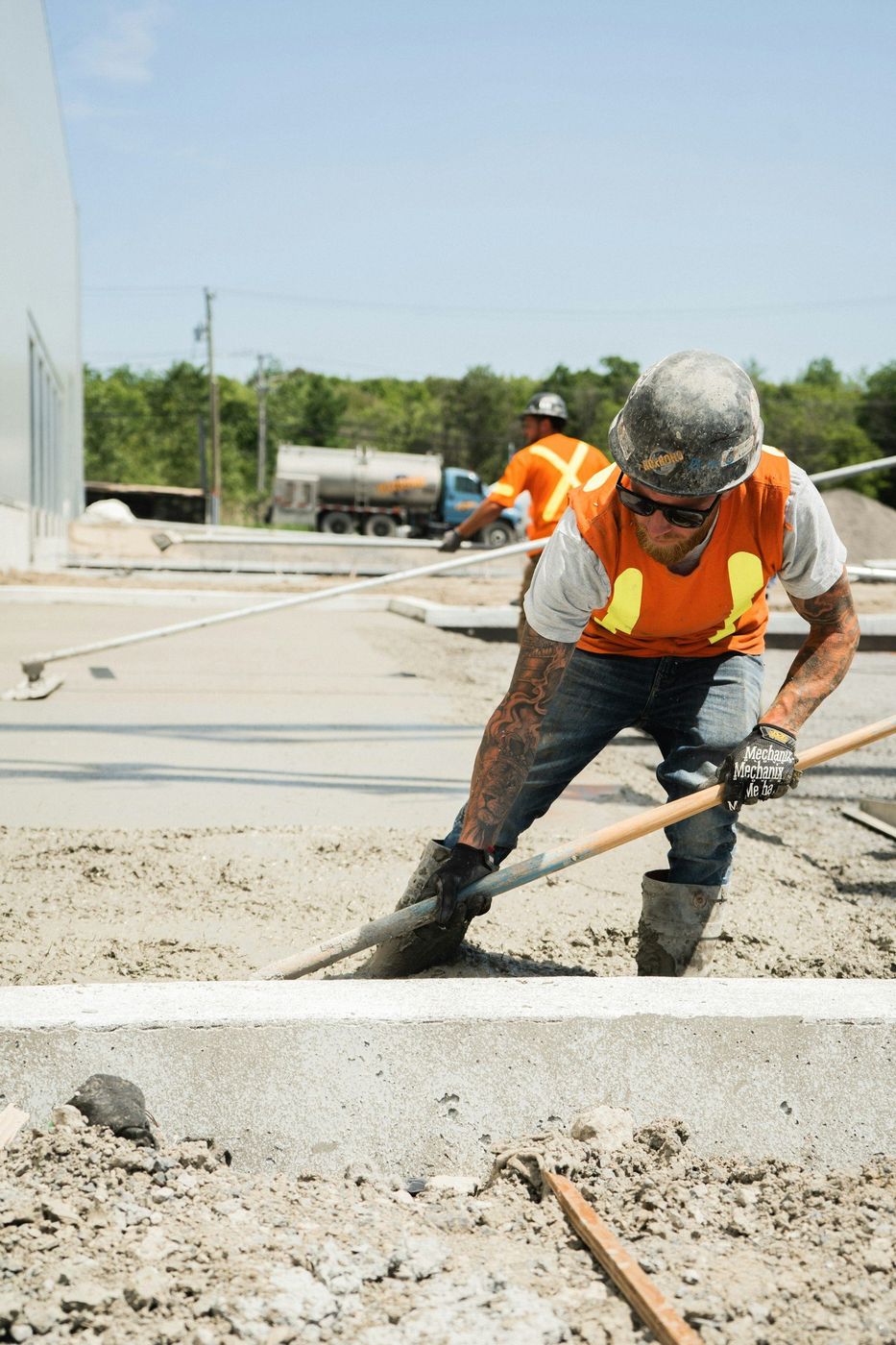
Two panels poured the same week by the same crew, and only one of them failed. The difference is always underneath, and usually it's the landscaping.
Walk a community's sidewalks with a board member and a pattern shows up fast. The bad panels aren't scattered. They sit next to sprinkler heads, under trees, beside downspouts, and in the corner where the plow contractor has stacked snow every winter since the place was built. Everything else on that walk is fine.
That pattern is the whole argument for how a bulk program should be scoped. Replacing a failed panel and putting nothing else right buys you the same panel again in eight years. We run community concrete programs for boards and managers around the north metro, including mature associations near Legacy Ridge, The Ranch, and Quail Creek where the original walks are now well past their easy years.
Sidewalk panels are thin, unreinforced or lightly reinforced, and completely dependent on the ground beneath them. So they act like sensors. Wherever the moisture under a community walk stays high, the ground gets soft and the panel drops. Wherever moisture gets in and freezes, the panel lifts. Both leave you with a lip, and a lip is what somebody catches a toe on.
Irrigation causes more of this than anything else on a residential property. Not because sprinklers are bad, but because they run on a schedule for months and nobody ever checks where the spray lands after a head gets bumped by a mower. A head throwing onto concrete puts water into the joint on every cycle, and that joint delivers it straight to the base.
Trees are the second one, and they're the harder conversation, because the tree is usually the reason people like that stretch of the community. Roots go where the water and air are, which under a sidewalk means right below the panel. And downspouts are the third, dumping an entire roof into one small area a few feet from a stoop.
| What's next to the panel | What it does underneath | What changes when we rebuild |
|---|---|---|
| Spray heads throwing onto the walk | Wets the soil under one edge all season long | Rotate, swap, or relocate the head before we pour, or the new panel repeats the old one |
| Drip line running along the panel edge | A steady damp ribbon a few inches from the base | Move the line out, or accept that edge as the weak side of the panel |
| Tree roots under a narrow walk | Lifts the panel and shears it at the joint | Root work with your arborist, a thicker section, or routing the walk around the tree |
| Downspout discharging near a stoop | A concentrated soaking every time it rains | Extensions carried past the concrete into landscape that can absorb it |
| Snow stacked in the same corner yearly | Slow saturation that runs into April | A new stacking location written into the snow contract before the season |
| Landscape beds sitting higher than the walk | Holds water against the edge instead of draining away | Regrade the bed so water leaves the panel rather than pooling at it |
We'll survey the community, mark the map, and give you a panel count you can actually budget against.
Here's what we tell boards. Fixing landscape conditions at the same time as the concrete adds very little to the program and it's the only thing that changes the outcome. An irrigation head takes minutes. A downspout extension is trivial. Moving a snow pile costs a conversation. Compared to what a panel replacement costs, those are rounding errors, and skipping them is how a community ends up running the same replacement list every few years.
Under the panels themselves, we rebuild rather than reuse. Excavate to material that holds, compact base in lifts, and set the new work at a grade that carries water off the walk instead of along it. Where a walk crosses a drive approach, thickness goes up and steel goes in, because that panel is carrying cars.
Scheduling in a community is its own discipline. We work April through October, block by block, with resident notice going out before saws run and access maintained to every door. Cars are the constant problem, so we need the manager's help with towing policy and driveway timing. Winter is for surveying, budgeting, and voting. Frozen ground under a thin sidewalk panel is not something we'll build on, and thawed spring ground gives us a truer read on what's failing anyway.
Still unsure about something?
Call the crew at (303) 569-4046 and we will talk it through.
Get a free, no-obligation estimate from a crew that knows Colorado soil, Colorado weather, and how to finish concrete that lasts.
Accessibility
Adjust the site to fit how you read and browse. Your choices are saved on this device.