
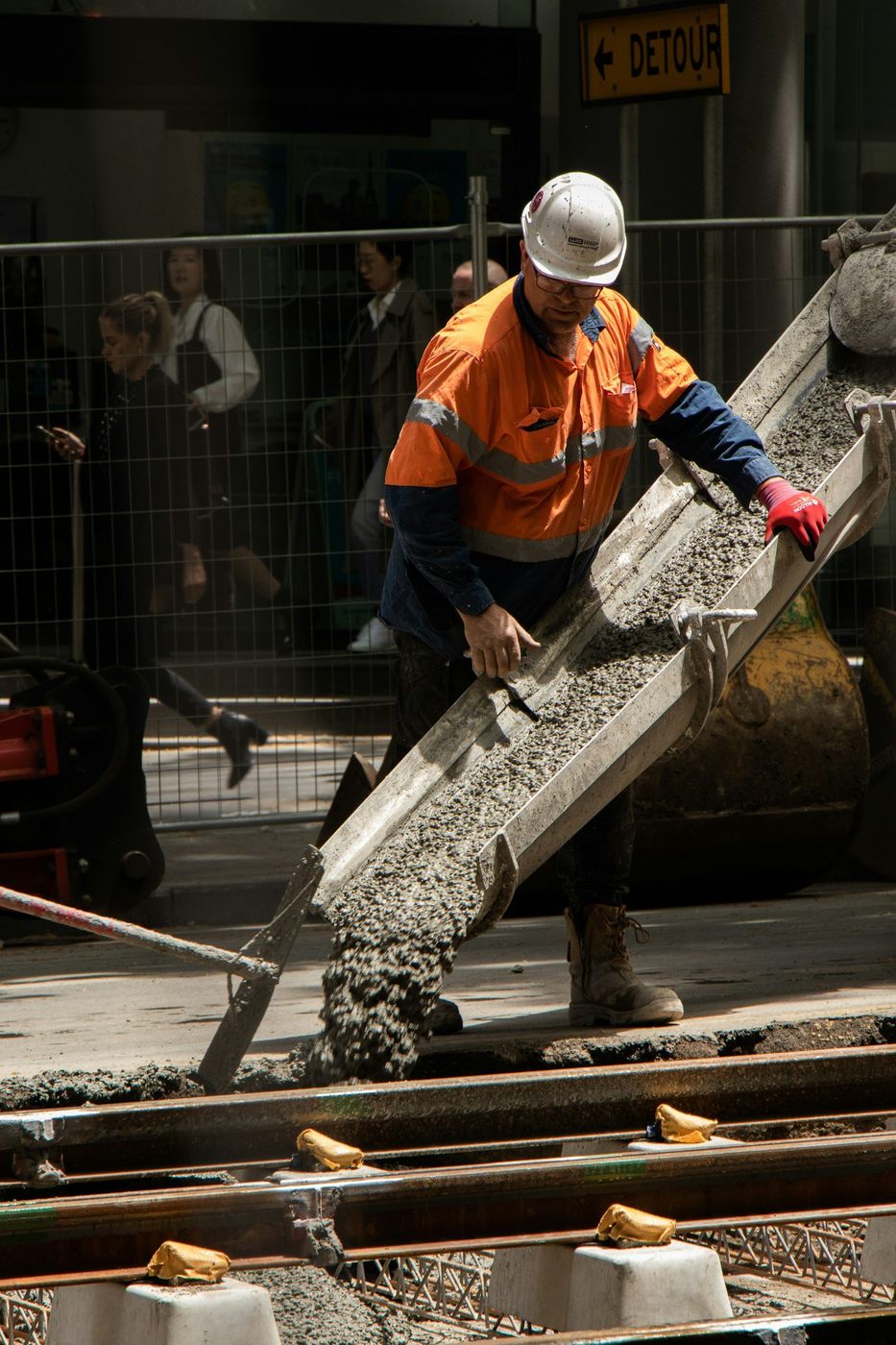
The floor goes in last, which means it inherits every hole anybody else on the job dug and backfilled in a hurry.
Arguments about warehouse floors happen at the surface. Flatness numbers, joint filler, whether the finish is hard enough for hard-wheeled lifts, what coating goes down and when. All legitimate. None of it is what ruins a floor.
Floors get ruined about eighteen inches down, by material that went back into the ground months before anybody ordered concrete. The footing crew backfilled their trenches. The plumber cut across the pad. The steel erector drove a lift over the same line four hundred times in March. By the time we walk into a shell in Thornton, that pad is a patchwork of six different dirt conditions wearing one flat surface, and our first job is to find out where the boundaries are.
Every crack we get called about in an existing building tells a story about a specific day during construction. Cracks running parallel to the exterior walls, a few feet in? That's footing trench backfill that settled. A crack wandering diagonally across a bay in a line nobody can explain? Follow it out the wall and there's usually a utility run under it. A soft, dusty area in one corner? That's where the pad got wet and nobody wanted to be the one who delayed the schedule.
So we start with a proof roll. A loaded truck or a fully weighted machine gets driven across the entire pad in a grid while somebody watches the ground rather than the tires. Anywhere the surface pumps, flexes, or leaves a rut deeper than it should, we mark it and dig it. That's an uncomfortable morning on a job where the shell is already up and the schedule is tight, and it's the single most useful hour we spend on a floor.
Then we rebuild what failed. Not bridge it with more concrete, not stiffen the slab and hope. Dig out the bad material, replace it with structural fill, compact it in lifts with the right equipment, and re-proof. Uniform beats strong under a floor slab, every time. A pad that's consistently mediocre outperforms one that's excellent in nine bays and soft in the tenth.
| What we find in the pad | How it got that way | What we do before concrete is ordered |
|---|---|---|
| Trench spoil pushed back against the footings | The footing crew backfilled with what came out of the hole, in one big lift, with a bucket | Dig it back out to the footing face and replace with structural fill in lifts. Cracks that run parallel to the walls start right here. |
| Uncompacted utility trenches crossing the pad | Plumbing and electrical went in on their own schedule and nobody came back to compact behind them | Re-excavate or backfill with flowable fill. This is why so many floor cracks trace a pipe run you can't see from above. |
| Over-excavated corners the fill never caught up to | Operators clean out corners deeper than the plan, and the correction gets forgotten | Structural fill placed in lifts and compacted with equipment that fits the space, then proof rolled like everywhere else |
| Saturated clay from a wet winter shell | The building went up over a long winter, the roof closed in late, and the pad drank everything that fell | Dry it, scarify and rework it, or dig it out. Sometimes we wait. Placing over wet clay is the most expensive shortcut available on this job. |
| Imported fill that looks right and tests poorly | Somebody bought material by appearance rather than by gradation | Test it. If it won't compact to spec, it comes out. Fill that looks like road base and behaves like sand is worse than native ground you actually understand. |
| Ruts through a pad that was already approved | Concrete trucks, scissor lifts, and the steel crew worked across the finished subgrade for weeks | Regrade, recompact, re-proof. The pad signed off in June is not the pad that exists in September. |
Get us in for a proof roll before the schedule locks. Finding a soft bay now is a morning. Finding it later is a saw and a crane.
Under the slab, above the base, goes the vapor retarder, and it goes there whether or not the building is heated. Water vapor moves out of the ground toward the drier air inside a building, and in Adams County that ground holds moisture in clay that stays damp far longer than the surface suggests. Without a retarder, that vapor arrives at the underside of your slab and keeps going. It shows up as a floor that sweats in the spring, as adhesive failures under any coating you install later, and as white efflorescence at the joints.
There's a real argument about whether a layer of sand goes between the retarder and the slab. Our position is that it usually causes more problems than it prevents on the kind of buildings we work in, because that sand becomes a water reservoir if it gets rained on before the pour. We place the slab directly on the retarder, over a clean compacted base, and we manage the finishing schedule to deal with the slower bleed that comes with it. Retrofitting any of this is not a thing you can do. It's the layer you get one chance at.
Season still matters even under a roof. A shell without heat in January is a cold box with a cold slab, and concrete that can't gain strength on schedule will sit there vulnerable for weeks. We place winter floors with heated water, accelerator, temporary heat, and enough air movement to control humidity without blowing dry air across a green surface. Around the older light industrial buildings near Eastlake we're usually replacing floors inside operating businesses, which is a phasing problem more than a weather problem. Out toward the newer construction around North Creek Farms it's mostly new shells, and there the timing is dictated by whether the roof and the doors beat the cold.
We proof roll every pad, including the ones with a passing compaction report already in the file. Reports get run on the day the pad is finished. We show up two months and a hundred lift passes later, and the two are rarely the same piece of ground.Our crew lead, after the walkthrough
Still unsure about something?
Call the crew at (303) 569-4046 and we will talk it through.

Get a free, no-obligation estimate from a crew that knows Colorado soil, Colorado weather, and how to finish concrete that lasts.
Accessibility
Adjust the site to fit how you read and browse. Your choices are saved on this device.