
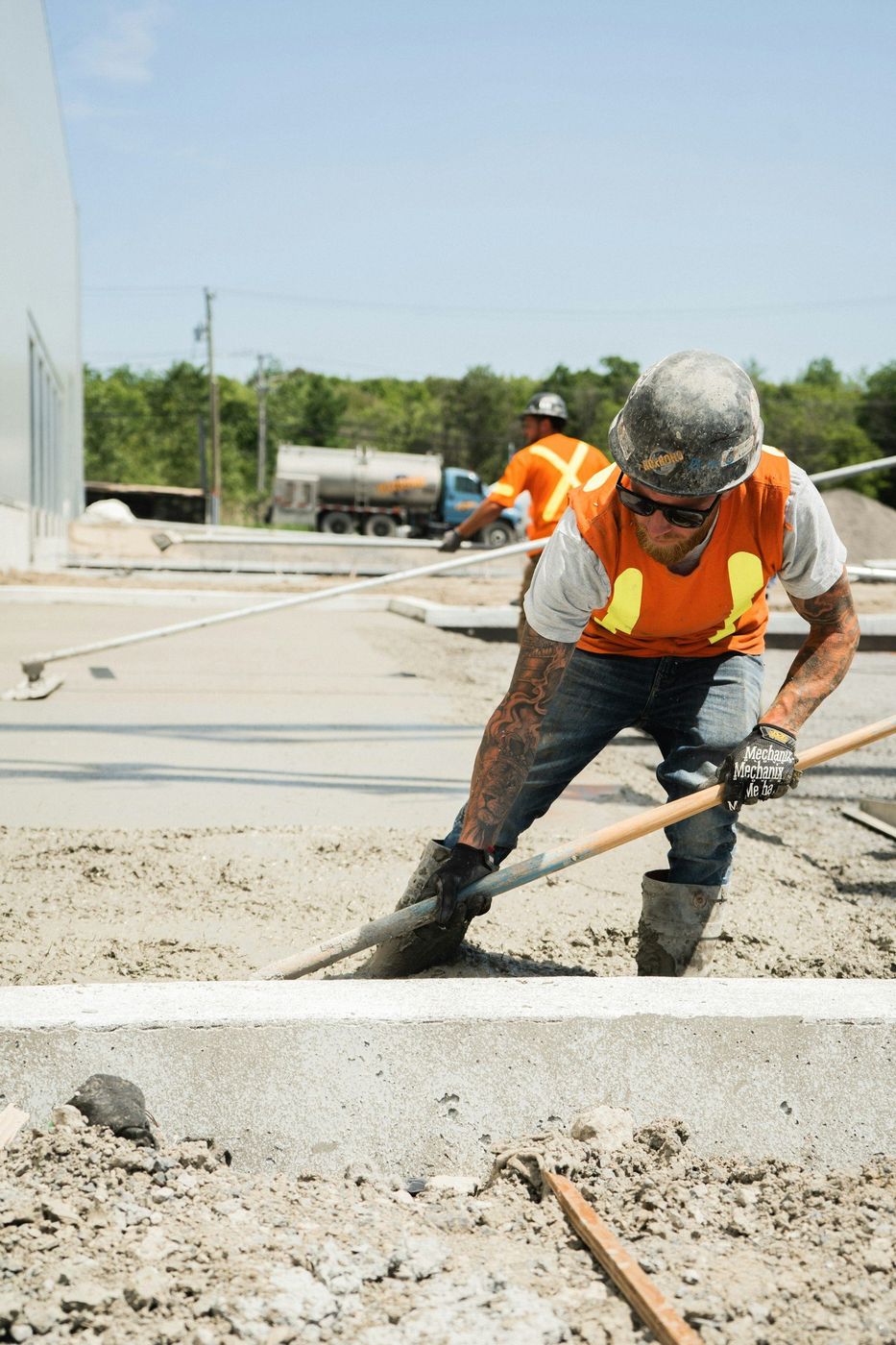
A commercial slab is decided in the ninety minutes after the last truck washes out, not in the hour everybody watches.
Most people who sign off on commercial concrete never see the middle of it. You approve a scope, you get a start date, and a week later there's new flatwork where the broken stuff used to be. Fair enough. But the day itself has a shape, and once you know that shape it gets a lot easier to tell a real crew from a cheap one.
So here's the honest version of a pour day on a Thornton property. Walks, service aprons, trash approaches, pads behind a retail row, entry landings at an office suite. They all run the same rhythm. Long quiet stretches where nothing appears to be happening, then a short window where six people move fast and the concrete decides what kind of surface it plans to be for the next twenty five years.
We're on your property before the batch plant loads the first truck. Forms went in the day before, but grade gets rechecked in the morning, because a form can get bumped overnight and nobody will admit it. We pull a string, confirm the fall runs away from every door the slab touches, and roll a loaded wheelbarrow over anything soft in the base.
Then the first truck backs in and placing goes fast. From a storefront window that looks like the whole job. It's maybe a fifth of the labor. Then the crew stops, and that pause is the important part. The slab is pushing bleed water up and can't be touched until that water is gone. Work it early and you lock water into the top eighth of an inch, which is how a surface ends up chalking under a push broom two winters later.
| What the slab is doing | What that tells us | What happens next |
|---|---|---|
| Water standing on the surface | The mix is still bleeding and the slab is nowhere near ready | We keep our hands off it. Anything worked into that water becomes a weak, dusty top layer. |
| Sheen gone, water pulled back in | The window just opened | Bull float goes across, then edges and joint layout. This is where the day gets loud. |
| A boot leaves a shallow print | Ready for the broom or the first trowel pass, depending on the finish you picked | Crew spreads out and works in sequence so no section gets left behind the rest. |
| Top crusting while the middle stays soft | Dry air and wind are stripping water off the surface faster than the slab can replace it | Evaporation retardant, a wind break, and a tighter finishing order. On rough days we shrink the placement. |
| Print barely shows and the edges have gone firm | Saw time is close | Saw crew stages up. Cuts go in the same day, early enough to beat shrinkage and late enough that the edge doesn't ravel. |
Tell us the property and roughly how much square footage. We'll walk you through the sequence and what stays open, before anybody writes a number.
April through October is the comfortable stretch for exterior flatwork here, and given a free choice we'd take the back half of September every year. Warm days, cool nights, runway before the first hard freeze. June and July are fine. We start earlier and watch the radar, because at 5,351 feet a storm can build and cross your property inside twenty minutes.
Thornton keeps growing north, so our work splits between brand new pads and replacement flatwork at properties serving the older side of town near Eastlake. Associations in Hunters Glen and Quail Valley bring shared walks, kiosk pads, and clubhouse entries. Newer construction toward North Creek Farms usually calls about builder flatwork that never got the base it needed.
Winter placement happens: heated mix water, non-chloride accelerator, blankets, and a window chosen between fronts. What we won't do is place on frozen ground. Frost in the subgrade means the slab is resting on something that disappears in March.
Half of what goes wrong on pour day has nothing to do with concrete. A locked gate. A delivery truck parked against the forms. A container somebody rolled into our staging spot overnight. Those get solved with a phone call the day before.The crew lead's read on it
Still unsure about something?
Call the crew at (303) 569-4046 and we will talk it through.

Get a free, no-obligation estimate from a crew that knows Colorado soil, Colorado weather, and how to finish concrete that lasts.
Accessibility
Adjust the site to fit how you read and browse. Your choices are saved on this device.