
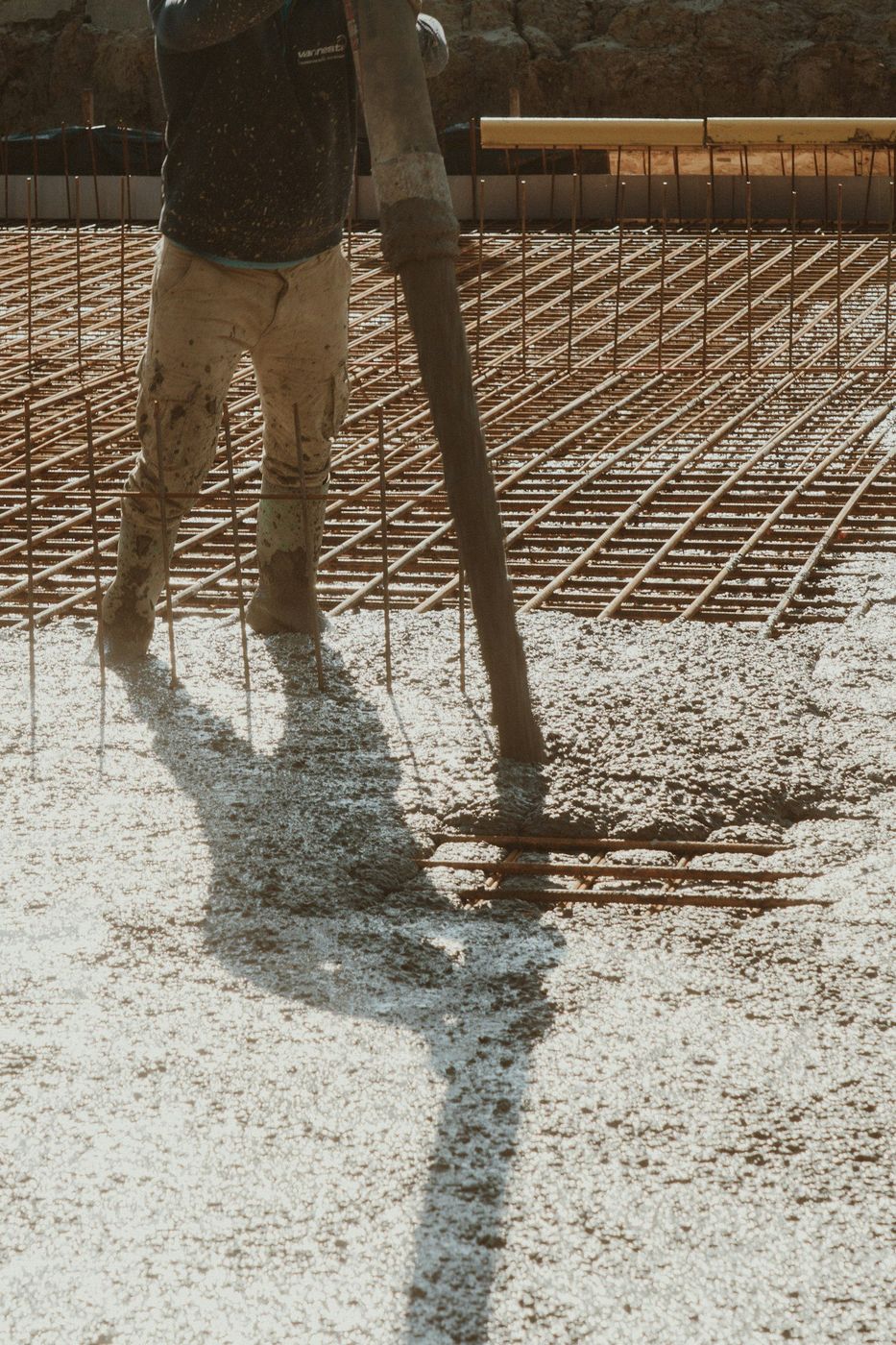
Your apron spends far more hours holding pallets, empties, and a parked forklift than it ever spends holding a trailer.
Everybody designs a dock around the truck. Fair enough, the truck is the heaviest thing that touches it. But go stand at a service door on a Thursday afternoon and watch what actually happens out there. A trailer is in the position maybe two hours of an eight hour shift. The rest of the time that concrete is a work surface, a staging area, a parking spot, and a place where things get dropped.
That daily use is what wears a dock out, and it's what most rebuilds get wrong. We build approaches for the truck load, obviously. We also build them for four hundred forklift passes a week across the same eight feet, for the corner where empties get stacked, for the pressure washer, and for the January morning when the meltwater from the roof drain freezes right where the pallet jack has to turn.
Morning starts with the door up and the forklift crossing the threshold, loaded, before anybody's had coffee. That crossing happens dozens of times a day, and it's the single most repetitive load anywhere on your property. Small hard wheels, a heavy load out on the forks, and a joint or a lip right in the path. If your operator can hear the crossing from inside the building, that's not a noise problem, that's an edge that's already breaking down.
Midday, the apron becomes a floor. Pallets stage on it. Empties stack in the corner. Somebody sets a pallet jack down. A gaylord full of returns sits out there for three days because nobody's moved it. Every one of those is a point load parked on the same square foot of concrete for hours, and on an apron with a weak subgrade you can eventually see the outline of where the stack lived.
Afternoon brings the cleaning. Hoses, scrubbers, sometimes a pressure washer at a setting nobody checked. Then the door comes down, the roof drain keeps discharging, and whatever water is on the apron at five o'clock decides what the surface looks like by March. That's the cycle. Not one dramatic load, just the same ordinary use hitting the same spots several hundred times a year.
| Transition the wheels cross | What the operator feels | How we build it |
|---|---|---|
| Building floor to the leveler lip | A hard bang once the floor edge has spalled back from the pit | Armored edge at the pit wall, concrete placed tight to the steel angle, and a joint filler that supports the corner rather than hiding it |
| Leveler lip to the trailer bed | Nothing, when the trailer sits in the leveler's working range. Everything, once the approach has settled. | Approach slope built so a loaded trailer parks inside that range instead of at the very bottom of it |
| Pit wall to the approach slab | A step that gets taller every year | Approach doweled into the pit wall and built on the same compacted section, so the two move together or not at all |
| Approach slab to the yard pavement | A lip or a dip right where the trailer wheels land | Doweled construction joint with a thickened edge on the concrete side, and asphalt built up to meet it instead of feathered onto it |
| Across a trench drain | A hollow rattle and a slow crawl over the grate | Frame cast into the slab, grate load rated for your equipment, and the concrete thickened on both sides of the trench |
| Approach into the drive aisle turn | Nothing at all, which is exactly the point | Full slab section carried through the turn, because a trailer's rear wheels track well inside the tractor and cut that corner every time |
Tell us how your freight runs and we'll build the phasing around it, then put the whole scope in writing at no charge.
A dock is a hole dug against a building, which means water that lands anywhere near it is headed your way. Roof drains discharge there. Snow gets plowed off the yard and stacked at the corner of the apron. Trailers arrive covered in whatever the highway got treated with and drip it onto your concrete for two hours. Then the shade of the building keeps that whole area frozen while the rest of the property thaws by ten in the morning.
That's why we spend as much time on the drainage as on the slab. Positive slope away from the door, a drain that actually has somewhere to go, and a base that drains instead of holding water against the pit wall. Skip that and the freeze cycles will lift the approach away from the building no matter how much steel is in it.
Best months for dock work here run from April into October, and shoulder season is genuinely nice because freight volumes at a lot of properties dip and a door can come offline without drama. We do winter dock work with heated mix water, non-chloride accelerator, and blankets, and it's often the right call at a light industrial building whose slow season is January. Around the older commercial buildings near Eastlake we mostly see single service doors with grade-level ramps, while the newer pads out toward North Creek Farms tend to have proper dock-high positions that were built fine and then drained poorly.
You can tell how a dock gets used before anybody says a word. Look for the polished stripe where the forklift runs, the four dents where the pallet stack lives, and the dark patch under the roof drain. Those three spots tell us where to put the steel and where to put the slope.Our crew lead, after the walkthrough
Still unsure about something?
Call the crew at (303) 569-4046 and we will talk it through.

Get a free, no-obligation estimate from a crew that knows Colorado soil, Colorado weather, and how to finish concrete that lasts.
Accessibility
Adjust the site to fit how you read and browse. Your choices are saved on this device.