
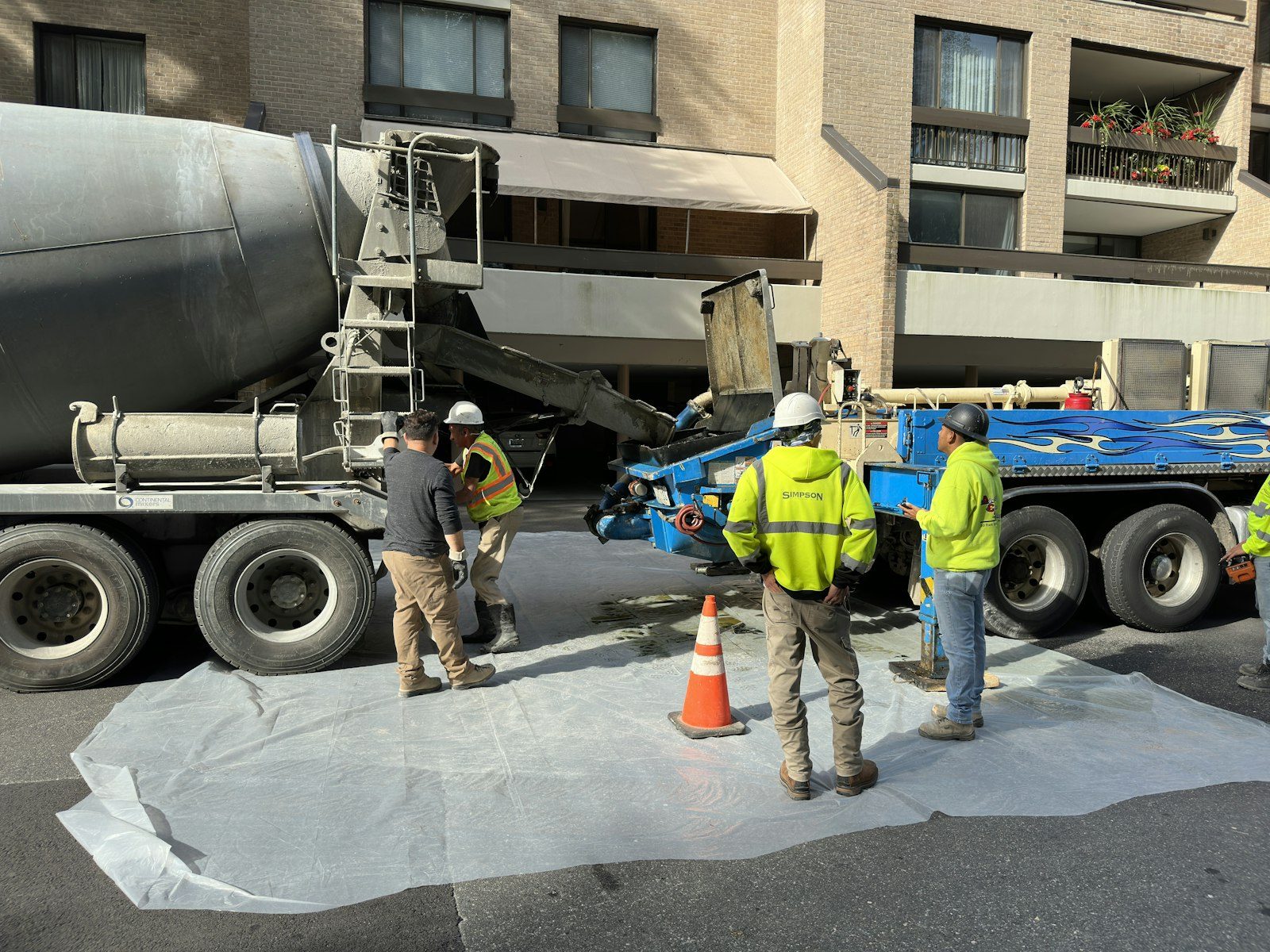
A community program isn't one big pour. It's a few hundred small ones, and every resident only ever sees the one in front of their house.
Boards approve community concrete programs in square footage and panel counts. Residents experience them as one specific morning when a machine shows up outside their bedroom window. Both of those are true, and the gap between them is where most of the complaints come from.
So this is the version we walk boards through before anybody votes. Not the phasing chart, not the budget spread, but the actual day. Who arrives, when the loud part happens, how long a resident is walking around a barricade, and when the orange fencing finally comes off. Once a board can picture that clearly, the notice letter almost writes itself, and the calls to the management company drop off a cliff.
We work a block at a time, and the block gets picked the week before so notice can go out with a real date on it. The afternoon before, somebody walks it with paint and marks every panel coming out. That's the last quiet step.
Morning starts with the saw. All the cutting for the block gets done in one pass, back to back, because it's the loudest thing we do and nobody benefits from spreading it across six hours. Then the breaker and the loader come through, panels come out, and the debris gets hauled off the street rather than stacked on somebody's lawn to wait for a truck.
Here's where a good crew separates itself. With the old concrete gone, the base is exposed and we can finally see what we're building on. Some panels are simple: regrade, compact, done in twenty minutes. Others show us why that panel failed in the first place, a soft pocket, a saturated area under a downspout, roots, a trench nobody knew was there. Those get dug and rebuilt. It slows the block down and it's the whole reason the new panel outlasts the old one.
Concrete arrives late morning or early afternoon depending on the block. Placing and finishing a run of walk panels is quick. Then it sits, and that waiting stretch is when residents assume everybody went home. We're on site watching it, and the saw crew comes back that evening to cut the joints.
We'll walk the community, mark and count panels by condition, and hand you a scope you can present. No charge and no obligation.
| Step | How long it takes | What it blocks while it's happening |
|---|---|---|
| Marking and layout | The afternoon before | Nothing. Paint on concrete and a hanger on the door. |
| Saw cutting the perimeter | A couple of minutes per panel | The walk, and it's loud. We batch a whole block's cutting into one pass to get it over with. |
| Breaking out and hauling off | Ten to twenty minutes per panel with a machine on the block | The walk plus a working area beside it. Noisiest stretch of the day. |
| Grading and compacting the base | Fifteen minutes on a clean panel, most of an hour when we find something | Same footprint. This is where a careful crew slows down and a cheap one keeps moving. |
| Forms and steel | About ten minutes | Nothing new. The block is already closed off. |
| Placing and finishing | Twenty minutes of work, then two to four hours of waiting on the concrete | The panel, and anything somebody could step onto it from |
| Sawing the joints | Same day, frequently after dinner | A short burst of noise. We warn the block when a cut is going to run late. |
| Barricades come off | 24 to 48 hours for walks, seven days for a driveway apron | Nothing at all, which is the point |
New concrete never matches old concrete on day one and any contractor who promises otherwise is setting up a hard conversation later. What we can control is texture, joint pattern, panel size, and edge detail, and those matter more to how it reads than color does. We match the broom direction, we hold the original joint spacing so the run keeps its rhythm, and we replace whole panels rather than leaving odd slivers. Give it two seasons of sun at this elevation and the tone closes up on its own.
Communities here age at different rates and it shows in the scope. The mature associations around Hunters Glen and Quail Valley have original walks with panels that have been lifting and dropping for decades, plus drive aprons that took the brunt of it. The older stock near Eastlake often has narrow walks poured without much base under them. Newer neighborhoods like North Creek Farms are usually dealing with builder work that was thin at the aprons rather than genuinely worn out.
For scheduling, May through early October is the window we want, and the sweet spot is right after school starts, when daytime traffic in a community drops and the weather is still generous. Deep summer works but afternoon storms complicate the finishing window, so summer blocks start early. Winter is possible with heated mix water, accelerator, and blankets, and we're honest that it's a harder pour with a longer barricade time. We won't place on frozen ground in a community any more than anywhere else.
Still unsure about something?
Call the crew at (303) 569-4046 and we will talk it through.
Get a free, no-obligation estimate from a crew that knows Colorado soil, Colorado weather, and how to finish concrete that lasts.
Accessibility
Adjust the site to fit how you read and browse. Your choices are saved on this device.