
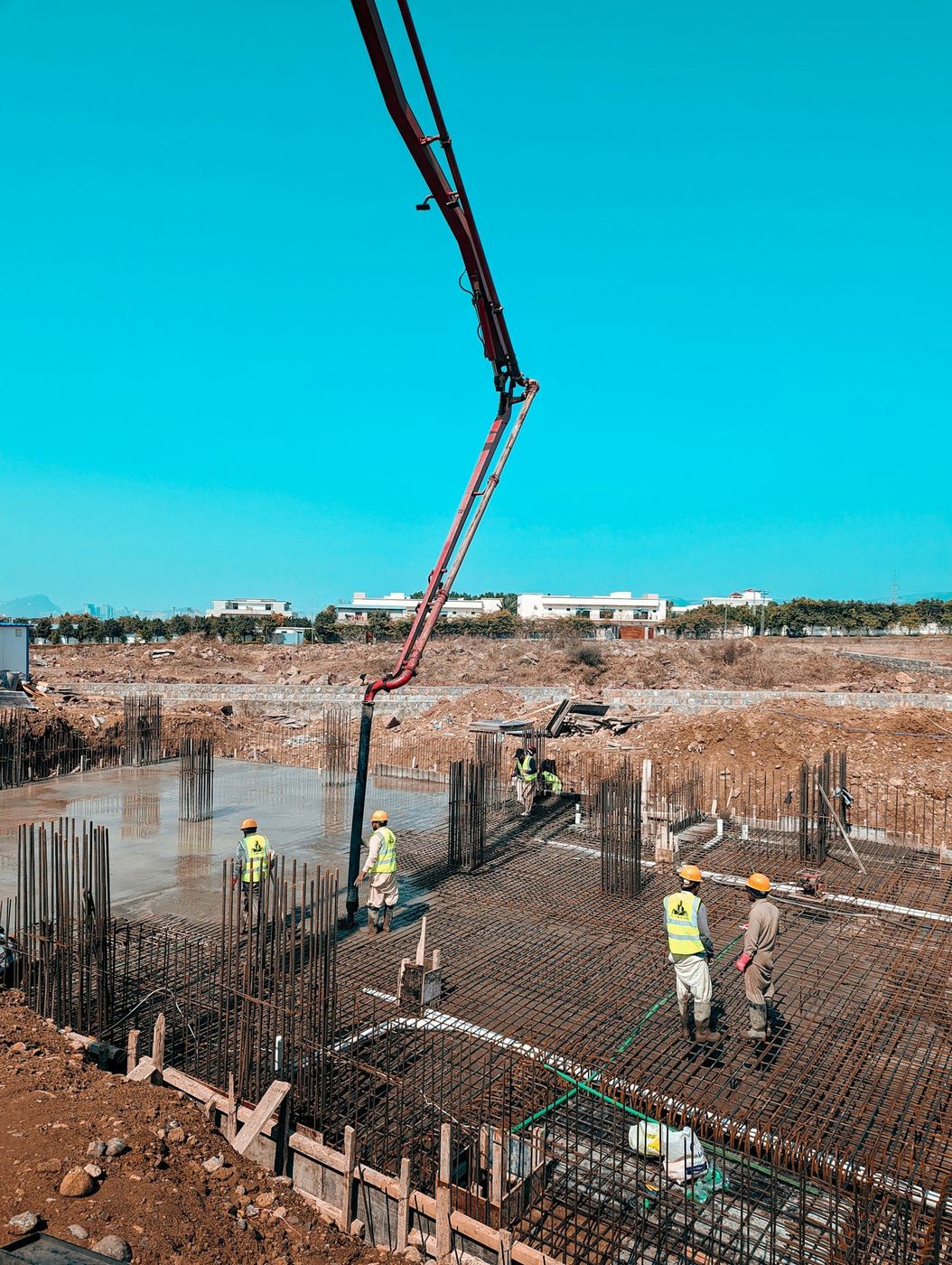
One loud morning, one dusty afternoon, and a graded pad handed back ready for whatever comes next.
A tear-out day starts well before anybody swings anything. The trailer gets spotted where it can leave without backing across your lawn. Saw lines get chalked. Somebody walks the perimeter flagging sprinkler heads and valve boxes. Twenty minutes of that saves a genuinely miserable afternoon.
Then the noise starts, and we'll be honest: the first couple of hours are the loud ones. Breaking concrete is not delicate work. What we control is how long it lasts, where the dust travels, and what your yard looks like when the trailer pulls away. Here's the day the way it actually runs on a Thornton lot, front to back, so none of it lands as a surprise.
Cutting comes first. A wet saw scores every line where the old work separates from concrete that stays, and the water knocks the silica down. It's a slow careful hour, and it's the hour that decides whether your finished edge looks like a decision or an accident.
Breaking is next, and that's the fast part. Old Eastlake flatwork lifts in big clean pieces because it's thin and there's rarely steel in it. Anything with a rebar mat, which describes plenty of the replacement drives around Hunters Glen, fights back and comes out in heavy chunks that get cut free as we go. A machine with a hammer handles a driveway. A back patio behind a narrow gate gets smaller equipment and more hands.
Loading happens alongside the breaking instead of after it. Clean concrete goes into the trailer bound for a recycler, rebar gets pulled and stacked for scrap, and mixed material like mortared flagstone gets sorted at the pile rather than at the yard. By early afternoon the concrete is gone and you're looking at dirt.
Then the part nobody photographs. We cut the subgrade to the depth the next slab actually needs, bring in road base, and compact it in lifts. That's where a tear-out either sets the new pour up for thirty years or hands it the same problem the old one had.
| Stage | What you'll notice | How we hold it down |
|---|---|---|
| Setup and flagging | Voices and a truck idling out front | Nothing needed yet. Good moment to move cars off the street. |
| Saw cutting | A steady high whine and a wet slurry line | Water on the blade, and the slurry gets contained and rinsed off |
| Breaking | The loud stretch, and it carries down the block | We put it early so it's finished before anybody's afternoon |
| Loading and hauling | Steel on steel, a truck coming and going | Loads sheeted, street swept between trips, drive kept passable |
| Cutting subgrade | Tracks on the yard and a growing dirt pile | Mats under the route, pile sited where it won't kill the turf |
| Base and compaction | A plate compactor buzzing away | Thin lifts, which means more passes and a base that holds |
| Cleanup | Blowers and brooms | Street swept, yard raked, pad graded to shed water |
Tell us the footprint, the thickness if you know it, and how a machine would reach it. That's most of the estimate right there.
Demolition barely notices the calendar. Concrete breaks the same in January as it does in July, and the crew honestly prefers the cold version. What changes is the dirt. Frost-locked subgrade digs slowly and won't compact to anything you'd want to build on, so a winter job sometimes means the concrete leaves now and the base work waits for the ground to open up.
Can a pad sit that long? Yes, provided it's shaped to shed water rather than collect it, and we grade it that way before we go. What wrecks an open pad is two months of runoff standing in a low corner, because saturated subgrade has to dry out or get replaced before anything is poured on it. We'll cover it when a real storm is coming, and we recheck compaction before forms go back in.
If a replacement is the plan, try to get demolition and the pour into the same stretch between late April and October. The pad stays open for days instead of months, the base stays exactly where we compacted it, and your new slab gets a full cure in before the first hard freeze.
People brace for the breaking, and the breaking is over by lunch. What decides how a job feels is the last hour. Street swept, grass raked, no chunks hiding in the flower bed. Nobody has ever complained about the noise on a site we left clean.From the crew lead on these jobs
Still unsure about something?
Call the crew at (303) 569-4046 and we will talk it through.

Get a free, no-obligation estimate from a crew that knows Colorado soil, Colorado weather, and how to finish concrete that lasts.
Accessibility
Adjust the site to fit how you read and browse. Your choices are saved on this device.