
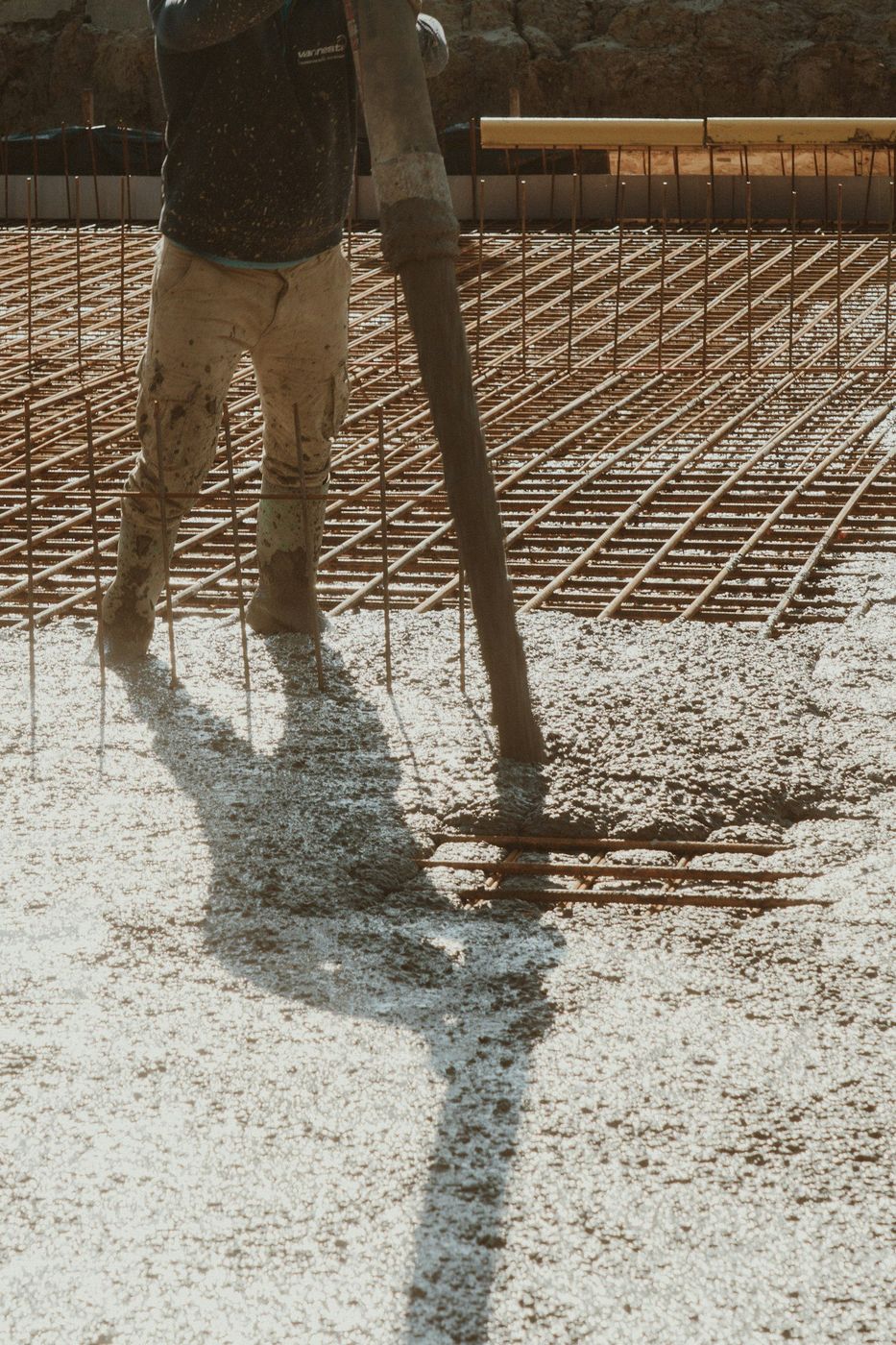
The court surface everyone argues about is four millimeters of acrylic sitting on the thing that actually decides its life.
Boards and property owners spend the whole selection meeting on color schemes and net systems. Fair enough, those are the visible decisions. But a court that cracks in year three didn't fail at the paint. It failed at a subgrade that wasn't uniform, a base that wasn't compacted the same everywhere, or water that found its way underneath and stayed.
We build pickleball courts for homeowner associations, apartment and townhome communities, clubs, schools, and private recreation facilities around Parker. Amenity budgets are tight and courts get used hard, so this page is about the part below the surfacing: what we do to the ground before a single yard of concrete arrives, and why that is where the money should go.
A court slab is wide, thin, and completely unforgiving about differential movement. Every other slab we pour can hide a little unevenness. This one can't, because acrylic surfacing is a thin film that telegraphs anything the concrete does underneath. A crack in the slab becomes a crack in the surface, and once it's there, patching it is cosmetic and temporary.
Uniformity is the target, more than raw strength. Subgrade that's soft in one corner and firm in the other moves differently through wet springs and dry Augusts, and the slab bridges that difference until it doesn't. So compaction being the same everywhere matters as much as hitting a number, and we won't build a court straddling a fill line without addressing it.
Water is the other half. Courts get sited on leftover ground: the low corner of the amenity parcel, the flat spot below a slope. Exactly where runoff collects. We intercept water above the court, slope the pad in a single plane, and keep irrigation off the perimeter. At 5,869 feet, saturated ground under a slab in November is a heave problem by February.
| System | Right for | What you accept |
|---|---|---|
| Conventional reinforced slab with acrylic surfacing | Most community and club courts | Cracks are possible over decades. Good base work makes them rare |
| Post-tensioned slab | Sites with difficult soil and a long horizon | Highest cost, specialty crew, and the best crack performance available |
| Asphalt with acrylic surfacing | Tight budgets, shorter time horizons | Softens in summer heat, cracks sooner, needs resurfacing more often |
| Modular tile over a concrete slab | Where drainage or joint movement is a known issue | Different ball response, and the slab underneath still has to be right |
| Converting an existing tennis court | A worn tennis pad with sound structure | Only works if the slab is intact. Old cracks come back through |
Courts are a spring and summer project, and the reason isn't the concrete. It's the surfacing. Acrylic systems need warm, dry weather to cure between coats, and the slab underneath has to be fully cured and dry before the first coat goes down. That pushes the whole calendar. A slab poured in late September may not get surfaced until the following spring, which is a fine plan if everyone knows it going in and a disaster if the community was promised courts by Memorial Day.
Our preferred sequence: earthwork and base in late spring, pour in early summer, cure through the warm weeks, surface in late summer, play in early fall. The concrete gets real time to shrink before anything is bonded to it.
Winter is for design and approvals. Vote in January and we schedule site work the moment the ground thaws, which puts you at the good end of the season.
Let us look at the site before the location is locked in. Where the court goes matters more than anything else you'll decide.
Everybody wants to know how thick the slab is. I'd trade an inch of concrete for another day of compaction and a proper drain uphill of the court, every time. The courts I've seen crack didn't crack because the slab was thin. They cracked because one end of the pad was sitting on something different than the other end.From the crew lead on these jobs
Still unsure about something?
Call the crew at (303) 569-4046 and we will talk it through.
Get a free, no-obligation estimate from a crew that knows Colorado soil, Colorado weather, and how to finish concrete that lasts.
Accessibility
Adjust the site to fit how you read and browse. Your choices are saved on this device.