
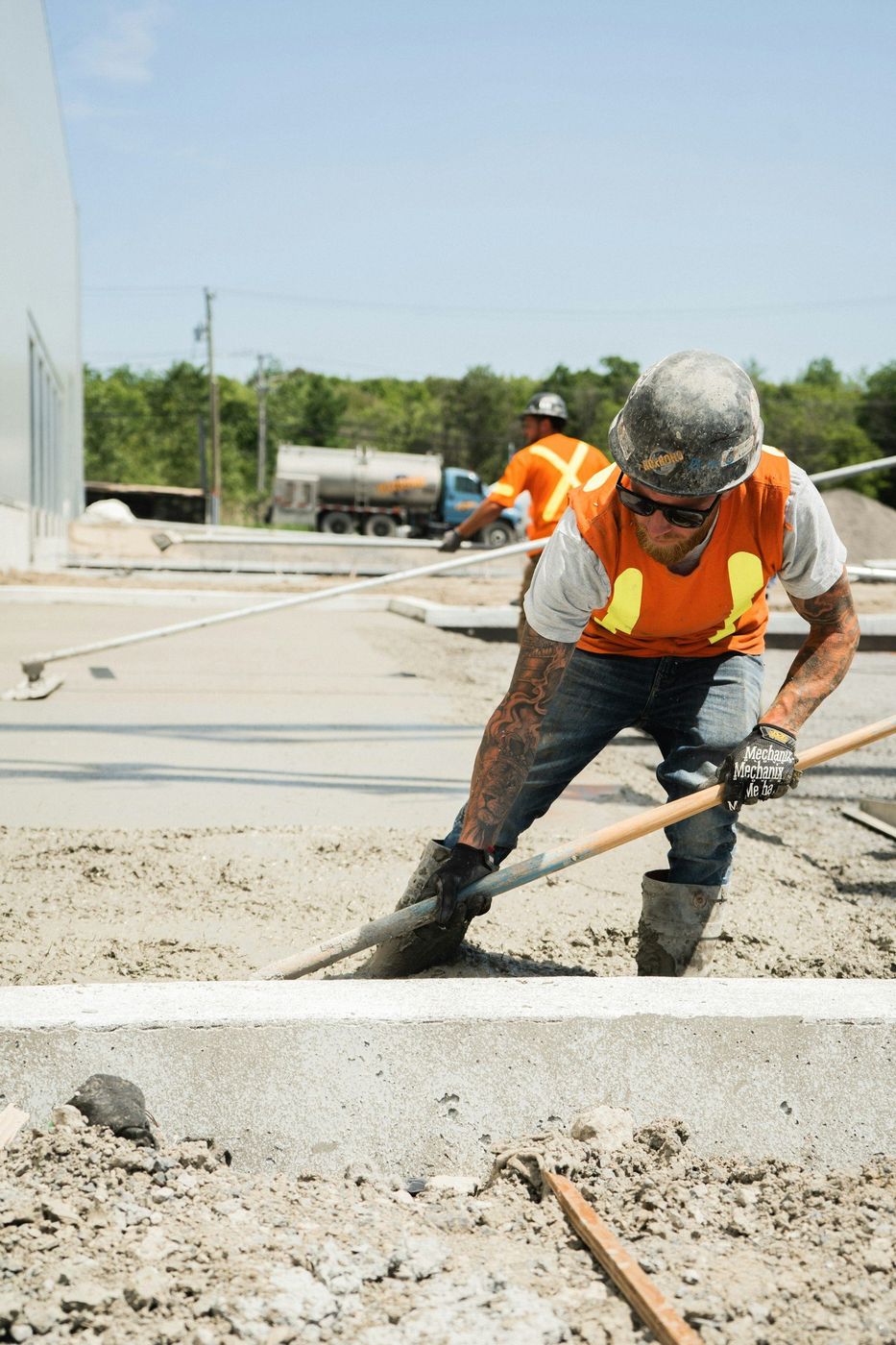
Engineered shells, steel schedules, and shotcrete placed by people who pour structural concrete for a living.
Parker has two kinds of pool lots and they lead to two different projects. Out on the wooded acreage the constraint is almost never space. It's trees, slope, septic, and how a truck gets to the hole without wrecking a hundred feet of grass. Inside the newer subdivisions the lots are flatter and the access is tighter, so the constraint becomes the gate, the side yard, and how close the excavation gets to a neighbor's foundation.
Both build the same way underneath. A pool is a structural concrete box holding tens of thousands of pounds of water, sitting in soil that changes volume with moisture, in a climate that freezes and thaws all winter. That's a structural engineering problem before it's a swimming problem. We come at it from the concrete side, with an in-house structural engineer and crews who place reinforced concrete every week of the year.
On the treed acreage up around The Pinery, the first walk is about routes and roots. Where does the excavator enter, where does spoil get stockpiled, and can a shotcrete rig reach the hole with hose. Mature trees complicate all three, since you can't cut major roots on one side of a trunk and expect the tree to shrug it off. Slope matters too. A pool set into a grade needs retaining and drainage solved alongside the shell.
In Idyllwilde and Reata, and other neighborhoods built on graded pads, the questions change. Side yard width decides equipment size. Easements decide where the equipment pad lives. And the fill under a graded backyard is a design input, because a pool is a rigid structure that won't tolerate uneven support.
Stonegate and similar established areas give us a third case: working an older backyard where landscaping, sprinkler mains, and a mature canopy all stand between us and a hole thirty feet long.
The shell does two jobs at once. It holds water in and it holds soil out. Full pool, water pressure pushes outward on the walls. Empty pool after a wet spring, soil pushes inward and groundwater underneath pushes up. That's why an engineered pool has a hydrostatic relief valve in the floor and a reinforcement layout built for both directions.
Reinforcement is a schedule, not a guess. Bar size, spacing, lap length at the corners, extra steel in the bond beam, and how the floor mat ties into the wall cage. Those numbers come from geometry, depth, and soil, and on our jobs they carry an engineer's stamp instead of a rule of thumb somebody picked up twenty years ago. Once the cage is tied, plumbing gets set through it and left under test pressure while the concrete goes in, so a leak shows itself before it's buried.
Then the shell gets placed, and then it gets cured. Wet curing a fresh shell is not a formality. Concrete that dries out in high-altitude sun and wind before it has developed strength ends up weaker and more crack prone than the same mix kept damp for a week. We water it.
| Shotcrete or gunite | Cast-in-place | |
|---|---|---|
| How it goes in | Pneumatically applied against the excavation and the steel cage, shaped by hand | Placed into two-sided formwork and vibrated |
| Shapes it suits | Curves, freeform edges, beach entries, vanishing edges, anything not rectangular | Straight walls, sharp corners, rectangles and geometric designs |
| Excavation | Cut close to final shape, since the dirt is one side of the mold | Over-excavated to leave room for forms and access behind them |
| Crew skill | Nozzle work is the whole job. A bad nozzleman leaves voids you can't see. | Standard formwork discipline, easier to inspect before the pour |
| Schedule | Shell placed in a day on most residential pools | Longer, because forms go up and come back down |
| Where we'd steer you | Most residential pools here, especially anything with a curve in it | Rectangular pools, tight geometric designs, and shells tied into structural walls |
Start with a site walk. We'll look at access, slope, and soil, and tell you what's realistic before you spend a dollar on design.
Everybody focuses on the day the shell goes in, and it is a good day. But the week after decides how the pool ages. Fresh concrete in Colorado sun and wind dries out fast, and dry concrete is weak concrete. So we water it, and we keep watering it, and we warn homeowners their brand new pool will look like a mud pit for seven days.What the crew sees on site
Still unsure about something?
Call the crew at (303) 569-4046 and we will talk it through.
Get a free, no-obligation estimate from a crew that knows Colorado soil, Colorado weather, and how to finish concrete that lasts.
Accessibility
Adjust the site to fit how you read and browse. Your choices are saved on this device.