
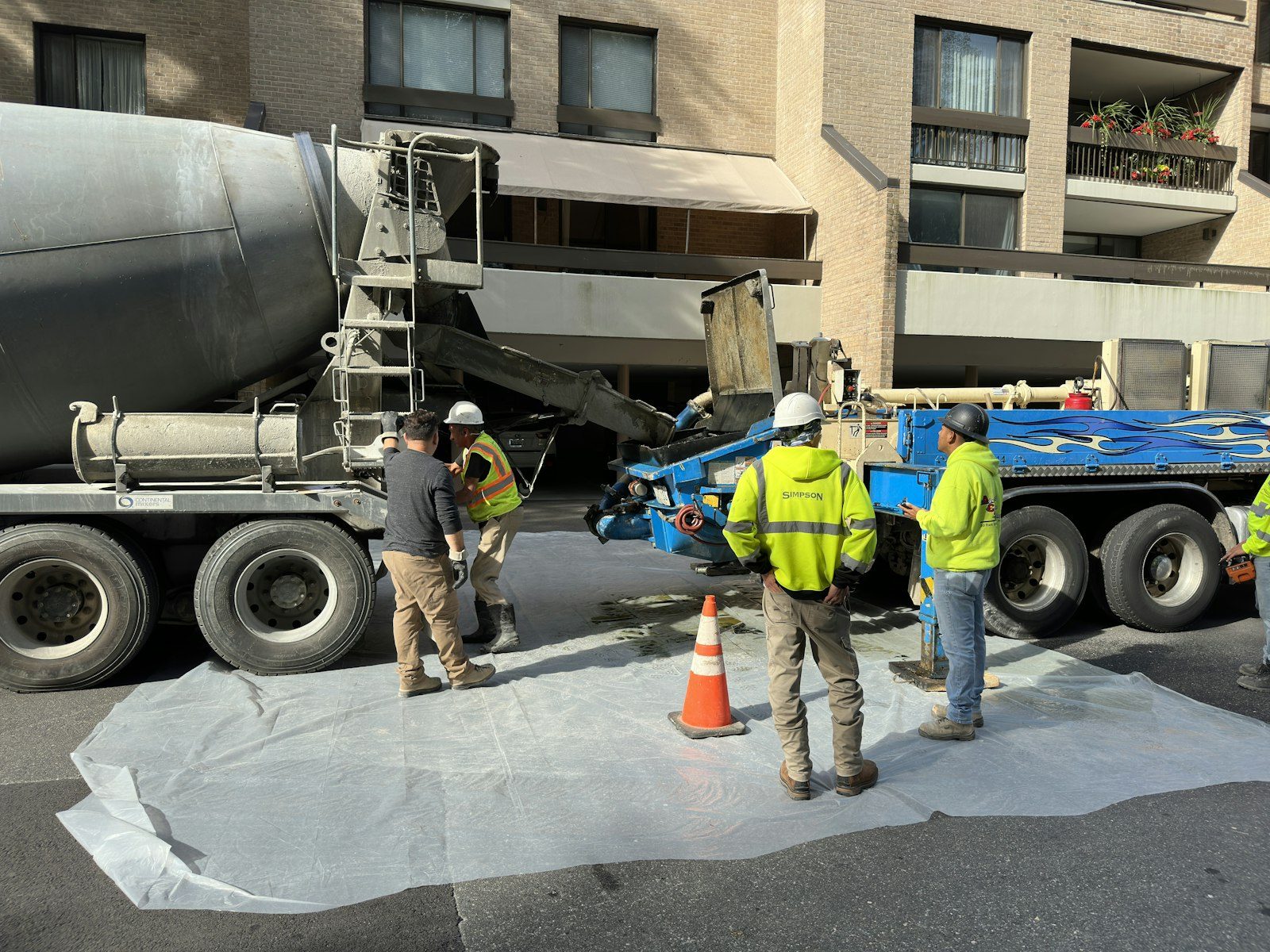
One plane, one direction of fall, and a surface that's playable again half an hour after a July cloudburst quits.
The storm shows up around four, does its business for twenty minutes, and moves off east. What happens in the next half hour tells you everything about how a court was built. A good one sheds water in one direction, dries in the sun, and has kids back on it before the gutters stop dripping. A bad one holds three puddles in the same three places it always does, and the game is over for the day.
Summer here is built out of those afternoons. So is the rest of the year: sun that clears snow off a south-facing slab by mid-morning in January, hail in June, a forty degree swing in a single day. A court is a big flat piece of concrete with nothing to hide behind, and the weather gets a vote in every design choice we make.
| The weather | What it does to a court | What goes into the build |
|---|---|---|
| Afternoon downpour | Puddles that outlast the storm and end play early | One plane of fall, no crown, no dish, checked with a laser |
| Hail | Bruises a soft coating, rarely troubles cured concrete | Full cure first, and a coating rated for exterior abuse |
| Heavy wet snow | Blades gouge the surface, chemicals eat the paste | Air-entrained mix, tooled edges, a shoveling plan |
| Freeze and thaw at joints | Water in an open joint widens it and spalls the edge | Sawed joints filled and kept out of the play area |
| High-altitude sun | Fades color and chalks a coating years early | Recoating cadence planned in from the start |
| Wind and heat on pour day | Surface dries ahead of the slab and crazes | Early start, retarder on hand, joints cut same day |
A patio can slope two directions and nobody cares. A court can't. The moment a surface has a crown down the middle or a low spot near the key, the ball starts behaving differently depending on where you're standing, and every player feels it before they can name it. So we build a court as one tilted plane: pitched in a single direction, at a slope small enough that a ball set down at the top doesn't roll away and large enough that water leaves without being asked.
Joints are the other half of the puzzle. Concrete this size has to have control joints, and every joint is a seam a dribble can catch. We lay them out during design, not on pour day, and we push them toward the perimeter and away from the key and the top of the arc where the footwork happens. On most layouts the joint grid can be made to land on the line work, which hides it twice: once from the ball and once from your eye.
We'll size a court to the ground you have, lay out the joints around the key, and set the hoop footing while we're there.
Winter is better than people expect. South-facing courts on the flatter ground around Southbridge and Highland Walk clear themselves on any sunny day, and a shoveled slab at forty degrees in February gets used. Up in Ken Caryl, shade off the slope hangs on longer and a court on the north side of a house may stay white for a week. That's worth knowing before we pick the spot.
Snow removal is simple: push it with a plastic or rubber-edged blade, never steel, and skip the deicers entirely. Salt on a court surface, coated or bare, is how you buy a resurfacing job a decade early. Sand for traction if you must, then sweep it off before it gets ground in.
For scheduling, late spring through early fall is the window, and it's really the coating that sets it. Concrete needs its full cure before an acrylic system goes on, and the coating itself wants warm days and overnight temperatures that stay reasonable. Pour in June, coat in July, and everything happens with margin. Pour in October and the coating waits for spring, which is fine, provided nobody's expecting painted lines before then.
Still unsure about something?
Call the crew at (303) 569-4046 and we will talk it through.
Get a free, no-obligation estimate from a crew that knows Colorado soil, Colorado weather, and how to finish concrete that lasts.
Accessibility
Adjust the site to fit how you read and browse. Your choices are saved on this device.