
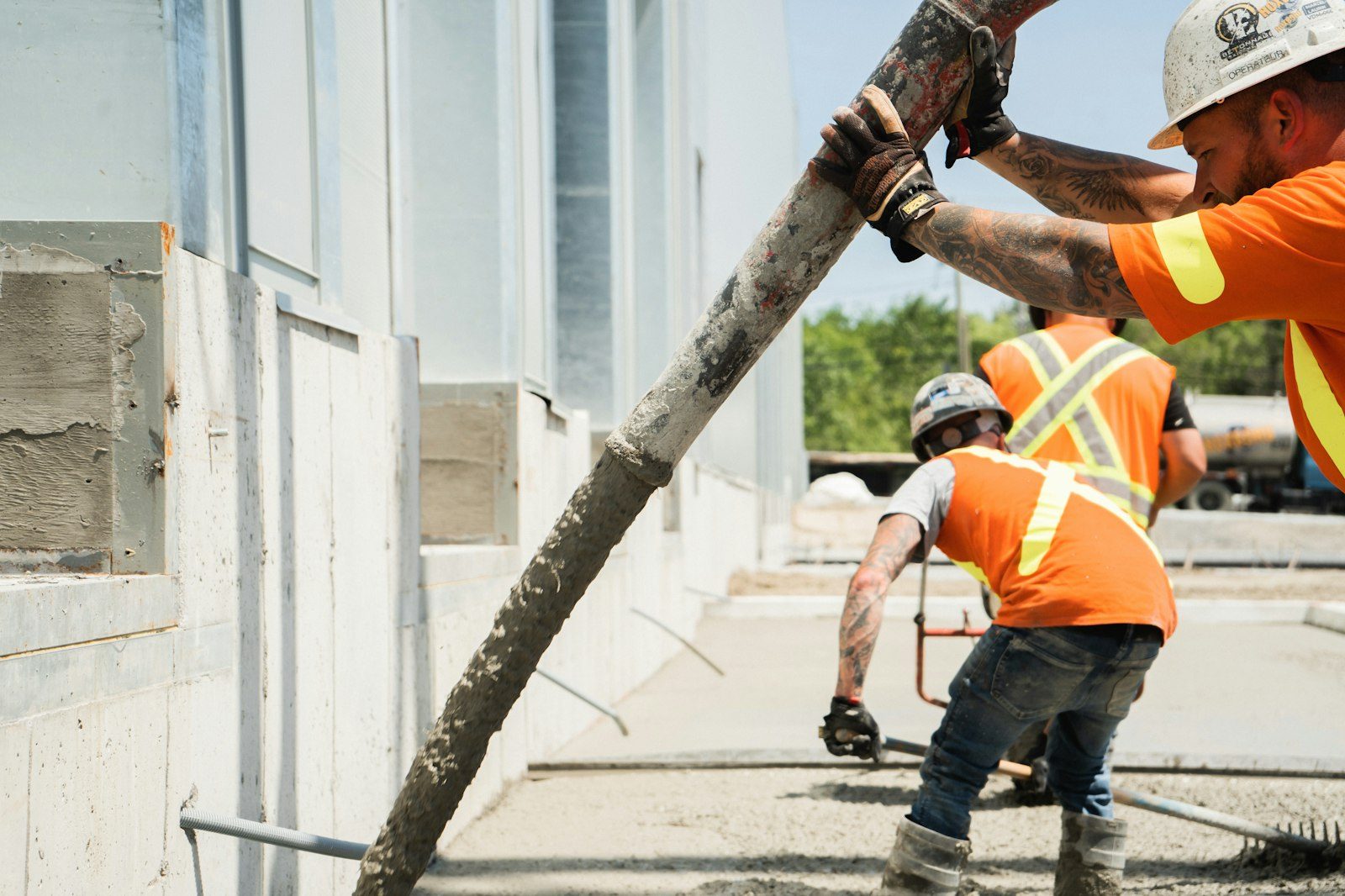
Breaking out the old slab is a morning's work. What we find underneath is the part worth paying attention to.
Demolition looks like the loud part of the job, and it is. It's also the least interesting part. Breaking a residential slab into haulable pieces is a solved problem: a hammer on a skid steer, a saw for clean edges against anything staying, a few hours of noise and a trailer that leaves heavier than it came.
The valuable hour comes right after, when the concrete is gone and you're standing on bare ground looking at the reason the slab failed. Everything that matters is down there. How much base the original crew put in, whether any of it drains, where the water has been traveling, what the soil does when you put a boot in it. We photograph it, we walk you through it, and on Larkspur properties we do that with a shovel in hand, because ground carved into a hillside rarely tells the same story twice.
Method follows access, always. On an open driveway with room to work, a skid steer with a breaker is fastest and cheapest and it leaves the least mess. Tight backyards, courtyards behind a gate, or anything close to a foundation get handheld breakers and hand loading, which costs more hours but doesn't put tracked equipment where it shouldn't be. Where a slab meets something that's staying, a walk butting into a patio, an apron against a garage floor, we wet-saw a straight line first so the survivor keeps a clean edge instead of a ragged tear.
Reinforced concrete changes the plan. Old rebar has to be cut and pulled rather than dragged, or you'll rip up more than you intended. And on these long private drives we think hard about the loaded trailer's route before we start. Soft shoulders, a wet spring surface, or a culvert crossing can turn one careless pass into a repair you didn't sign up for. We lay mats where we need them.
| Subgrade condition | How it got that way | What has to happen next |
|---|---|---|
| Concrete poured straight onto native soil | An older pour where nobody wanted to pay for gravel | Import and compact real road base before anything gets formed |
| Two inches of dirty gravel churned into dirt | Base laid too thin, then driven on wet during construction | Scarify, remove the contaminated layer, rebuild the section to depth |
| Roots running under the slab | Ponderosas doing what ponderosas do next to a moisture source | Prune where it's safe, then redesign so the new slab isn't the draw |
| A damp pocket that never dries | Slope water traveling underground and reaching the pad | Perimeter drain or a drainage layer, or the new slab inherits it |
| A soft trench crossing the footprint | Water, power, or septic line backfilled loose years ago | Dig out the trench zone, replace in lifts, compact each one |
| Buried forms, wood scraps, or old asphalt | Construction leftovers covered instead of hauled | Dig it out. Anything that rots leaves a void behind it |
Nearly every slab we remove failed one of two ways: nobody built a base, or water got into the base and carried the fines off. On flat metro lots that second process is slow. On a Larkspur property with grade behind the house it is quick. Runoff sheeting off a wooded slope in an August cloudburst has real energy behind it, and it doesn't need a channel to move dirt. Gravel is a fine highway.
So with the ground open we read the whole picture. Where roof water lands. Whether finished grade genuinely falls away from structures. Whether an old swale has silted in. Perry Park lots often carry mature landscaping that has quietly rewritten the grade over decades. Sage Port has stepped building sites where cut and fill meet beneath a single pad. Bear Dance work is newer, and there the culprit is usually a compaction shortcut rather than erosion.
Correcting drainage while the concrete is off is cheap. Correcting it later means removing concrete twice.
We'll come measure, talk through the demo route on your drive, and quote removal on its own or bundled with the replacement pour.
Still unsure about something?
Call the crew at (303) 569-4046 and we will talk it through.
Get a free, no-obligation estimate from a crew that knows Colorado soil, Colorado weather, and how to finish concrete that lasts.
Accessibility
Adjust the site to fit how you read and browse. Your choices are saved on this device.