
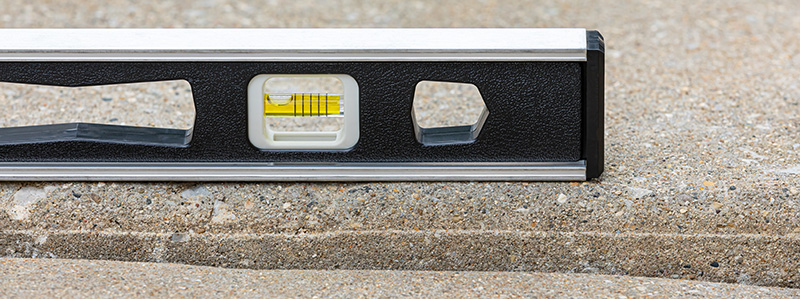
Sunken panels floated back to grade on a sand-and-cement slurry, no tear-out truck required.
Subdivisions built in one push tend to fail in one push too. A whole street of Westridge front walks went in during the same few weeks, over trenches backfilled by the same crew, and thirty-some years later those walks are dropping in the same places. Same story on garage aprons, where the water and sewer laterals run out to the street under four inches of concrete.
Mudjacking puts those panels back where they belong. We drill a small grid of holes, pump a slurry of sand, cement, and water underneath, fill the void, and float the slab up until it reads level against its neighbor. The concrete you already own stays. The trip hazard leaves. And you park on it that afternoon.
Age tells you a lot about which panel dropped. On the older side of the community, Northridge and Westridge, the usual suspects are the front walk and the strip of driveway right at the garage door. Both sit over trench backfill that was dumped in and tamped by boot rather than compacted in lifts. Water finds those trenches, the loose fill settles, and the slab loses its support from the middle out.
Eastridge and Southridge bring a different pattern. Those yards have had thirty years of sprinkler heads spraying the same six feet of patio edge, and the soil under that edge has been wet and dry so many times it packs down like a mattress with a person-shaped dent. Newer streets in BackCountry and The Hearth aren't immune either. When a builder backfills against a foundation and the landscape crew tops it off two months later, the settlement is still coming. We lift plenty of ten-year-old patios.
| Slab | Good candidate? | What we check first |
|---|---|---|
| Front walk panels | Almost always | Whether the panels are whole. Intact concrete lifts clean. |
| Driveway apron at the garage | Yes | How far it dropped and whether water now runs toward the garage door. |
| Patio against the house | Yes, and it's urgent | Which way it slopes. A patio tipped toward the foundation sends water where you least want it. |
| Garage floor | Often | Whether the slab is separate from the footing. We lift the field, not the bearing edge. |
| Stoop and steps | Sometimes | Steps that rotated away from the house usually need rebuilding, not lifting. |
| Pool deck panels | Yes, with care | Coping, bond beam, and any plumbing buried in the backfill. |
| Anything cracked into four or more pieces | No | Broken concrete rides up in pieces and lands crooked. That one gets replaced. |
We'll measure the drop, count the holes, and hand you a fixed number before we touch a drill.
A slab doesn't sink because the concrete got tired. It sinks because something below it left. Loose backfill compresses, a slow irrigation leak washes fines out sideways, a downspout drops a hundred gallons in one spot during an August cloudburst, and the panel bridges the gap until it can't. Our slurry goes into that gap. Sand-and-cement mud is heavy on purpose, which is exactly what you want when the void needs filling as much as the slab needs raising.
Season matters less for lifting than for pouring, and that's one of the nice things about it. April through November is easy. We work through cold snaps too, right up until the top few inches of ground go hard, because frozen soil won't let the mud spread the way it needs to. Late summer is our busiest stretch, since that's when storm runoff exposes every soft spot in a yard. If the drop is bad enough to catch a toe, don't wait for spring. A hazard doesn't care what month it is.
Still unsure about something?
Call the crew at (303) 569-4046 and we will talk it through.

Get a free, no-obligation estimate from a crew that knows Colorado soil, Colorado weather, and how to finish concrete that lasts.
Accessibility
Adjust the site to fit how you read and browse. Your choices are saved on this device.