
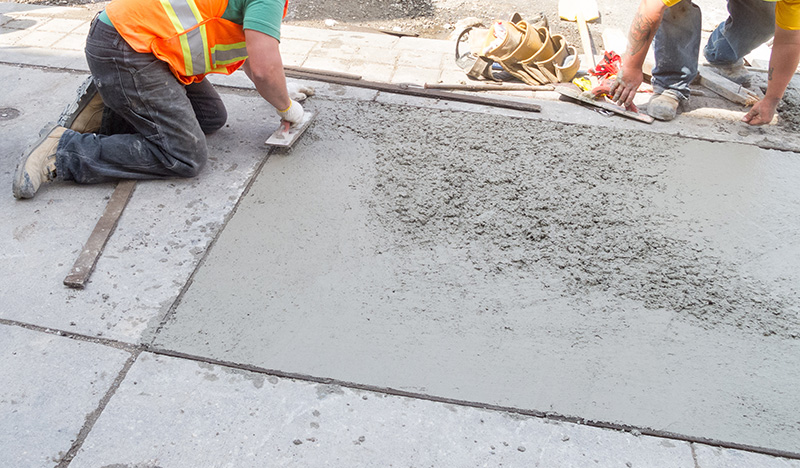
Routing, patching, lifting, and a straight answer about when patching stops paying.
Mid-February in Highlands Ranch. Snow melts off the sunny half of a driveway by noon, runs down into a crack, and freezes hard again by eight that night. Run that cycle forty times between November and April and a hairline turns into a quarter-inch gap with crumbling shoulders. That's the call we get every spring, usually from someone in Northridge or Westridge staring at concrete that looked fine in October.
We repair what's worth repairing. Routing and sealing, partial-depth patches on spalled edges, lifting where a panel dropped, resurfacing where the top layer gave out but the slab under it is still sound. When the damage runs deeper than a patch can reach, we say so out loud instead of selling you three more years of touch-ups.
Water is the whole story. A crack that stays dry stays a crack. Fill it with snowmelt, drop the temperature twenty degrees after sunset, and ice pries the shoulders apart by a fraction of a millimeter. It never pushes them back. At 5,920 feet our winter days swing hard, sunny and forty in the afternoon, teens by nine at night, and a south-facing slab can run that cycle dozens of times before the crocuses show up.
Deicers pile on in a different way. Magnesium chloride keeps meltwater liquid at temperatures where it should have stayed frozen, so more of it soaks into the pore structure and more of it turns to ice later. Shovel and sand instead. On repair work that rule matters double, because a patch bonded to salt-soaked concrete has a short future. We grind and wash the substrate before any new material touches it.
| Repair | Cold-weather window | Why |
|---|---|---|
| Routing and sealing a crack | Yes, on a dry day above 40 degrees | Sealant needs a clean, dry groove. We chase the sunny afternoon and knock it out. |
| Partial-depth patch on a spalled edge | Sometimes | Polymer patch materials have temperature floors. Below theirs the bond is a gamble, so we wait. |
| Lifting a settled panel | Usually yes | Lifting doesn't cure like concrete. Frozen ground under the void is the only thing that stops us. |
| Resurfacing or a bonded overlay | No | Overlays want warm slab and warm air for days, not hours. April at the earliest. |
| Sawing joints into an unjointed slab | Yes | A saw cut cares about slab moisture, not the thermometer. |
| Tear-out and repour of one failed section | Case by case | Heated water, non-chloride accelerators, and blankets make it doable. Frozen subgrade makes it pointless. |
Text or email a picture of the worst crack. We'll tell you what it is, free, without anyone driving out.
Sound concrete with trouble in the top half inch? Repair it. But when one edge of a crack has dropped below its neighbor, or the gap widens in spring and closes by fall, the ground below is moving and no patch on earth changes that. Repairs on a moving slab are rent, not ownership.
The math shifts by neighborhood. Around Eastridge and Southridge we're often working on slabs that still have their original structure, so routing, patching, and lifting can carry them another decade without drama. Older pockets of Northridge sit further along the curve; plenty of those drives have been patched twice already and a third round is money thrown at a base that quit years ago. Out in BackCountry and The Hearth the calls skew younger, usually one panel that settled over soft fill while everything around it stayed put. Those are the good ones. Lift it, fix the drainage that caused it, done.
Half the cracks we get called about aren't the actual problem. The downspout dumping two feet from the slab edge is the actual problem. Fix the water first, then the concrete, or we'll be back looking at the same crack in a different spot.What the crew sees on site
Still unsure about something?
Call the crew at (303) 569-4046 and we will talk it through.
Get a free, no-obligation estimate from a crew that knows Colorado soil, Colorado weather, and how to finish concrete that lasts.
Accessibility
Adjust the site to fit how you read and browse. Your choices are saved on this device.