
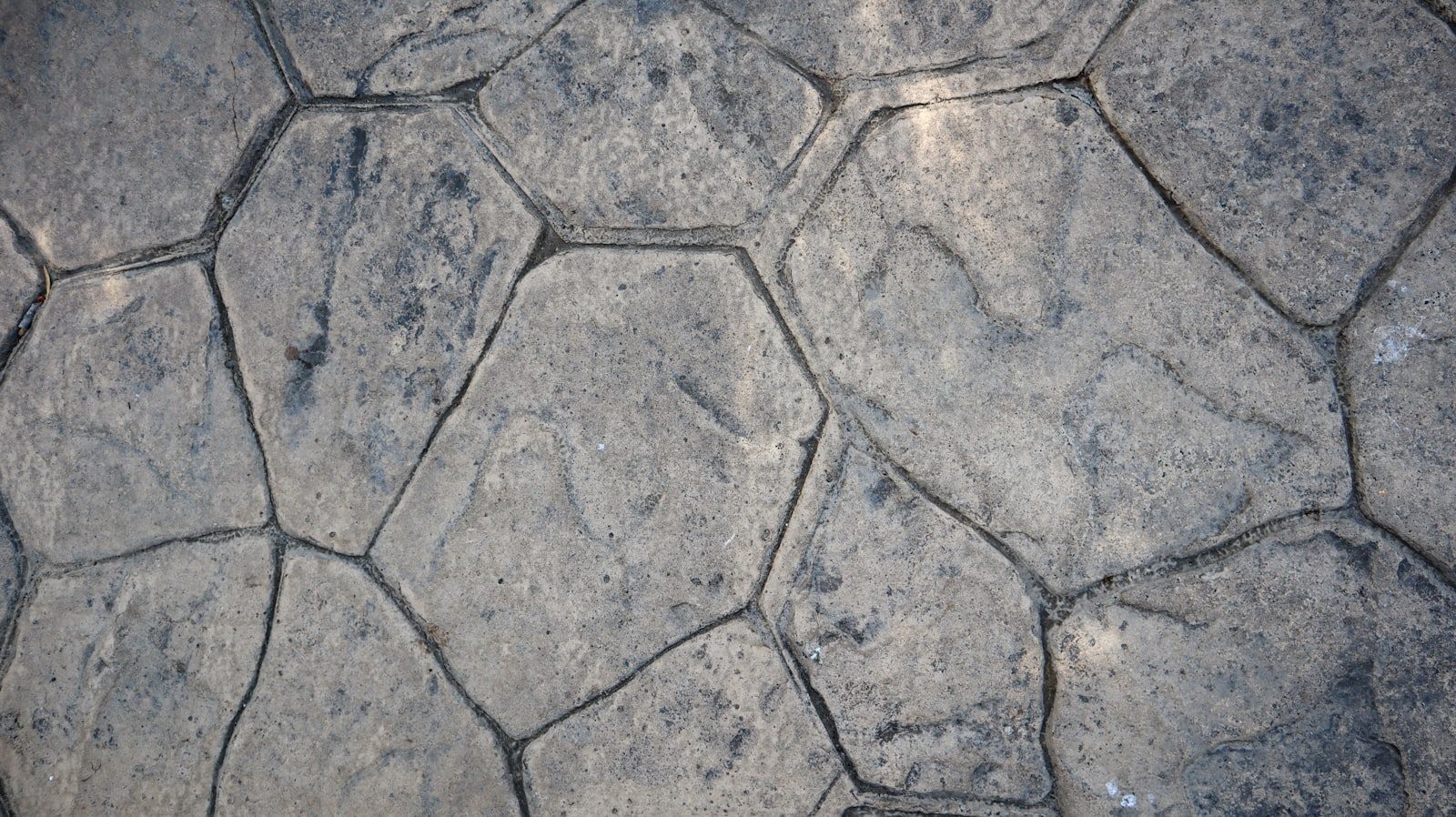
Late August, a cell building over the foothills, and a terrace that has to be imprinted before it gets here.
The cells build over the foothills around two in the afternoon most of late summer, and every stamp crew in the south metro watches the western sky the way farmers do. A stamped slab gets one window. You can't pause it, you can't tarp it and come back Thursday, and once the first mat goes down the whole run has to finish.
So we move the clock instead of arguing with it. On a Greenwood Village lot in August the truck arrives early enough that the crew is imprinting by mid-morning and washing tools before the first anvil head gets tall. That isn't caution. It's the only honest way to place a large decorative slab on a big property here without betting the color, the pattern, and a full day of hand work on a radar app.
Properties out here are wide. Sounds like an easy day. It isn't, because a wide slab means a long placement, and a long placement means the first section is tightening while the last of it is still coming out of the chute. In Greenwood Hills and Cherry Hills Farm we've stamped terraces longer than one crew can imprint at a walking pace, so we either split the pour into panels with a joint we can hide inside the pattern, or we put more hands on the slab and run mats down both sides at once.
The Preserve and Sundance Hills tend to give us better access, usually a side yard wide enough for a machine and a route that doesn't cross the whole lawn. Older homes sitting behind thirty years of landscaping are the tight ones, and there the real question is whether a pump line goes around the house or over the roof. Either answer changes crew size and start time, so we settle it standing in your driveway rather than discovering it at seven on pour morning.
Scale drives the pattern too. A large open terrace carries a wide random stone with a long repeat and still reads like stone. Put that same mat on a narrow walk beside the garage and you'll spot the repeat from the back door every single time.
| Pattern relief | How it reads | What it asks of you |
|---|---|---|
| Deep tooled stone, heavy grout lines | Closest thing to real cut stone, with shadow lines that hold up at any hour of the day | Shovel blades catch on it. Water sits in the joints. Plan on more scrubbing and a light hand in winter |
| Medium ashlar or slate | Pattern is obvious, edges are softer, still reads as stone from the kitchen window | The middle ground. A plastic blade rides across it fine and a hose cleans it |
| Light texture with tooled joints | The layout comes from the cut lines more than from any depth in the surface | Easiest one to keep. Traction drops slightly when it's wet and freshly sealed |
| Wood plank | Grain, knots, and board ends instead of grout lines | Grit collects in the grain channels. A stiff broom once a season is the whole chore |
| Skin texture, no joints | Stone surface with no pattern at all, usually a border or a quiet field | Almost nothing, though it's the least forgiving of a patch since there's no joint to hide a repair in |
Give us a rough size and where it goes. We'll tell you whether the scale suits your slab and whether the relief you like is going to fight your snow shovel. Call (303) 569-4046.
May through the first week of October is the honest season. If we could pick one month it'd be September: warm middays, cool nights, low storm risk, and runway to cure well before the ground locks up. June and July work when we start at first light. Late August is the gamble.
Rain is two entirely different problems depending on when it shows up. A shower on a slab that's already imprinted and set is mostly a cosmetic risk, and plastic on stakes handles it. Rain during finishing is the one that costs you, because water worked into a surface that hasn't taken its set dilutes the paste right at the top, and dusting or scaling turns up months later exactly where the color lives. We cover and stop. We don't push through a squall to save an hour.
Winter stamping happens and we do it. Heated mix water, a non-chloride accelerator, blankets down the same evening, and no placement on frozen ground for any reason at all. What we won't do is stamp into a hard wind, since moving air pulls surface water faster than direct sun and a skinned-over slab refuses a clean imprint. When the week looks rough we build forms, compact base, and hold the truck for a clear stretch.
Everybody watches the thermometer. Wind is what actually ends your day. Fifteen miles an hour across an open terrace and you've lost twenty minutes off the window before anybody on the crew feels warm.
What the crew sees on site
Still unsure about something?
Call the crew at (303) 569-4046 and we will talk it through.
Get a free, no-obligation estimate from a crew that knows Colorado soil, Colorado weather, and how to finish concrete that lasts.
Accessibility
Adjust the site to fit how you read and browse. Your choices are saved on this device.