
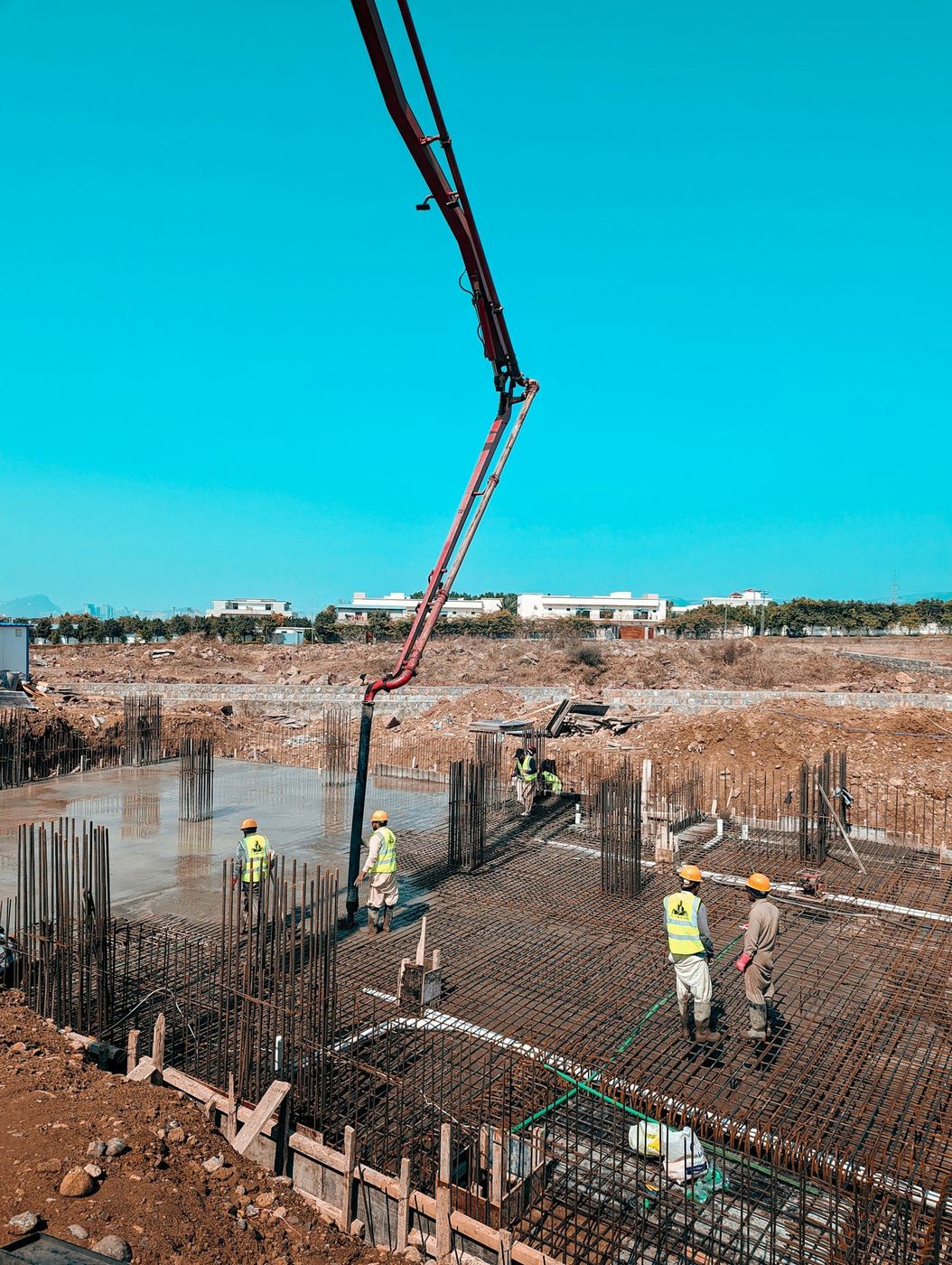
The concrete is the part you see. What we bury under it decides how long you keep it.
The most useful hour of a replacement happens after the old drive is gone and before a single form board goes down. The excavator peels the slab off, the loader hauls it out, and for a while there is nothing to look at but dirt. That dirt is the whole job. Everything we do for the rest of the week is a response to what it turns out to be.
Most failed drives in this town did not fail because somebody bought cheap concrete. They failed because whoever poured them treated the ground as a surface to work off of rather than a structure to build on. We tear out plenty of slabs across Greenwood Hills, Cherry Hills Farm, and The Preserve that were perfectly good concrete sitting on a foundation nobody ever built.
A driveway on a big lot crosses a lot of different ground. The stretch nearest the garage sits on backfill from when the house was built, and backfill was rarely compacted the way anyone would compact it today. Halfway down the run you are usually on native soil. Out near the street you cross whatever the utility crews dug and put back.
So the subgrade under one driveway can be three different materials with three different appetites for water. We probe it, we walk it while it is exposed, and we watch what happens under the weight of the machine. Soft spots show themselves. Ground that pumps and springs under a loaded track is ground that will pump and spring under a slab, just slower and with more expensive consequences.
When we find a bad pocket we dig it out and replace it with material that behaves. That is not an upsell; it is the difference between a driveway that lasts and one that cracks in a curve nobody can explain later.
| The check | How it gets made | If it does not pass |
|---|---|---|
| Lift thickness | Base goes down in layers we can actually compact, not one deep dump | We pull material off and redo it. A thick lift compacts on top and stays loose underneath, which is invisible right up until it is not |
| Moisture in the fill | Squeeze test in the hand plus how the material behaves under the plate | Too dry and it never locks together. Too wet and it pumps. We water it or we wait for it to give up moisture |
| Compaction | Plate or roller passes until the material stops moving, then a loaded truck driven across it | Any spot that ruts gets reworked. Compaction you can watch beats a number on paper |
| Grade and fall | Laser and stakes across the run, checked against the garage slab and the street | Reset and recut. Fixing fall in dirt is cheap. Fixing it in concrete thickness is not |
| Trench crossings | Wherever a utility line was cut in, we probe deeper and compact harder | Extra clean base, and extra steel bridging a wide one. Trenches keep settling long after everybody forgets they exist |
Soil under a slab only misbehaves when its moisture keeps changing, and out here we hand it plenty of chances. Irrigation runs hard from May through September on lawns this size. Roof valleys dump a concentrated stream at the same spot every storm. Snow gets piled along one edge of the drive all winter and then releases all at once in a February warm spell.
Before we pour we want to know where every one of those inputs lands. Downspouts get extended past the new slab or tied into a buried line. Heads that were watering the driveway get turned or moved. Grade gets cut so the water leaves rather than pools at the low corner.
Handle that and the ground under your concrete stays boring, which is the only thing anybody should want from soil.
We will come out, look at the cracks, check the fall with a level, and tell you whether the slab is the problem or just the evidence. Free written estimate, no deposit. (303) 569-4046.
Every homeowner watches the pour. Almost nobody watches the compaction, and that is the part I would want to see if it were my house. Concrete is a commodity. Base work is a decision somebody made when you were not looking.Our crew lead, after the walkthrough
Spring through fall is the easy window, and October is quietly one of the best months for this work because digging is comfortable and the base does not fight you. Cold weather replacements happen under blankets, with the mix water heated and an accelerator that carries no chloride in it. Frozen subgrade, though, is a hard stop. Compacting frozen ground is a lie you pay for in April.
Book earlier than you think. Tear-out weeks fill fast once the weather breaks, and a replacement lines up a demo crew, a base crew, and a pour crew.
Still unsure about something?
Call the crew at (303) 569-4046 and we will talk it through.

Get a free, no-obligation estimate from a crew that knows Colorado soil, Colorado weather, and how to finish concrete that lasts.
Accessibility
Adjust the site to fit how you read and browse. Your choices are saved on this device.