
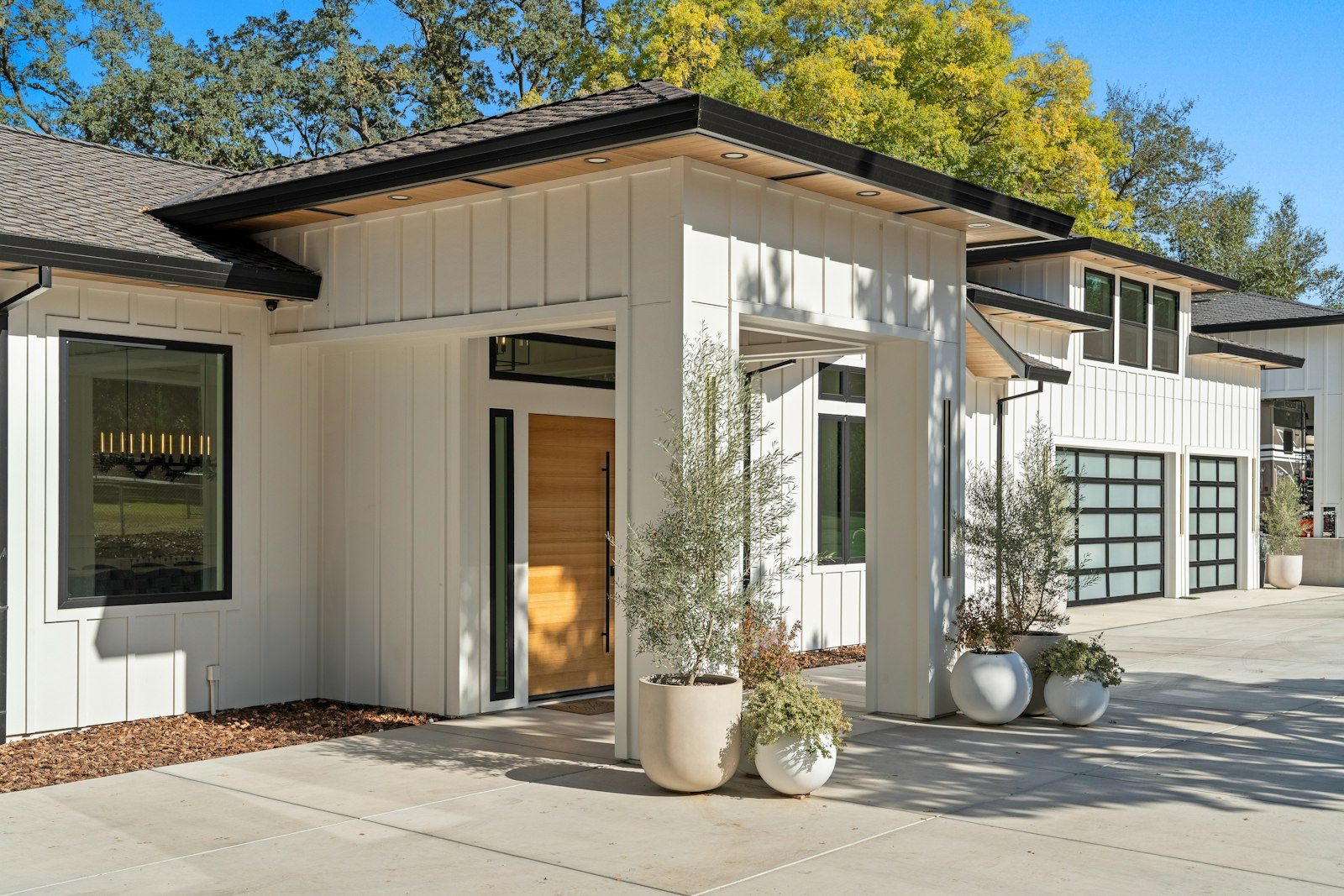
Go look at your driveway at seven in the morning. Low sun hides nothing.
Step out early, before the sun gets high, and look down the length of your drive from the street. Raking light does what a mid-afternoon glance never will. Shallow dishes that hold water show up as dark ovals. A panel that dropped a quarter inch throws a hard black line across its joint. The two faint stripes running toward the garage are the paths your tires have polished into the surface.
Five minutes, no tools, and you learn more about your concrete than a walk-around at noon will teach you in a year. Drives here are long, frequently curved, and they are the first thing anyone sees of the house, so every defect reads from a distance. Homeowners in Greenwood Hills, Sundance Hills, The Preserve, and Cherry Hills Farm call us because they finally caught their driveway in honest light.
A dark oval is a birdbath. The slab settled after finishing, or it was never screeded true. On its own that is a nuisance. Add our winters and it turns into a small rink that refreezes every night from November into March, and standing water wears out a concrete surface faster than anything else you can do to it.
A hard line across a joint is worse news. One panel is sitting lower than its neighbor, which means the ground under it moved and the ground under the next one did not. Run your foot across the lip. If you can feel the step, the base is talking to you.
Then there is texture. Sound concrete under low light reads like fabric, an even grain edge to edge. Once you see exposed pea gravel in patches, the paste that held those stones has worn away, and paste does not grow back. At 5,500 feet the sun works the surface all summer while freeze cycles pry at it all winter, so a surface that has opened up keeps opening.
| What shows up | What is causing it | What we do with it |
|---|---|---|
| Chalky white bloom, worst after a wet stretch | Salts riding to the surface as water leaves the slab | Cosmetic on sound concrete. It sweeps off and comes back until the slab dries out, so we go looking for the water source instead of scrubbing |
| Rust colored weeping out of a crack | Steel sitting too close to the surface and corroding | Rout the crack, treat the bar, patch. If those streaks run a whole panel, the steel never had enough cover and that panel is on borrowed time |
| A fine powder on your shoes after you cross it | The paste at the top has broken down and is releasing | Depending on depth, a densifier holds it or a bonded overlay gives you a new wear surface |
| Grey squares where the surface is simply gone | Scaling, from deicers or from a mix that never had the air content it needed | Nothing patches out of widespread scaling. That one is resurface or replace, and we will say which |
| Dark green film on the run that sits in shade | Algae holding moisture against the concrete for weeks | Clean it, then deal with why it stays wet. A sprinkler head aimed at the slab is the usual culprit |
Lots out here are generous, so the driveway is a real piece of construction rather than an afterthought between curb and garage. More length means more joints, more places for grade to wander, and a drainage plan that has to hold up over a long run instead of a short one. Curved approaches and courtyard turnarounds add edge work we lay out on the ground with a string before anybody orders concrete.
Depth is where the money should go. Four inches over a properly compacted base carries cars all day. Where a truck swings wide, where a trailer sits, where delivery vans turn around, we go to five or six and tighten the bar spacing. Steel is not optional on this soil. Number four bar, on chairs, tied at every crossing, riding in the middle of the slab where it does something.
Season matters less than people expect. April through October is easy pouring, and late September might be the best stretch of the year. We pour in winter too, with heated water, non-chloride accelerator, and blankets. What we will not do is put concrete on frozen ground.
One shot from the street with the sun low. We can usually tell you whether you are looking at a repair or a rebuild before we ever load a truck. (303) 569-4046.
I tell people to look at their driveway the way a painter looks at a wall. Get the light coming across it, not down on it. Half the calls we take start with somebody backing out early one morning and finally seeing the shape of the thing.What the crew sees on site
Still unsure about something?
Call the crew at (303) 569-4046 and we will talk it through.
Get a free, no-obligation estimate from a crew that knows Colorado soil, Colorado weather, and how to finish concrete that lasts.
Accessibility
Adjust the site to fit how you read and browse. Your choices are saved on this device.