
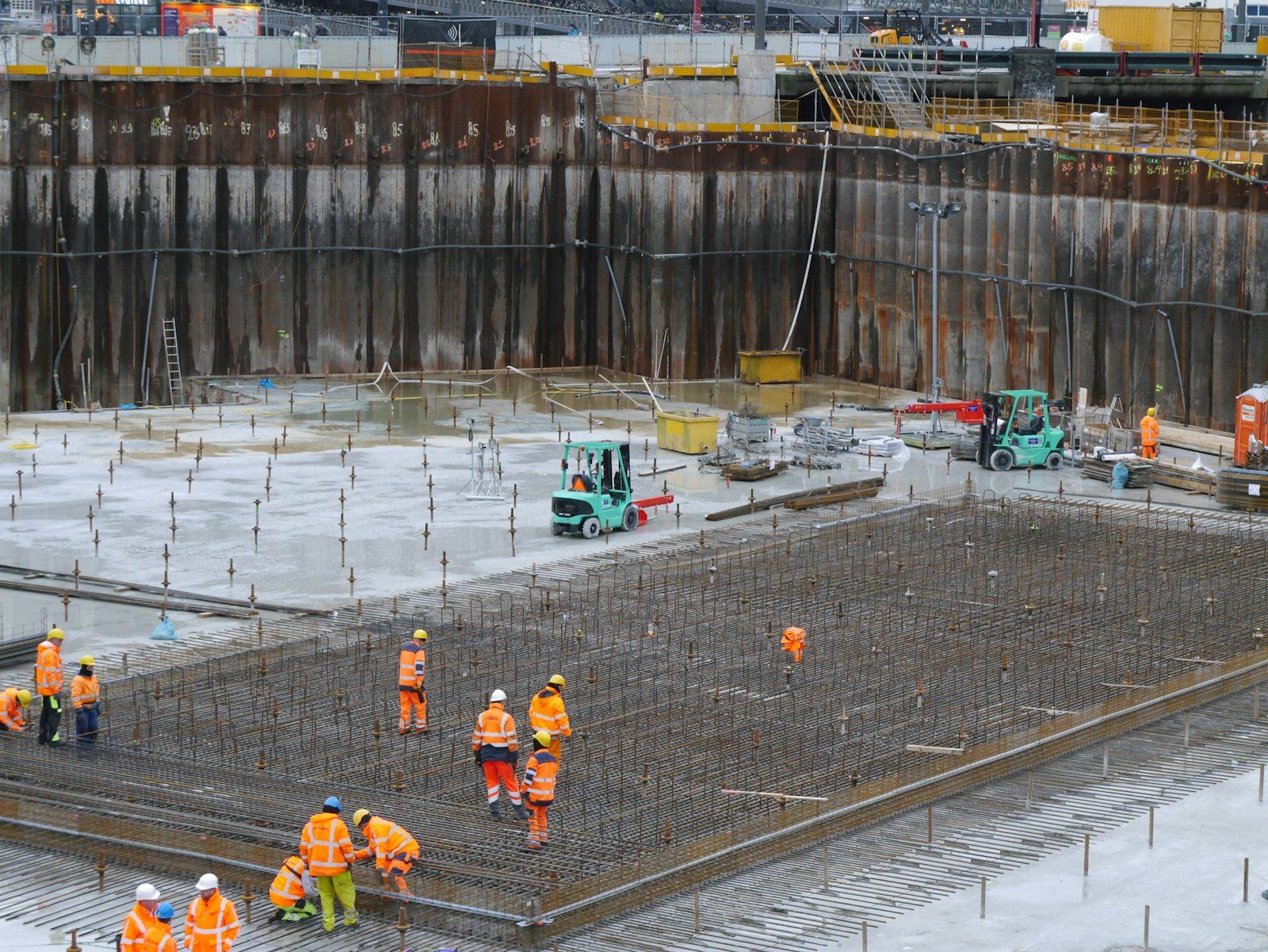
The slab is rarely the problem. We spend our first hour figuring out what the dirt did.
A slab that sank didn't shrink. It went down because something below it left. Could be dirt that washed sideways into a hole you can't see, could be a trench backfill that never finished compressing, could be a chunk of old topsoil that got buried during construction and then rotted down to nothing. The concrete is just the lid on all of that, and the lid gets blamed for what happened in the pantry.
Mudjacking puts material back into the space. We drill through the panel, push a sand-and-cement grout in under low pressure, watch the panel float up to the line we marked, then plug the cores. It works when the concrete is sound and the ground can carry weight. Both of those are questions with real answers, and we get them before we mix anything. On older Englewood lots, the answers are usually good news.
| What's down there | How we find it | What it changes |
|---|---|---|
| Sewer lateral running to the street | Locate marks, cleanout position, and the age of the house | Cores go outside the trench line and pressure stays low |
| Irrigation mainline or a zone valve box | Your controller, plus a walk with the system running | We shut it down for the day and shift the hole pattern |
| Low-voltage sleeve for lights or a gate | A conduit stub at the edge, or a scar in the joint | Easy to avoid once we know it exists, ugly to hit blind |
| Buried downspout drain line | A pop-up in the lawn and a splash block that goes nowhere | Often the reason the void formed, so it gets fixed first |
| Root mat from a mature tree | Heave on one side instead of settlement on both | Grout won't fix a lifting root. Different job entirely |
| Old fill from a previous tear-out | A test core that comes up with brick, asphalt, or slag | Voids run bigger and irregular, so we plan for more material |
Older neighborhoods here got their walks and drives poured on graded native soil most of the time. No road base, no compaction test, just a flat spot and a chute. That soil holds up fine for decades as long as it stays roughly as dry as it started. Introduce a steady water source and it starts moving, particle by particle, into whatever low place will take it.
In Northwest Englewood the water source is usually roof runoff at the corner of a house, and the void that opens is a wedge right where the walk meets the drive. Broadway Estates gives us more utility-trench settlement, since a service line crossing under a driveway leaves a soft ribbon that compresses under car traffic for years. Cherry Hills Vista has enough lawn area that over-irrigation does the damage, which shows up as broad shallow hollows rather than a sharp drop. Different causes, same pump, different hole patterns.
Grout is heavy, and that matters. Set slurry runs about a hundred pounds a cubic foot, so a lift puts real dead load back onto whatever is holding it. Under firm clay that's fine; the void was air, and now it's material that carries something. Over soft wet ground or old organic fill, weight on tired soil isn't a fix. When the probe rod goes in too easily, we say so.
We'll sound the panels, probe the soil at the edge, and say whether grout belongs on this job. The look costs nothing.
Slurry needs two things from the weather: ground that isn't frozen and a few hours above freezing after placement. Frost is the hard stop. Ice in the subgrade is a solid you cannot displace, so grout either refuses to travel or finds one path and cracks your panel getting there. That usually parks the pump from deep winter into early spring, which is why we book heavily in the fall and get people fixed before the ground locks.
Spring has its own trap. The first warm weeks leave the top foot soupy over ground that's still cold and tight, and a lift placed into that settles back as things dry. We'd rather wait two weeks. Summer and early fall are easy: dry soil, quick set, voids at their most obvious.
Still unsure about something?
Call the crew at (303) 569-4046 and we will talk it through.

Get a free, no-obligation estimate from a crew that knows Colorado soil, Colorado weather, and how to finish concrete that lasts.
Accessibility
Adjust the site to fit how you read and browse. Your choices are saved on this device.