
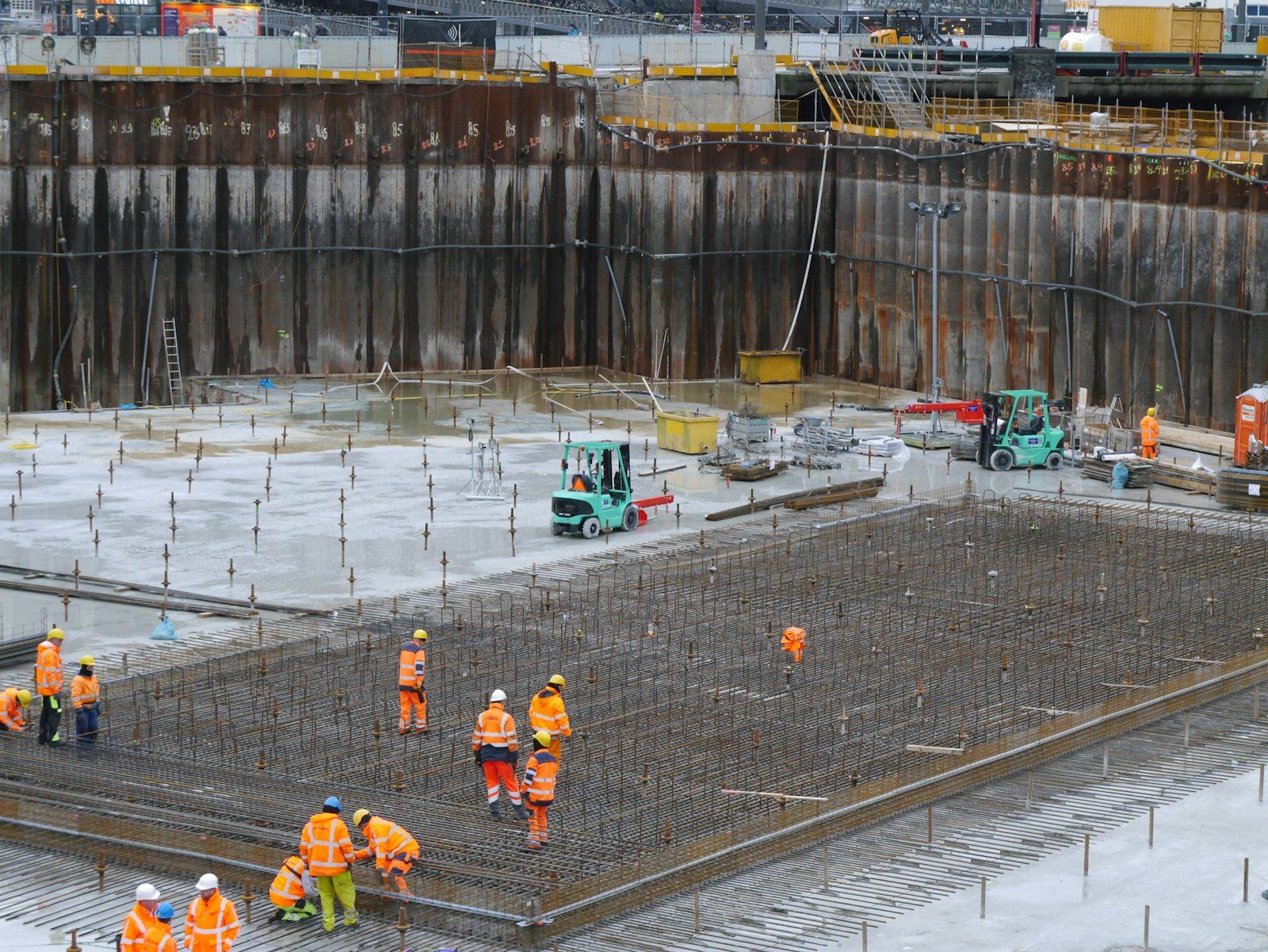
No ready-mix truck, no chute, and twice the clock pressure of a normal pour. That's resurfacing day.
The loudest hour is the first one. A shot blaster or a grinder comes off the trailer before anything else, and for the next stretch of the morning we're doing the least glamorous part of the job: taking the top skin off concrete you already own so a new one will stick to it. Neighbors notice. Dogs object. It's also the hour that decides whether the finish lasts.
After that the day goes quiet and fast. No truck idling at the curb, no chute, no five yards arriving all at once. Instead there's a mixing station, buckets of measured water, and a material that starts setting the moment it gets wet and gives us a working window measured in minutes rather than hours. On a tight lot in Englewood that means the mixing station, the water, and the path to the slab all get sorted before anybody opens the first bag.
People watch us blast for two hours and ask when the real work starts. That was the real work. Everything after it is just spreading material on a surface we already made ready.
What the crew sees on site
Cement toppings bond mechanically. They grab onto texture, so a slab that's been troweled tight, or sealed at some point, or polished smooth by traffic has nothing for the new material to hold. Our job in the morning is to create a profile: a surface with enough tooth that the topping keys into it and stays there through freeze-thaw cycles.
Which machine depends on the slab. Shot blasting throws steel media at the surface and vacuums it back, leaving a consistent profile with no slurry and no water, and it's our first choice on driveways. Diamond grinding is better in corners, along walls, and anywhere a blaster can't reach. Acid etching gets mentioned a lot and we mostly avoid it: inconsistent, leaves residue to neutralize, and the runoff is a problem on a residential lot.
Then it gets vacuumed rather than blown, since a leaf blower only relocates dust so it can settle back on the profile we spent the morning creating. Last step before mixing, we dampen the slab to a saturated surface-dry condition so a thirsty old slab doesn't pull water out of the topping.
| Application method | Texture you end up with | Where it belongs |
|---|---|---|
| Squeegee and broom skim | Thin and tight, following the texture already there | Driveways and walks where the goal is uniform gray again rather than a new look |
| Hopper spray with a knockdown pass | Fine orange peel, flattened with a trowel to a low profile | Patios and hot tub surrounds. The best wet traction of the bunch |
| Hopper spray left as sprayed | Coarse and grippy, and it hides plenty | Ramps, steep aprons, and pool decks. Harder to sweep clean |
| Hand trowel with a stamp or texture skin | Thick enough to take a pattern and read as stone | Feature patios where the surface is meant to look like something other than concrete |
| Self-leveling pour | Flows out flat on its own, indoor material only | Basement and garage floors that need flatness ahead of a coating or a polish |
If the point digs in and crumbles paste, that's one conversation. If it skates across, that's a much better one. Call (303) 569-4046.
It fixes surfaces. Spalling, scaling, discoloration, an ugly patch, a tired broom finish, a driveway that's gone chalky. It gives you back a uniform wearing surface at a fraction of what a tear-out costs, and on a sound slab it lasts a long time.
It fixes nothing below the surface. A settled panel stays settled, because a quarter inch of material cannot change elevation. A crack that moves seasonally comes back through. Base failure keeps failing. And a slab that's lost real depth to spalling is a poor bonding candidate, since the concrete we'd attach to is already weak. That call gets made with a hammer and a screwdriver before we quote.
What we see most on older properties in Northwest Englewood and Broadway Estates is a slab that's fundamentally fine and cosmetically finished. Those are ideal. Cherry Hills Vista sends pool surrounds and patios where the goal is traction and appearance, and a sprayed knockdown texture does that well.
Still unsure about something?
Call the crew at (303) 569-4046 and we will talk it through.

Get a free, no-obligation estimate from a crew that knows Colorado soil, Colorado weather, and how to finish concrete that lasts.
Accessibility
Adjust the site to fit how you read and browse. Your choices are saved on this device.