
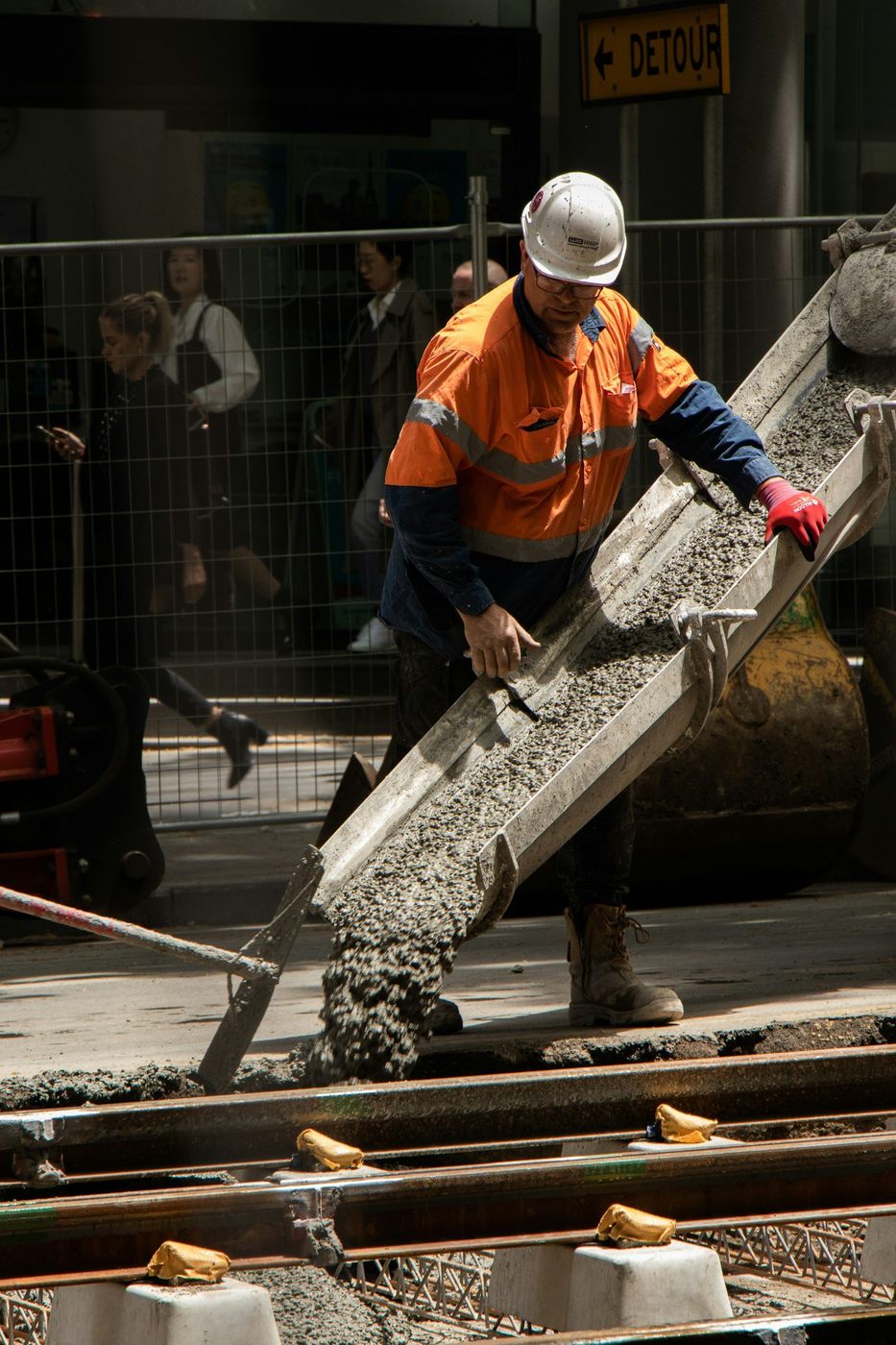
Price this one in equipment, not in concrete. The pad is the cheapest thing standing in that side yard.
Nobody wants to spend real money on a rectangle of concrete the size of a card table. We get it. But the way to think about this line item isn't what the concrete costs. It's what's bolted to it, what that machine costs to service, and what it costs to replace early because it spent a decade sitting crooked in a puddle.
On Englewood's tight side yards the pad usually ends up in the least considered spot on the property, between the house and the fence, on ground that got disturbed during construction and never got much attention afterward. That's the ground we're asking to hold a machine dead level for fifteen or twenty years. Worth a few minutes of thought, and worth understanding what actually moves the number.
Put the numbers in order of magnitude and the pad falls to the bottom of the list every time. Above it sits the machine, the installation labor, the electrical work, and the service calls it'll need across its life. A pad that fails doesn't fail on its own. It takes some of that other spending with it.
That's why we push the specification a little harder than the job seems to warrant. A few extra inches of thickness, steel that actually does something, base placed and compacted rather than just leveled, and the top surface sitting proud of the ground so water drains away instead of collecting. None of those meaningfully change the price of a small pour. All of them change whether you're doing this again in eight years.
The other thing worth buying is room. Pads get sized to the machine's footprint because that's what's in front of everybody on the day. Then a technician has to work on it, and there's nowhere to stand, and a service visit that should take an hour takes two, forever.
| What the pad does wrong | What it does to the machine | What putting it right takes |
|---|---|---|
| Sits a couple of degrees out of level | Oil migrates in the compressor, condensate stops draining where it should | Lift and relevel or replace, plus a service call to check the unit over |
| Drops at one corner over several years | The line set flexes at the same point until it eventually leaks | A new pad and a refrigerant repair, and the repair is the expensive half |
| Sits too low against the surrounding grade | Runoff and snowmelt pool at the base and the cabinet rusts from below | Rebuild higher with the ground shaped away, since a pad can't be raised |
| Cracks through where the conduit comes up | Conduit gets pinched or sheared and a fault takes the circuit down | Cut out that area, repair the conduit, repour with steel across the penetration |
| Too small for the unit that replaced the last one | Feet overhang, the frame flexes, vibration goes into the house instead | Full replacement, and it always happens on install day |
| No clearance for anyone to work | Every service visit runs longer and some work can't happen in place | Nothing at all, until the pad gets replaced. You just pay for it in labor |
Send us the cut sheet and a photo of the spot. We'll tell you what the pad needs and what it'll take to hit your install date. (303) 569-4046.
Very little of it is the concrete itself. A pad this size uses a fraction of a truckload, and the plant has a minimum regardless. So the cost is mostly everything around the concrete: getting to the location, digging and building the base, forming, coordinating with your electrician, and finishing a small area by hand with nowhere comfortable to stand.
Access is the big one on this side of town. A side yard you can reach with a wheelbarrow prices differently than one where every load goes through a gate and around a corner. If a truck can't get within reach, we're pumping or mixing on site, and that's a real difference.
Conduit is the other. When the electrician's stub-ups are set and located before we form, the pour is straightforward. When conduit arrives after the concrete, somebody is core drilling a pad that was perfect an hour earlier. That coordination is free if it happens in the right order and expensive if it doesn't.
And if you have more than one pad coming, say a condenser now and a generator next year, tell us. Doing them on one visit costs meaningfully less than doing them on two.
Almost every one of these has a date attached, usually somebody else's. So we plan backward from it. Concrete needs time before a machine sits on it, and the electrician usually needs the pad before they can finish. Give us a week or two of margin and the whole thing is relaxed. Give us three days and it's still often possible, just with less room for a bad weather morning.
Small pours are more weather sensitive than big ones, oddly enough, because there's so little mass to hold heat. Cold placements get warm mix water, a non-chloride accelerator, and blankets, and we don't place on frozen ground. Hot afternoons at this elevation take water out of a small pour fast, so summer work starts early.
The first winter is worth a mention. Keep deicers off it entirely, especially the magnesium chloride that comes off the street on tires. Sand gives you grip without attacking the surface. And when snow gets cleared around the unit, plastic and a shovel rather than a steel edge dragged across new concrete.
Still unsure about something?
Call the crew at (303) 569-4046 and we will talk it through.
Get a free, no-obligation estimate from a crew that knows Colorado soil, Colorado weather, and how to finish concrete that lasts.
Accessibility
Adjust the site to fit how you read and browse. Your choices are saved on this device.