
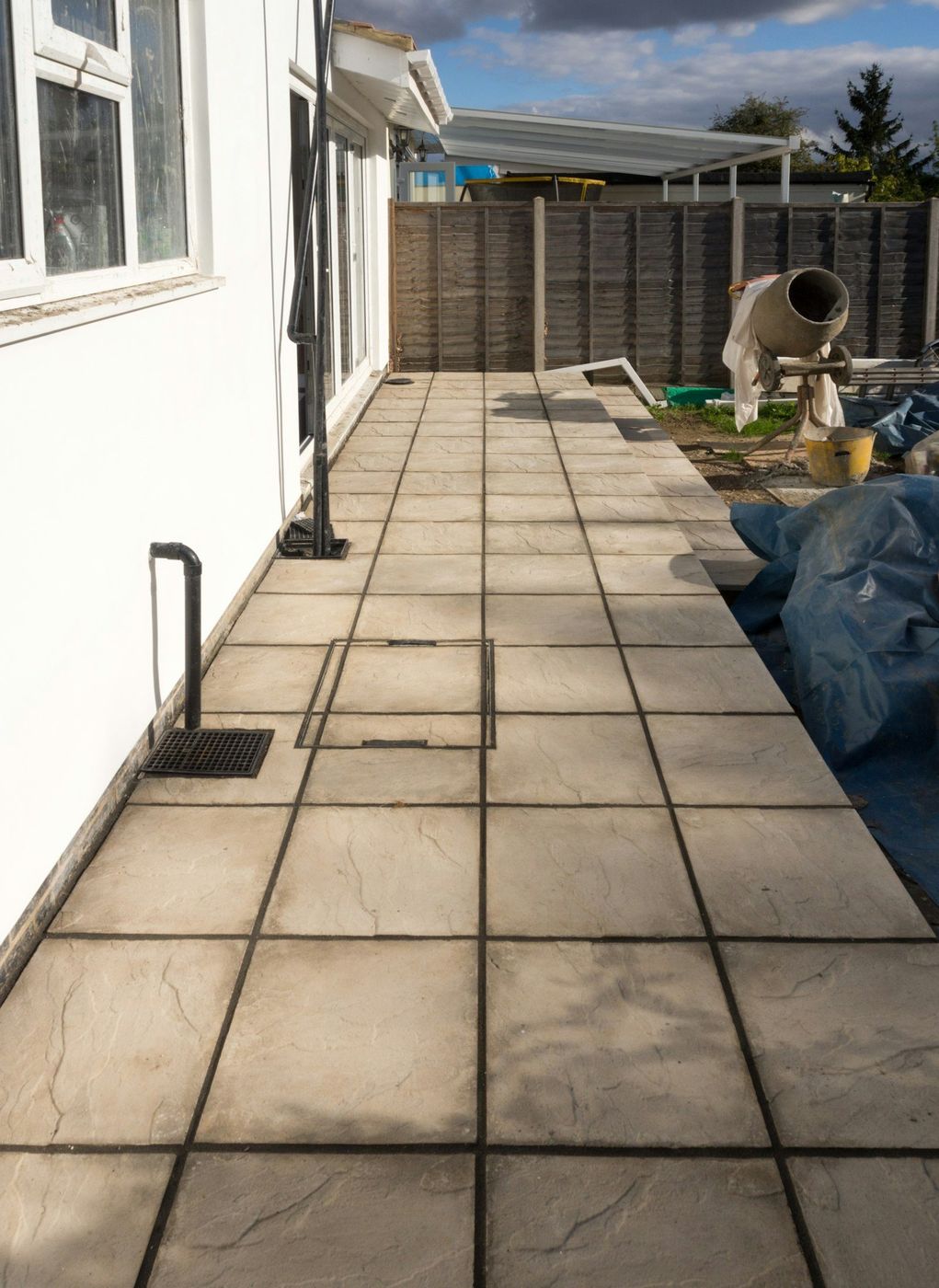
Everything that decides whether your patio is still flat in fifteen years gets buried on day one.
Nobody hires a concrete crew for the dirt. They hire us for the finished thing: the table, the grill, the string lights over the back corner. Fair enough. But by the time you're standing on a patio, every choice that decides whether it stays flat is already buried, and you will never look at any of it again.
Back yards here have history. Cherry Hills Vista and Broadway Estates sit on ground that's been landscaped, re-landscaped, trenched for sprinklers, and filled around additions. In Northwest Englewood we regularly open up a former shed footprint, a filled path, or a soft ribbon where a sewer lateral got replaced one summer. So we dig first and form second. A slab is only ever as flat as the ground holding it.
Four inches of concrete is stiff, but it's not a bridge. It carries load by spreading it into whatever is directly underneath, so support has to be even across the whole footprint. Even is the word that matters. A slab on ground that's firm in one half and spongy in the other doesn't sag gently. It snaps along the line between the two.
That's why day one of a patio job looks like nothing is happening. Strip sod, cut to grade, run a loaded machine across the subgrade and watch for spots that pump or rut. Those get dug out. Then rock goes in thin layers, packed as we go, because a plate only reaches so deep and a foot of loose rock dumped in one go stays loose forever.
| What turns up | Why it's down there | How we handle it |
|---|---|---|
| Loose dark fill a foot or two deep | Old garden beds, a filled walk, or the hole left behind when something got pulled out years back | Dig until the ground pushes back, then rebuild the depth with base rock instead of soil |
| A soft trench crossing the middle | Sprinkler mains, a replaced sewer line, or a gas run, backfilled by hand and never packed | Overexcavate the trench, compact it in layers, and carry steel across so the slab spans the seam |
| Clay that shines where the bucket cut it | Native ground holding moisture because nothing above it ever drained | Build base that moves water sideways and pitch the finished surface so it never sits |
| Broken concrete and brick | An earlier patio somebody smashed and left in the hole | It comes out. Buried rubble makes a hard point, and slabs crack over hard points |
Here's the thing about adding a patio: that ground used to absorb rain and now it doesn't. Every drop that lands on the slab has to go somewhere, and the wrong somewhere is toward the house. Pitched even slightly wrong, it hands every summer downpour straight to your foundation wall. That's a far bigger bill than the patio was.
So we shoot grade before forms go up and carry fall away from the house the whole distance. Where the yard runs the wrong direction we cut a swale past the slab edge, drop a drain, or step the patio down. We also isolate the slab from the house with a joint so the two aren't locked together, because they will not move the same amount and something has to give.
Season matters less on patios than people assume, but it isn't nothing. A spring dig waits until the yard is dry enough to pack. July work goes in at first light and keeps tarps handy for the storm that builds by three. September and October are the easiest weeks of the whole year. Cold-weather patios happen too, on heated water with blankets down, though frozen subgrade stops us every time.
Neither are we until we dig, and that's exactly why the estimate is free. Call (303) 569-4046 and we'll come look.
Still unsure about something?
Call the crew at (303) 569-4046 and we will talk it through.

Get a free, no-obligation estimate from a crew that knows Colorado soil, Colorado weather, and how to finish concrete that lasts.
Accessibility
Adjust the site to fit how you read and browse. Your choices are saved on this device.