
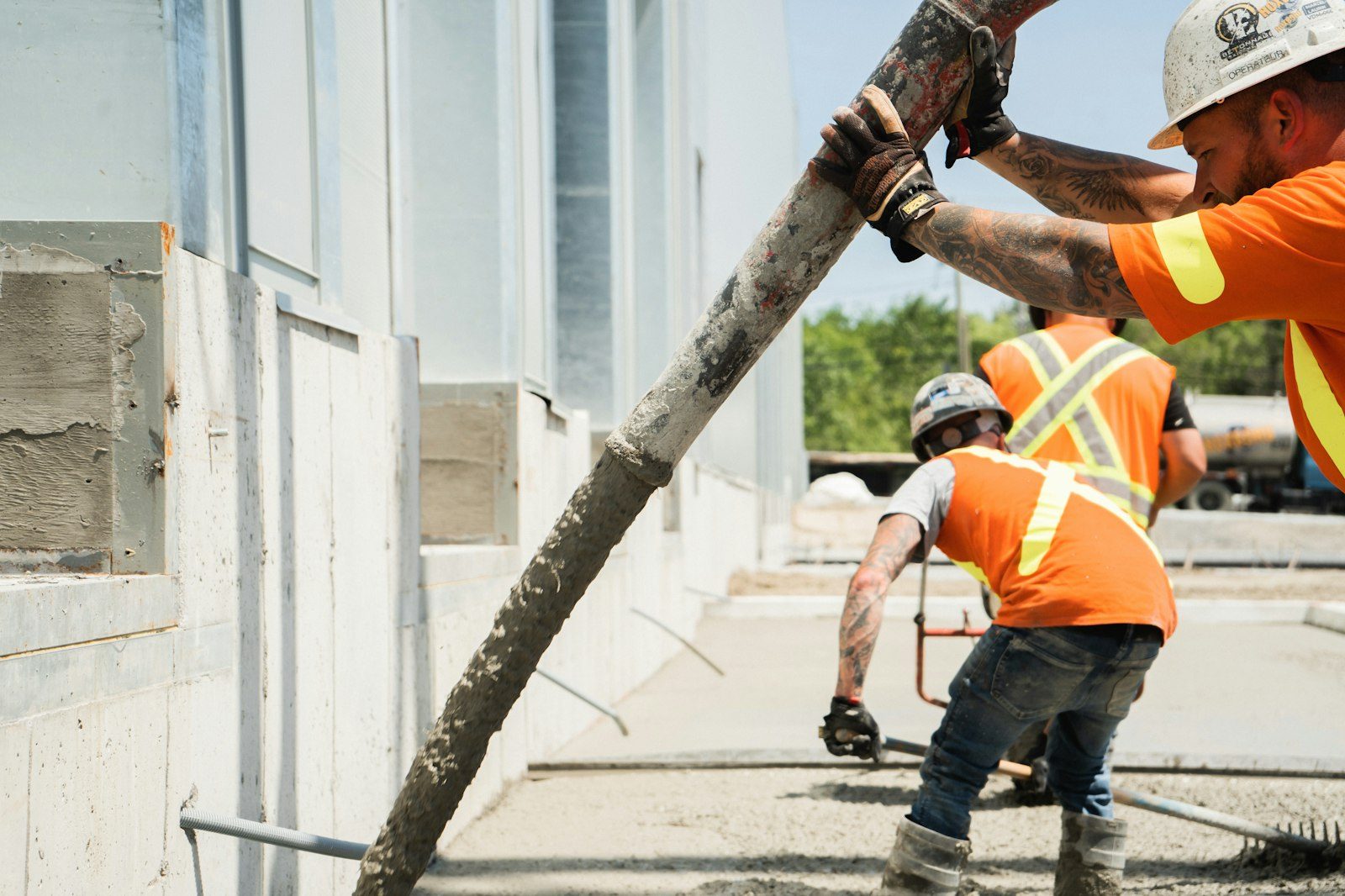
Half the properties that call us about curb don't need curb. They need the edge to do one specific job, and there are cheaper ways to do some of them.
Before anybody prices a foot of curb, we want to know what the edge is supposed to accomplish. Sometimes it's water: the flowline is the only thing carrying runoff to an inlet, and if it's flat or broken the whole lot suffers. Sometimes it's traffic: the curb is there to keep vehicles off a landscape island or a walk. Sometimes it's structure, holding an asphalt edge that would crumble outward under every turning tire. Three different jobs, and they don't all call for the same answer.
On established property here, especially the older commercial blocks and the mature multifamily near Northwest Englewood, we find curb lines poured for a lot layout nobody uses anymore. Replacing them in kind is usually the wrong reflex. Deciding what the edge owes you is the cheaper conversation, and it comes first.
Water first, because it's the one that punishes you for guessing. A gutter pan with fall in it moves runoff to the inlet and keeps it off the pavement and out of the base. A pan with a flat spot holds a puddle, that puddle freezes overnight, and the ice sits on the concrete and on the asphalt beside it, cycling all winter. That's how a flat flowline eats a lot from the edge inward.
Traffic containment is the easy job and the one most often over-built. If the point is to stop a delivery van from driving across a mulch bed, there are answers that don't involve a concrete pour. Edge support is the quiet one. A curb holds the outer few feet of asphalt in place, and where curb has broken away you'll see the pavement beside it raveling and dropping. Fix the curb and you've saved the pavement. Ignore it and you'll be paying for both.
| Edge option | What it's genuinely good at | Where it quits on you |
|---|---|---|
| Full curb and gutter | Carrying water to an inlet on a set grade while holding the pavement edge | Costs the most and needs real grade control, so a sloppy install is worse than none |
| Curb only, no gutter pan | Containing traffic and supporting an asphalt edge on a lot that already drains | Does nothing for water, so it's the wrong pick if runoff has no clear path |
| Concrete valley pan across an aisle | Moving water across a drive lane without an inlet, in a shallow, drivable channel | Takes wheel loads all day, so it needs to be built like pavement, not like trim |
| Mountable or ribbon curb | Edges where trucks need to track over the line occasionally without breaking it | Won't keep anybody out, and it holds less water than a standard pan |
| Wheel stops or bollards | Stopping vehicles at a specific point, cheap and quick to install or move | Zero drainage help, zero edge support, and plows tear them out every few winters |
Walk the flowline with us after the next storm. We'll tell you what to rebuild, what to leave, and what isn't a curb problem at all. (303) 569-4046.
We turn down curb work fairly often. Here's when. If the inlet the flowline drains to is silted shut or sitting high, new curb changes nothing, because water goes where the grade tells it and the grade ends at the inlet. If the asphalt behind the curb has settled several inches, replacing the curb leaves you with a beautiful edge next to a bowl. And if the broken sections are all at one corner where trucks cut short, the real fix is a wider radius, not a longer run of the same profile that keeps getting hit.
What we will always argue for is grade. Curb is one of the few things on a property where a small error at install becomes permanent. String goes up, we shoot it, we check it, and the pan gets built to run. A gutter that holds water was built wrong on one morning and it stays wrong for the life of the property.
Spring through fall, with a strong preference for doing curb before any paving or overlay, not after. Set the flowline first and the paving contractor has a hard elevation to work to. Do it backward and somebody is grinding asphalt to meet a curb that's already in the wrong place.
Cold months are workable for short runs if the ground isn't frozen, using heated water, blankets, and a chloride-free accelerator, though small curb sections lose heat fast because there's so much surface for the volume. That's the real cold weather problem with curb, more than the calendar date. If your property has a flowline that's clearly failing in January, we'd rather do a temporary patch to get water moving and build it right in April.
Still unsure about something?
Call the crew at (303) 569-4046 and we will talk it through.
Get a free, no-obligation estimate from a crew that knows Colorado soil, Colorado weather, and how to finish concrete that lasts.
Accessibility
Adjust the site to fit how you read and browse. Your choices are saved on this device.