
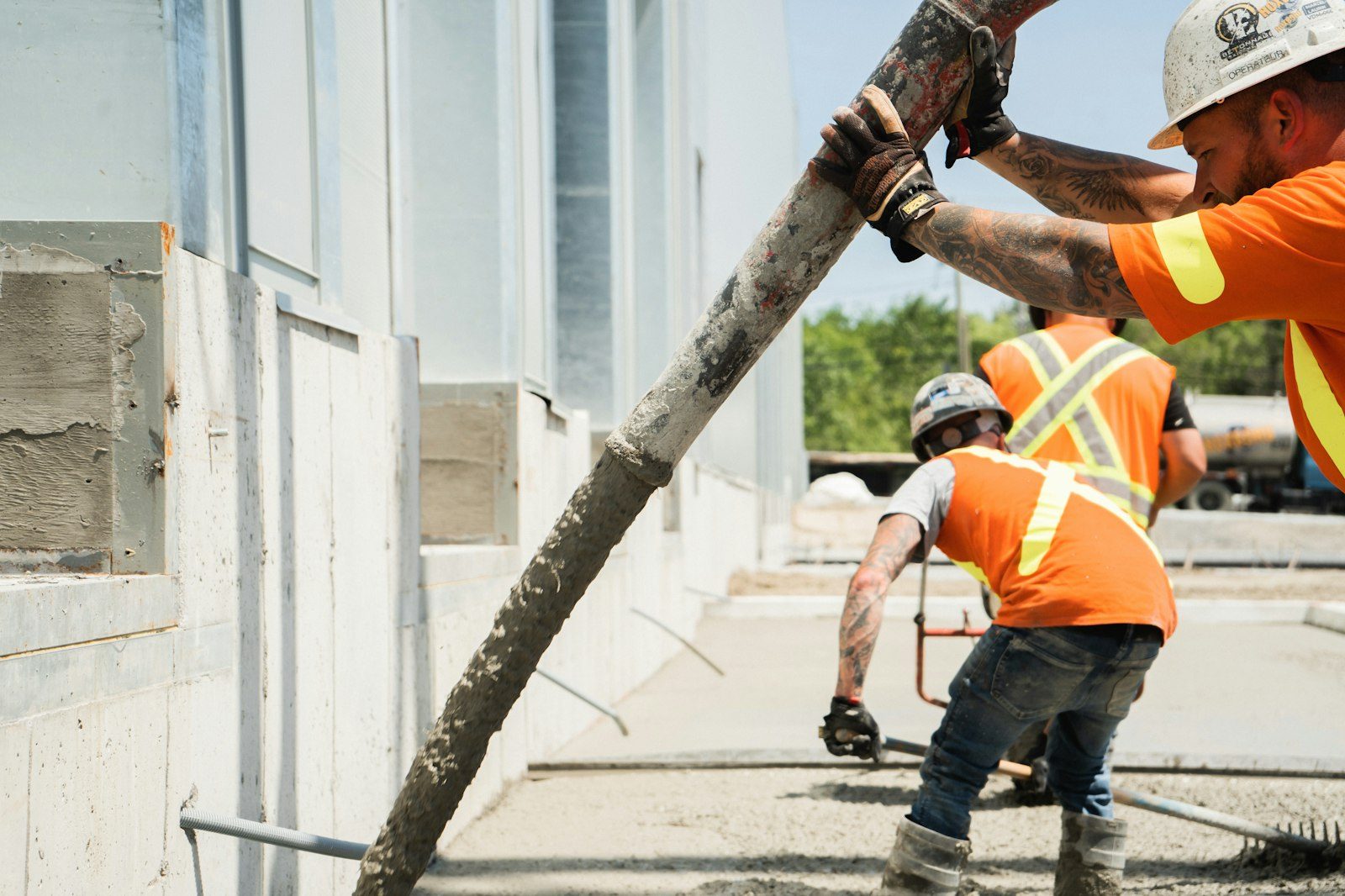
The delivery truck comes Saturday. Here is exactly how the pad gets ready before it does.
The building arrives on a truck with a delivery window and a driver who has four more stops. The pad has to be cured, flat, square, and in exactly the right spot, because nobody is shifting a twelve-foot structure three inches left as a favor. That deadline is why most shed pad calls sound a little tense.
Usually we can work with it. A pad is a small pour, and small pours move fast when the layout is done right first. The whole thing is a day of dirt and forms, a morning of concrete, and a cure clock you can't argue with. Here's the actual sequence, whether it's a garden shed behind a Wash Park bungalow or a workshop out in University Hills where there's room for something worth anchoring.
We start with the building, not the yard. Manufacturer drawings give us the footprint, and the footprint is not the roof line, so we need to know whether there's an overhang and how far it projects.
Then the question of whether the pad matches the walls or runs past them. Our position: match the walls. A pad sticking out four inches all around catches roof runoff and holds it against the siding, which is how a back wall rots while the building looks fine. Want an apron for a mower? Pour it deliberately at the door, with fall built in.
Then comes the square check. Two diagonals, measured, adjusted until they match. It sounds trivial and it's the most important twenty minutes of the job, because a pad out of square by an inch turns into a building that won't latch.
| When | What the crew is doing | What you will see and hear |
|---|---|---|
| First light | Forms rechecked for square and grade, base dampened, steel tied on chairs | Quiet work. Stakes, string lines, a lot of measuring twice |
| Mid morning | Truck arrives, concrete placed and struck off to the forms | The loud hour. Chute or buggies, then a straightedge across the forms |
| Late morning | Bull float, edges tooled, bleed water rises and evaporates | Nothing appears to happen for a while. That wait is the job, not a coffee break |
| Early afternoon | Broom finish pulled, anchor bolts set into the wet slab, joints cut | One pass in one direction, then nobody sets foot on it again |
| Next morning | Forms stripped, edges backfilled, site raked and cleaned | Stakes gone, yard tidy, and the pad is a couple of days from ready |
Here's the thing about a shed: it's a building nobody heats. Ground under a heated structure stays warmer and drier. Ground under a cold outbuilding freezes as deep as the ground beside it, then lifts, and the pad lifts with it unless we've given the moisture somewhere to go.
Our answer is drainage, not mass. We over-excavate, lay compacted aggregate that lets water move sideways instead of sitting under the slab, and grade the finished pad to shed off every edge. That does more good than pouring the thing six inches thick. For a heavier building or a workshop with equipment inside, we thicken the perimeter or put footings under the bearing lines below frost depth, which along the Front Range is a real excavation, not a shovel scrape.
The other half of holding a building down is anchors. Wind here is not decorative. A shed is a box kite with a floor, and the wall plates need to be bolted to the concrete rather than resting on it. We set anchor bolts while the slab is wet, positioned off the shed's own sill layout.
Tell us the date and the building size. We'll say straight out whether it can be ready. (303) 569-4046.
We get called out to owner-poured shed pads more than any other job. Almost always the same two problems: not square, not level end to end. The building goes up anyway, the doors bind by fall, and by the second winter there's a gap you can see daylight through.What our crew lead tells homeowners
Work backward from the day the truck comes. Concrete takes a day or two before it holds foot traffic, and we want a week before a structure goes up on it. Add a day for layout and dirt, a day for the pour, and a weather buffer, and you're at roughly two weeks from handshake to a pad that's genuinely ready. Call before you order the shed, not after.
Season-wise, spring thaw through October is straightforward. Summer pours start at sunrise, since high-altitude sun pulls water out of a fresh surface faster than most people believe, and a July storm can scar a green slab in five minutes. Fall is our favorite stretch for outbuilding work and easier to book.
Winter pads are possible, and a small slab is among the easier things to protect since blankets cover the whole thing. We won't place concrete on frozen ground, so if a cold snap has the subgrade locked up, we wait it out. Keep deicer off the pad through the first winter, including the walk-up to the door.
Still unsure about something?
Call the crew at (303) 569-4046 and we will talk it through.
Get a free, no-obligation estimate from a crew that knows Colorado soil, Colorado weather, and how to finish concrete that lasts.
Accessibility
Adjust the site to fit how you read and browse. Your choices are saved on this device.