
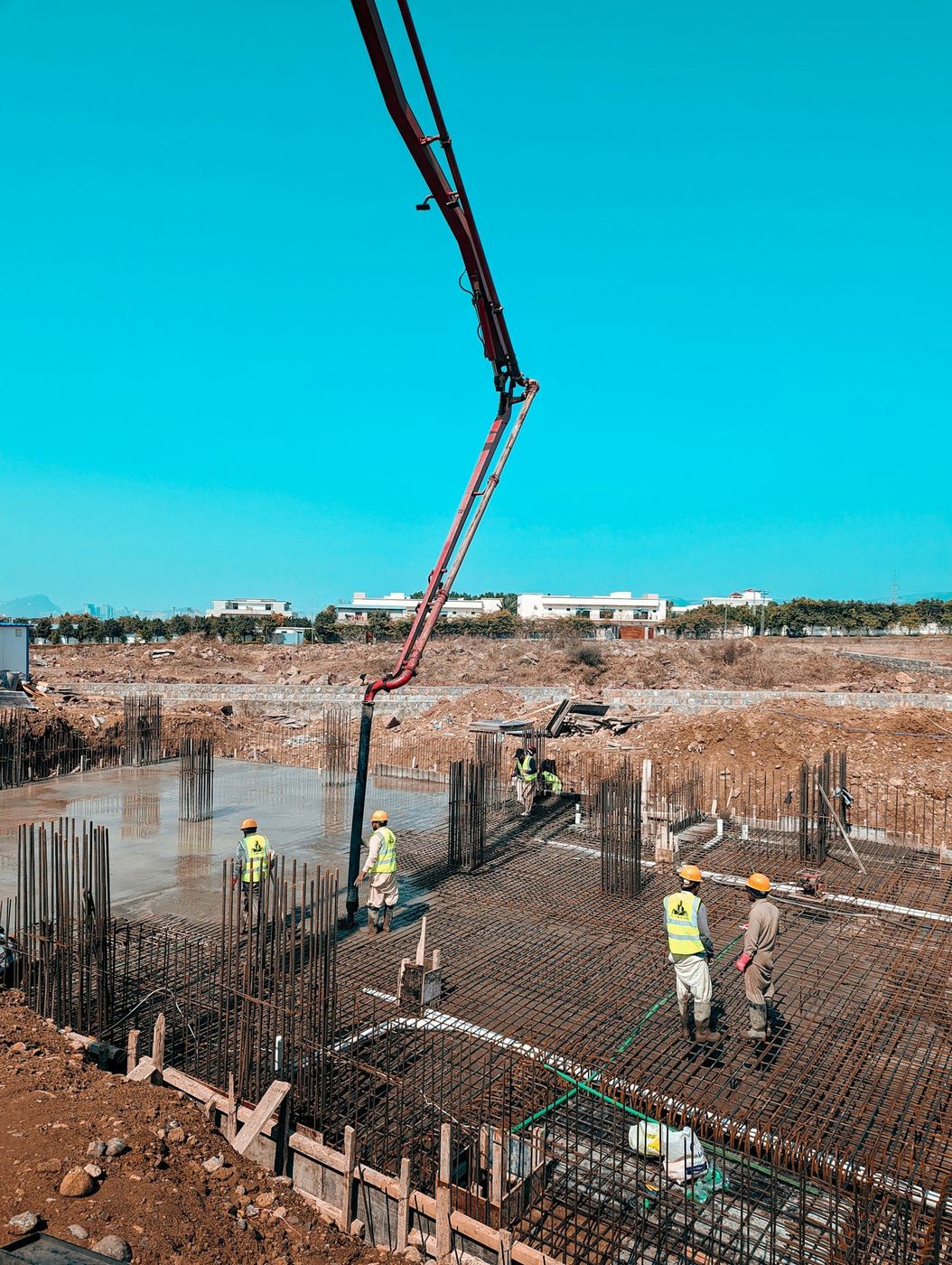
You can spot a failing parking pad from the sidewalk. Here is what the lean is telling you.
Walk past a house with a bad RV pad and you can diagnose it from the sidewalk. The rig sits with a visible tilt. There's a dished shadow under the tongue jack where the concrete gave up. One corner dropped, and somebody has stacked leveling blocks three high to argue with it. Cracks run corner to corner instead of following the straight lines a saw would cut.
None of that happened in a season. A trailer or a motorhome concentrates an enormous load into very small footprints: two axles a few feet apart, jack feet about the size of a dinner plate, and a tongue that parks a couple thousand pounds on one point. A slab designed like a patio will not hold that, and never did. We build pads that will, on lots across Denver, from the deep back yards in Berkeley and University Hills to the side runs in Park Hill where a rig threads past the house with inches to spare.
Each visible failure points at a specific mistake. A dish under the jack means the slab was thin, unreinforced, or both, and a point load found the weak spot the way water finds a crack. A dropped corner means the base there was never compacted, usually because it sat over the edge of the excavation where nobody ran the plate.
Diagonal cracking from a corner inward says the slab went down as one big unjointed rectangle, so it cracked where the stress went instead of where a saw told it to. A crumbling entry edge means the transition had no thickened section, and every tire that ever rolled on has been chipping unsupported concrete. Standing water means the pad was poured flat, which here also means ice all winter and a saturated subgrade.
Here's what matters. Every one of those symptoms lives below the surface, so no patch reaches it.
| What you can see | What is happening below | What it takes to fix |
|---|---|---|
| Bowl-shaped low spot under the tongue jack | A point load punched through a slab that was too thin for it | Full-depth replacement with a thickened section at the jack location |
| One corner sitting lower than the other three | Uncompacted fill at the edge of the original excavation | Tear-out and rebuild, or lifting if the slab itself is still sound |
| Cracks running corner to corner | No control joints, so the slab relieved stress on its own terms | Replacement with a proper joint layout matched to the pad dimensions |
| Crumbling edge where the tires roll on | Unsupported concrete at an unthickened transition | New pad with a thickened edge and an apron tying into the drive |
| Standing water or a green ring after storms | The pad was placed dead flat with nowhere for water to go | Repour on grade with a slight fall toward the yard, away from structures |
Measure the rig, then add to it. Not the brochure length, the real one, with the tongue and the spare carrier and the ladder on the back. Add walking room on the door side so you're not stepping into mud every time you load. Then add the run-up, because a tight swing into a narrow side yard eats more room than anybody guesses standing there with a tape.
The transition is the piece people forget until it fails. Where the existing driveway meets the new pad there's a seam, and that seam takes every pound of the rig twice per trip. We thicken the slab there and dowel the two pours so they move together instead of stepping apart. If the last few feet before the concrete are dirt or loose gravel, that's where a rut forms, and the rut is what breaks the edge.
One more thing to settle before the pour, not after: conduit. If you'll ever want power or a hose bib out there, sleeve under the slab while it's still a hole in the ground.
We'll say what the pad needs and what it doesn't. Free estimate. (303) 569-4046.
Most Denver rigs travel a handful of weekends and then park. That parked stretch is when the damage happens, because a static point load working the same square foot through forty freeze cycles is a different stress than a truck rolling across a driveway. Moisture gets into the subgrade, the ground under the jack heaves and settles, and the slab either has the steel to bridge it or it doesn't.
The mix matters as much as the depth. Exterior concrete here needs entrained air so freezing water in the surface has somewhere to expand, and 4,000 PSI is where we start on anything that holds a vehicle.
On scheduling, late spring through early fall is the easy stretch. Book the pad while the rig is out on a trip and you never have to find somewhere else to park it. Winter pours are possible with heated water, an accelerator without chlorides, and blankets, though a large pad is harder to protect and we'll say so. Frozen ground is a hard no. And skip the deicer that first winter.
The jack feet give it away every time. We show up, the rig is parked, and there are four little craters where those feet have been resting. That's a slab telling you it was poured thin, on dirt.What the crew sees on site
Still unsure about something?
Call the crew at (303) 569-4046 and we will talk it through.
Get a free, no-obligation estimate from a crew that knows Colorado soil, Colorado weather, and how to finish concrete that lasts.
Accessibility
Adjust the site to fit how you read and browse. Your choices are saved on this device.