
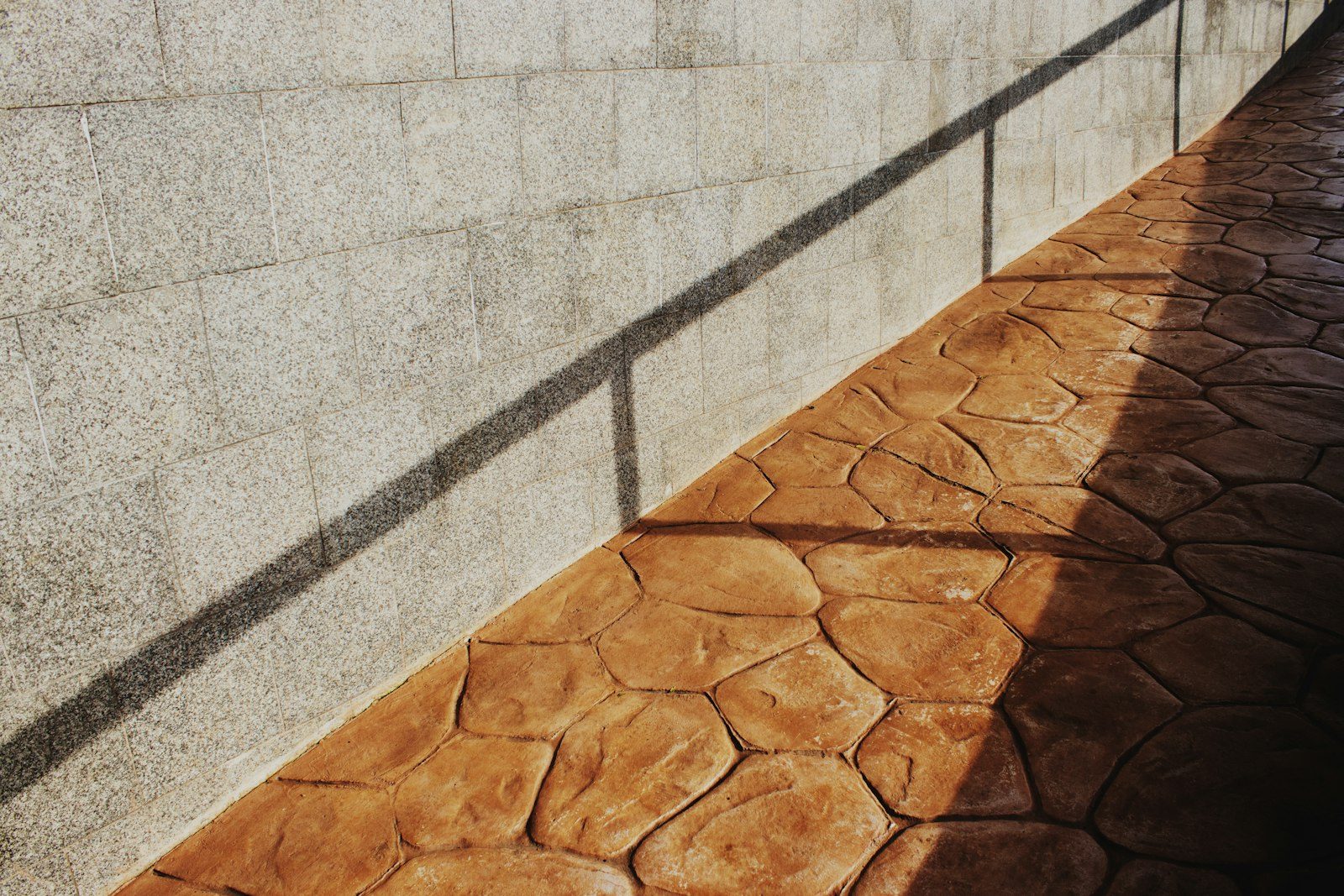
Grip when it's wet, a joint at the coping that's allowed to move, and a straight call on overlay versus tear-out.
Most pool deck calls arrive as a choice rather than a project. The deck is tired, one contractor said resurface, another said tear it out, and you're stuck holding two confident opinions. Both can be right. It depends entirely on what the concrete is doing below the part you can see.
Our sorting rule is short. Surface problems get surface fixes. Structural problems don't. If the top skin is flaking but the panels sit flat, tight, and shed water away from the water, an overlay is the smart money and you'll be swimming on it in a week. If the ring of deck nearest the pool has dropped, or the joint at the coping was mortared shut years ago, an overlay is just a fresh face on a slab that's still moving.
First, texture. A steel-troweled surface photographs beautifully and turns hazardous the moment a kid climbs out. We finish pool decks with real texture: a fine broom, a knockdown overlay, or exposed stone. You give up a little smoothness and you get traction that works soaked, which is the only condition that counts.
Second, where the water goes. Splash and storm runoff both need somewhere to be, and away from the pool is only half the answer. Away from the house is the other half. If the geometry traps water in the middle, we add deck drains instead of pretending a flat spot will evaporate.
Third, the one that gets skipped: the joint at the coping. A shell and a deck slab are two structures that move on their own schedules, so the seam between them stays compressible and sealed for the life of the deck. Mortar it shut and the deck starts shoving your coping stones around.
| What the deck is doing | Our call | When that's the wrong answer |
|---|---|---|
| Light dusting or scaling, panels flat and tight | Bonded overlay with a textured finish | Wrong if the surface is delaminating in sheets. An overlay needs sound concrete to grab. |
| Slick trowel finish, otherwise sound | Add texture: knockdown overlay or mechanical profile | Wrong if you dislike the layout too. Fix geometry before grip. |
| The ring closest to the pool has settled | Lift it first, then talk about the surface | Wrong to overlay now. You'd be finishing something that hasn't stopped moving. |
| Coping joint packed with mortar or hard caulk | Cut it out and rebuild a working expansion joint | Never skip this one. That gap is why the coping stays where it belongs. |
| Wide cracks crossing several panels, spalled edges | Replace that section and keep the sound panels | Wrong to demo the whole deck when only one side gave up. |
| Deck sheds water back toward the house | Replace and regrade. There's no shortcut here | Overlays add thickness. Adding thickness to a backwards slope makes it worse. |
Sun is the first thing. UV at this height is hard on sealers and harder on color, so a deck that got a topical coating three years ago often looks chalky today while the concrete under it is fine. Pick a penetrating product, keep the reseal cycle honest, and you avoid most of that.
Freeze-thaw does the rest. A pool deck is the wettest flatwork you own for four months, then sits frozen under snow for another four. Water that soaks into the top skin on a warm October afternoon is what pops that skin loose in November. Air entrainment handles it, drainage helps, deicers undo both.
Yards shape the work too. Older pools around Park Hill and Cherry Creek came with narrow decks and original concrete that has done its time. Wash Park and University Hills give us room to widen while we're in there. On scraped lots in the Highlands and near Sloan's Lake, the deck is the only hardscape in the yard, so it has to work as a patio too.
One of the coping joint, one down the deck at eye level, and one of the worst panel. That's usually enough for a real answer.
Ask about the coping joint. Nine times out of ten, when somebody tells me their coping stones are lifting, I find that joint filled solid with mortar. The deck grew in the heat, had nowhere to go, and pushed. That gap is not a gap. It is a working part.What our crew lead tells homeowners
Still unsure about something?
Call the crew at (303) 569-4046 and we will talk it through.

Get a free, no-obligation estimate from a crew that knows Colorado soil, Colorado weather, and how to finish concrete that lasts.
Accessibility
Adjust the site to fit how you read and browse. Your choices are saved on this device.