
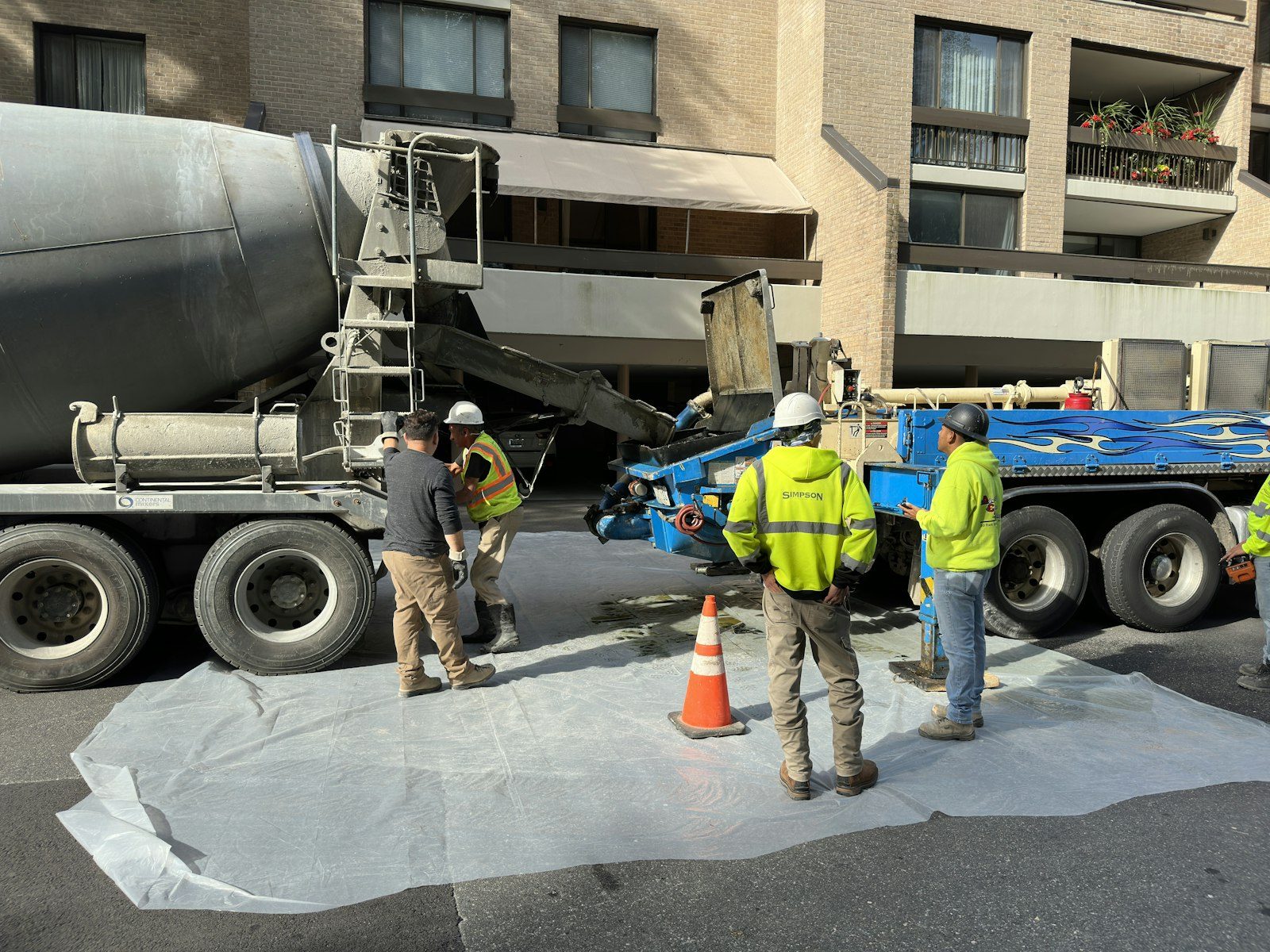
The pad itself happens in one morning. Everything that decides how long it lasts happened in the two days before the trucks showed up.
Homeowners picture pour day as the whole job. It is the loud part, and it is the part the neighbors watch. But by the time the first truck backs down the side yard, the outcome is already mostly determined, because a pad that holds a loaded rig for twenty years is decided by grade stakes and a plate compactor, not by how fast the finishers move.
We build these across Centennial wherever a lot has room. Piney Creek and Foxridge have side yards deep enough to swing a trailer into, and Walnut Hills properties often have the width to run a pad alongside the existing drive. What follows is what actually happens on your property, day by day, so nothing on the schedule catches you sideways.
Day one is layout and dirt. We stake the footprint off the real dimensions of your rig plus room to open the door and walk around the tongue, then strip the topsoil and haul it off. Topsoil is organic, organic material compresses, and no slab survives being built on it. Then we cut to grade, which on a pad like this means going deeper than people expect, since we are stacking six inches of concrete over a base section that has to carry axle loads without dishing.
Day two is base, forms, and steel. Aggregate goes down in lifts with compaction between each one. Forms get set to a pitch, never dead level, so water leaves instead of sitting where the tires do. Then the steel: number four rebar tied on a grid, sitting on chairs so it ends up in the middle third of the slab rather than lying on the dirt doing nothing. That is what a suspiciously low bid leaves out. Steel on the ground is decoration.
Text us a picture of your gate and the ground between it and the street. That detail tells us more about the schedule and the number than the size of the pad does.
A pad big enough for a motorhome is a lot of open surface, and open surface is where our weather does its damage. In July the sun at this altitude plus a dry wind pulls moisture out of the top faster than the slab can bleed it back, and you get a crusted skin over soft concrete. So summer pours start at first light and we keep an evaporation retarder and hoses close.
Afternoon storms are the other half. Rain on concrete that has finished and begun to set is a nuisance we cover with plastic. Rain during finishing is destructive, since it works water into the paste and leaves a surface that dusts and flakes from then on. When the forecast turns ugly we start early, keep sheeting on hand, and push the date if the morning radar is bad enough. You want us making that call.
Cold changes the recipe rather than the plan. We warm the water at the plant, run an accelerator with no chloride in it, and blanket the slab until it has strength. Frozen subgrade is the hard stop, every time.
| Location | Getting the rig in and out | What it changes about the build |
|---|---|---|
| Alongside the existing driveway | Easiest. Straight shot from the street, no tight pivot | Needs dowels or a clean isolation joint at the seam so the two slabs move independently |
| Behind the gate in the side yard | Tight. Mirror clearance and swing radius are the limits, not pad width | Access for our equipment matters as much as yours. Often a buggy or pump job |
| Extension off the back of the drive | Good, if the turn at the top of the drive is wide enough for a long trailer | Existing apron usually needs correcting so the transition is not a bump under the axles |
| Standalone pad with a gravel approach | Depends on how the approach is built and how it drains | Cheaper slab, but the gravel strip ruts every spring and you will be regrading it |
The pours that go sideways are the ones where nobody walked the route first. We show up with concrete on the way and find a gate two inches narrower than the buggy.What the crew sees on site
Still unsure about something?
Call the crew at (303) 569-4046 and we will talk it through.

Get a free, no-obligation estimate from a crew that knows Colorado soil, Colorado weather, and how to finish concrete that lasts.
Accessibility
Adjust the site to fit how you read and browse. Your choices are saved on this device.