
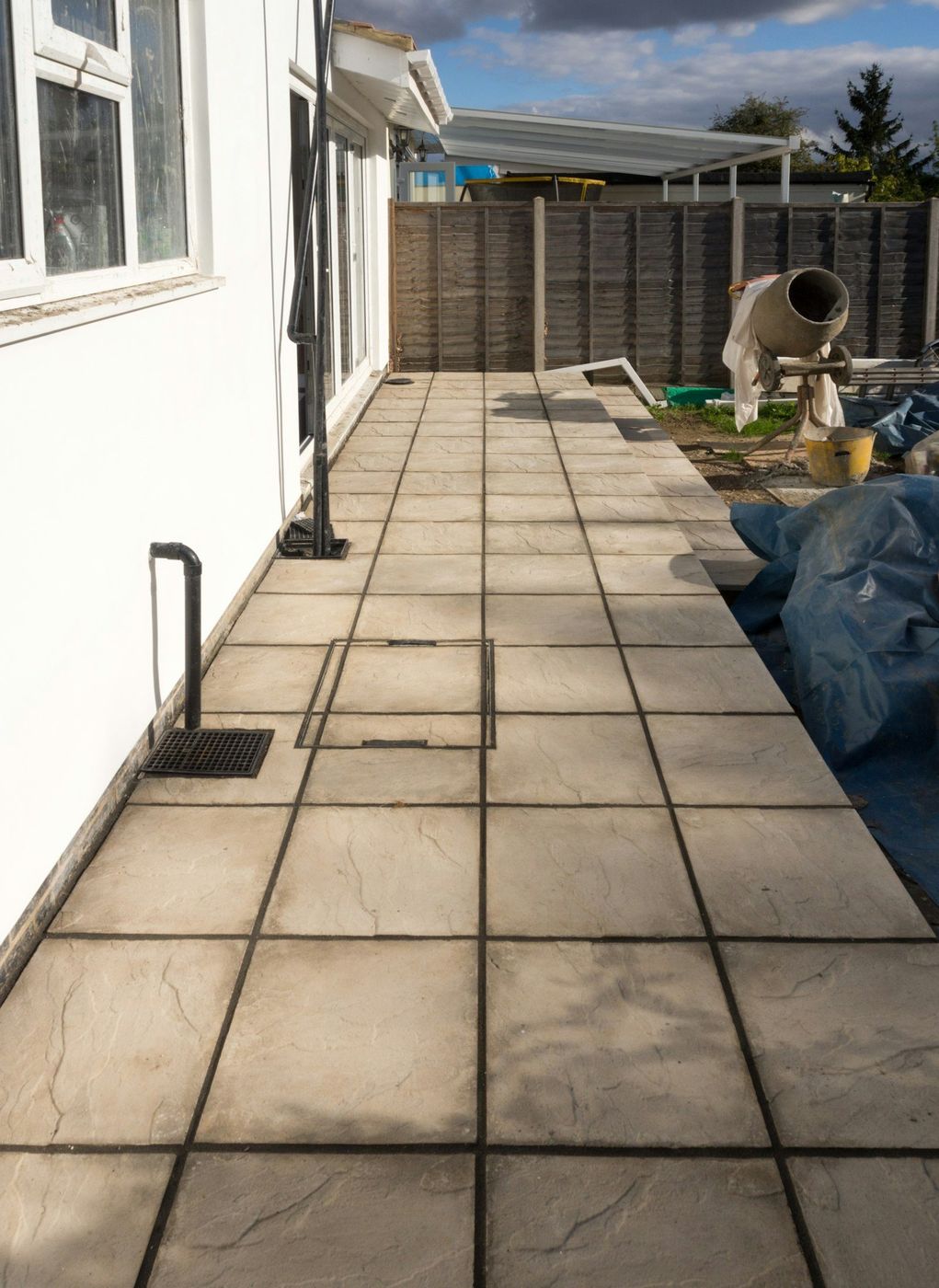
We wash the cement paste back off the top and let the stone do the work.
Castle Rock isn't one housing story, it's four or five. Plum Creek and Founders Village hold homes with mature trees, tight lots, and flatwork that has already given somebody thirty winters. Metzler Ranch and Red Hawk sit in the middle. Then you've got Cobblestone Ranch, Castlewood Ranch, and Sapphire Pointe, where the builder left a plain broom pad out back and called it a patio. Different houses, same request: give us something with texture that doesn't look like the sidewalk.
Exposed aggregate answers all of it. We pour normal structural concrete, then wash the cream off the top before it hardens so the stone in the mix stands proud. What you end up with is a surface that has grip when it's wet, hides dirt the way a plain gray slab never will, and reads as intentional from the street.
| Stone | How it reads once washed | The trade-off |
|---|---|---|
| Pea gravel in the mix | Small, rounded, tan and brown speckle across the whole surface | The cheapest route and the most common. Reads busy at close range. |
| Washed river rock, larger blend | Bigger stones, more shadow, a rougher and more rustic face | Harder on bare feet, and a snow shovel catches on the high points. |
| Crushed granite or quartz | Angular, sparkles in direct sun, cooler gray and white tones | Angular stone means more grip and slightly more effort to keep clean. |
| Seeded specialty stone | Decorative rock broadcast onto the fresh surface and pressed in | Total control of color and size. Costs more and takes a longer finishing window. |
Older neighborhoods usually come to us with a replacement in hand. The original walk from the drive to the front door has heaved, the back patio is spalling, and once we're tearing out anyway the upgrade to aggregate costs very little extra. Those homes have shade trees, so we lean toward lighter stone that keeps a damp north-side patio from reading like a cave.
Newer subdivisions are a different conversation. The slab out back is usually sound, it's just small and plain. There we're extending, and the question becomes whether to match or contrast. Our answer is contrast, done deliberately: pour the extension in aggregate, run a smooth troweled band between old and new, and the transition looks designed instead of apologetic. Front entries in Sapphire Pointe get the same treatment where an aggregate walk pairs against a broom-finished driveway.
We'll bring aggregate samples to your yard and set them in the light they'll actually live in.
Here's the part homeowners never see coming. Exposed aggregate lives or dies on a window that lasts a couple of hours. Spray retarder to hold the top skin soft, wait for the concrete underneath to set enough to grip the stones, then wash. Too early and you blow the rock loose and leave craters. Too late and no amount of pressure gets the paste off, and you're left with a gray slab full of ghosts. Our crew stays on the pad and tests a corner every fifteen minutes. Nobody leaves for lunch.
Castle Rock weather makes that clock move around. At 6,224 feet a dry breeze and full sun in June can pull the set forward by an hour, so we shade the pad and get the wash going early. A cool overcast morning in May does the opposite. Afternoon storms are the real hazard, because rain hitting a retarded surface washes it unevenly and leaves stripes you can't fix later. We pour these in the morning, every time.
Best season here is late April through early October. September is our favorite: warm slabs, cool nights, no monsoon. Winter we generally hold off on exposed work, not because we can't pour in cold weather but because the wash window shrinks to almost nothing when the surface is fighting to set at all. If you call us in January, we'll get the design and the base plan done and put you at the front of the spring board.
One care note that matters more on this finish than any other. The exposed face has more surface area, which means deicer chemistry has more to grab. Keep magnesium chloride off it. Shovel and sand. Reseal every two to three years and the stone stays tight for decades.
Still unsure about something?
Call the crew at (303) 569-4046 and we will talk it through.
Get a free, no-obligation estimate from a crew that knows Colorado soil, Colorado weather, and how to finish concrete that lasts.
Accessibility
Adjust the site to fit how you read and browse. Your choices are saved on this device.